• TalkBass has been independent since 1998. Add your voice.
    Create a free account to reply to discussions, view embedded media, and browse with fewer display ads.
    Join freeLog in
    Want zero display ads or expanded classifieds tools? Compare plans.

Double Bass Which wood goes where??

I haven't tried it so this is pure speculation, but I would think that oak would be way too porous for a fingerboard. I don't find planing it very enjoyable either.

George

It would work pretty well if it was epoxied like a fretless electric bass (jaco style). At that point you may as well just use a different wood unless you really want the oak bedroom set look on your fingerboard.
 
A hickory fingerboard would work well. I made one, and it's very strong. Also, black locust is extremely strong, but I've never worked with it. I dont think it grows straight. Using oak and wood filler should work, and a couple coats of black epoxy paint, to hide the oak ( my least favorite looking wood ), should work. You can also inset carbon fiber rods into the board or the neck, or both, if your going to be using a softer or less resistant wood...
 
I like the alternatives (without paint), if they can be made to look good (dark finish, light finger board with matching tailpiece). They can be dressed many times in the event of string grooves, and can cost 1/4 or 1/8 the price of tropical hard woods. Also, I think we have to consider the impact of our wood choices. Ebony is becoming scarce, and it's extraction is devastating. I still think it's ideal, and install it when a customer wants it. Demand will be the determinant. One day, not too far away, the cost of it will be prohibitive, and alternatives will seem much more attractive, for most basses. With carbon inserts, the resistance of the neck is sufficient, but yes, they will wear down faster. I've thought a lot about it. The only alternatives besides these seem to be synthetics, and I'm not sure what's worse.
 
Locust
I have made and used a fingerboard from locust. It is a very dense, stable, and closed-grain wood that smooths and polishes nicely. It is almost as hard as ebony and works well with power tools. I sanded a lot. It looks good with boiled linseed oil applied if you like grain. The overall result was darn good, nice to the touch, much better than the Brazilian cherry some are using.
For a raft of info (and debate) on black locust:

Black locust uses

White Oak
Recently I was trying a new way to machine a finger board and grabbed a piece of flat-sawn white oak for cheap. It was hard to work with a lot of hardness variation in the grain that caused waviness. Tried power sanding but planing and scraping did better. I applied ebonizer and it looks good with the grain pattern showing through. I probably should have tried paste filler prior to the black even though the pores are naturally clogged. It might be serviceable but not as good as some other domestics i.e. locust, hickory or maple.

I would not build a body or neck with slab red or white oak the grain is too course and inclined to splinter. Maybe a body with walnut or sassafras.
 
Gael, check toxicity of black locust. As i recall its rather nasty stuff to inhale and causes skin sensitization.

(another reason maple and spruce are so popular I think - they are relatively inert and non-toxic. can't say the same for ebony, though)


I should fit mine with a tiny little endpin and tune it in fourths.

I have a violin done this way. novelty value only :-/
 
I think I would avoid oak as a neck material. I have never built a double bass but I am a professional woodworker and build bass guitars so I do understand wood. Oak is certainly a "strong" wood but all woods are not "strong" in the same way. I find that oak is not particularly wear resistant or stable unless it's near perfectly quartersawn but it is excellent at bending without breaking. I find it most useful structural for pieces that need to flex but not break like spindles in the back of a Windsor chair. I tend to think it's natural elasticity would cause problems with seasonal changes. On the other hand it could possibly work well as a body wood, though weight could be an issue, and would be reasonably easy to bend, though not as easy as the willow that was mentioned earlier. Of course I am only familiar with american oak species for the most part and European varieties could vary.
 
What about a neck made of multiple laminates? That's the most stable scenario, imho. Guitar builders do it on fine instruments. You could make a good neck, I think, with relatively cheap maple boards glued to each other. It could even look good if done well ( light/dark alternations?)

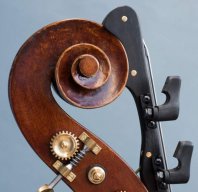
I carved my neck from 2 cherry boards glued together - because that's the wood I had left over from another project. It is also lighter than maple (and the scroll was a joy to carve).

George
 
Does anyone know how birch would fare as a body material?

What about synthetic material for a fingerboard? Carbon fiber or delrin is the only thing that comes to mind for me.

Birch would be fine as back and sides - Gibson made a lot of their mandolins and archtop guitars with Birch during WWII.

The problem with a CF fingerboard would be in setting and adjusting the radius and the camber. There are plenty of woods available for fingerboards. If you wanted to, you could harden the board by impregnating it with epoxy.
 
What about a neck made of multiple laminates? That's the most stable scenario, imho. Guitar builders do it on fine instruments. You could make a good neck, I think, with relatively cheap maple boards glued to each other. It could even look good if done well ( light/dark alternations?)

I think it's a great idea. I figured if the neck on Paul's Bohmann had held up so long with a whole bunch of laminations and with hide glue, it should be fine.

image6.jpg


So I did my first bass with a simple two-piece neck of tasmanian blackwood laminated with hide glue. Added "ears" to the scroll too, and a CF insert. I did this to reduce waste and minimise warping. it's held up fine so far (four years) with no change whatsoever.

4306060802_7a11b78617.jpg


But for my taste, I think one has to resist the temptation to make things look too dressy and OTT by adding too many colours or laminates, as in this bass (click for bigger pic)

[Invalid or Expired Link Removed]

(sorry Chris Threlkeld but its just not my cup of tea)
 
domestic FB wood:
*osage orange, (black locusts' tenacious cousin
*persimmon, (white ebony)
*curl leaf mountain mahogany, western species, but rare to find one large enough for a dbl bass.

anyone consider anthracite ? slab cut and shaped, not the soft brown, but the hard as nails black?
 
Thanks for the info. I've been wondering about locust forever. Good to know. I'd like to start using such a wood commercially. Do you have any photos of the board you made?
I'd love to see it.

I found it hard to photograph the locust FB well, it is iridescent and changes colors from different angles from almost as dark as walnut to a golden oak tone. So here are several angles so you get the idea.

BTW this was a Harpkit designed teardrop bass I built about 10 years ago before I ever played a DB. If the FB looks kind of flat and guitar-like that is because it is. You couldn't bow it.

Speaking of necks this one is l o n g (the body is short) and laminated walnut (great wood to work with and nice to the touch) with a stripe of hard maple for strength, also has a truss rod.

The last picture shows some of a white oak FB with ebonizer black that I was using to check alignment on my project bass. Both the FB and the alignment are less than optimum!

locust fingerboard pictures by ghbaker - Photobucket

Locust is toxic to animals as food and to other plants for territory. Saw operators don't like it because tends to be hollow. I doubt it would be good to breath the dust, although I probably did some and am still upright.
 
Has anyone done a phenolic resin FB yet? I know a lot of fretless electrics feature this material and it's harder than ebony, but the only synthetic on a DB I've seen was boat hull epoxy poured over some really soft ebonized fingerboard wood of some sort that had previously been "real groovy, man". After ten years or more on the epoxy there is still no sign of grooves other than surface scratches from the string. The sound is, well, no other way to describe it than a 'soft' attack. I'm thinking a phenolic resin such as 'ebonal' would share the acoustic properties of a hardwood but at least be sustainable and, sorry to say it, but put all the local luthiers out of the FB planing business (good for poor musicians; not good for working luthiers).