

Enjoy the benefits of a premium membership!
Upgrade Account
-
TalkBass has been independent since 1998. Add your voice.
Create a free account to reply to discussions, view embedded media, and browse with fewer display ads.
Join free Log in
Want zero display ads or expanded classifieds tools? Compare plans.
You are using an out of date browser. It may not display this or other websites correctly.
You should upgrade or use an alternative browser.
You should upgrade or use an alternative browser.
Who plays 40-95 set?
- Thread starter TheArchitect
- Start date
More options
Who Replied?

Thinking about trying an A - C tuning.
A - C with 40-95? What scale length?
I play 40-95 in EADG on 34" scale. Can't imagine up-tuning them by five half steps; it's going to be VERY tight! I wouldn't recommend it.
Using the Stringjoy Tension Calculator just as an example...
40-55-75-95 tuned to EADG:

40-55-75-95 tuned to ADGC:

40-55-75-95 tuned to EADG:
40-55-75-95 tuned to ADGC:

The problem is indeed not the A: it would be the C. In proportion, a .01" increase in diameter from a customary 030 to your envisioned 040 is quite a bit more than a tick (it would be like going from a 075 A to a 100 A, if you think about it). Assuming it doesn't break before reaching target pitch, or at the first heavy-handed pluck.34"
95 just a tick heavier than the 85 used for A strings in many sets

Passinwind
I know nothing.
- Dec 3, 2003
- 23,043
- 45,899
- Disclosures
- Designer/Toaster Tech @ Passinwind Electronics
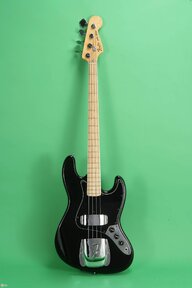
I have a set of GHS Pressurewounds in those gauges on a 34” fretless, standard tuning. Not too different than the T-I Jazz Flats I used for many years previously. The PWs are a liitle higher tension, actually. Used to have the light Ernie Ball cobalt flats on the same bass for a while too, about the same tension as the PWs.Fair enough. Who is using this gauge? They seem pretty light for standard tuning.

Close: 40-100 + 120. 35” and 34” basses. Standard tuning but at times I’ve tuned down a half step. I don’t miss the heavier gauges at all.
Fair enough. Who is using this gauge? They seem pretty light for standard tuning.
I do sometimes.
A new bass gets 35-90 to start. Then I see how well it does with it.

Get a DR 6 string set. It's not that much more from fret nation. If you know a local assassin, give him / her the E and B for their garrote.
The pull on the D and G strings will mess your neck. Going custom set costs more.
The pull on the D and G strings will mess your neck. Going custom set costs more.
Of the too many flatwounds I've tried, my favourites are the GHS Precision Flats 45-95 standard tuning.

Fair enough. Who is using this gauge? They seem pretty light for standard tuning.
I use 40-55-70-95-130 on some of my basses (standard 5 string tuning at 24 inch scale length). The rest use Kaliums, which come in at 37-51-70-94-130. If you measure the actual diameter of the Kaliums (with calipers), they usually come in a thousandth or two smaller than the stated gauge. Both those sets work great at standard tuning - in the low to mid 30's pounds of tension. Your suggested gauges (as shown by the tension calculator) will be in the low 60's tension wise - that will be hard on your neck, and you may end up breaking strings at that tension - all depends on how thick the cores are.
A note on strings that are "too light - I like low tension, and a 130 B is about 35 pounds tension, which matches the rest of the set. Most 5 string sets have a 120 or a 125 for the B. That means rest of the set is at much higher tension than I like, and the B is lower in tension than I like. Floppy B strings are not a "bass" phenomenon - they're a string issue.
Last edited:
I used to use Rotosound Swing Bass 66 double ball end strings in 40-95. Now most of my basses are strung 45-105, with two or three with 40-100.

I bought a set of those to put on my old 2030GF (sig. strings on a sig. bass).I use a set of the Victor Wooten super lights on my Fodera YYS. They work great.


