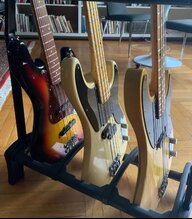
Well, actually, the most immediately obvious fact about the Fender bass as compared to the upright was how much louder it was and how much better it cut through.You know why the electric bassist in 1953 playing a 51P through a Bassman combo didn't fiddle?
Cause there was really nothing to fiddle with.
But I guarantee he was thinking "gee I wish I could be heard through this 26 watt amp. The guitarist cuts right through the mix!!!!".
The more headroom and knobs I have the more likely I can find a pleasing sound that cuts through.
In 1953, they weren't comparing the Precision Bass through a 26W amp against a Rickenbacker with Rotosounds through an Ampeg fridge; they were comparing it against a double bass with nothin'.
In fact if you notice, rock and roll was upright basses for quite a while after the Fender bass was introduced. It wasn't till the late 50s that the electric bass totally took over in rock and roll and the volume of everything started seriously climbing. Country western jazz and R&B musicians were the initial adopters of the Fender bass.
But the reason I brought Monk Montgomery and Hamp into the conversation was the claim that just plugging in the bass to the amp and playing was some kind of recent hipster trend. Well, in geological terms 1953 is practically yesterday, but in human terms it shows that far from being a "recent hipster trend" it's been a mode of using the electric bass ever since the electric bass was introduced. Even in the late 60s/early 70s when rock players were trying pretty much every electronic effect anyone could come up with, electric bass players in other forms (and yes, there ARE other kinds of music!) were mostly using it pretty straight. Listen, for example, to Ray Brown playing electric (!!!) on Quincy Jones' album "Walking in Space", or any of the various country bands from the same time period.






 It doesn't take long to figure out what works for me and what doesn't.