• TalkBass has been independent since 1998. Add your voice.
    Create a free account to reply to discussions, view embedded media, and browse with fewer display ads.
    Join freeLog in
    Want zero display ads or expanded classifieds tools? Compare plans.

Why are there no vertical 410 cabs?

Are most 210 cabs designed with the speakers on a diagonal to horizontal?

Who makes quality horizontal 210's? These would be a way to get a vertical 4 ohm 410.

I recall David Gage claimed a few years ago to have Epifani NYC t-210 cabs with the 10's on the horizontal. My current Epi 210's certainly are not, so when stacked you get this:
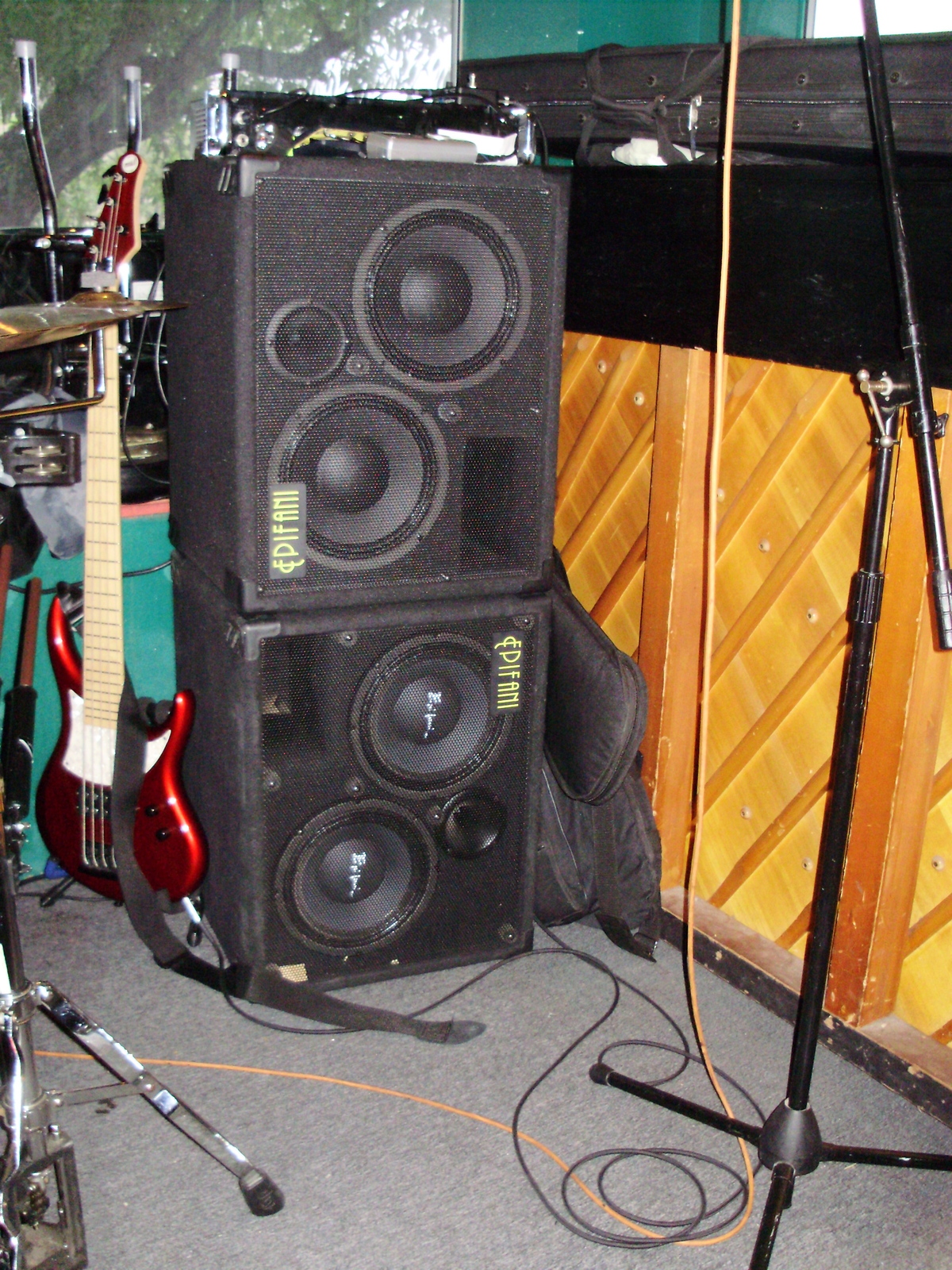
210array.jpg


I presume creating the mother of all comb (over ;)) filters....
 
Personally, I'd still stick with 2 2x10's stacked vertically just for the versatility and convenience. I've had odd stages where i've had to use them as a 410 rather than a 210, and hauling on a 2-wheeler is much easier as stacked as a 410.

Convenience is hte main thing for me. I use mine 90% of the time as 2 vert stacked 210's, but it's nice to have options.
 
Are most 210 cabs designed with the speakers on a diagonal to horizontal?

Who makes quality horizontal 210's? These would be a way to get a vertical 4 ohm 410.

I recall David Gage claimed a few years ago to have Epifani NYC t-210 cabs with the 10's on the horizontal. My current Epi 210's certainly are not, so when stacked you get this:

210array.jpg


I presume creating the mother of all comb (over ;)) filters....
Actually, most companies make their 210's horizontal. Some, like Ampeg, make both. It's really not a comb filtering nightmare. Mid/high dispersion is cut down more than vertically, but not to an intolerable level unless you're Bill Fitzmaurice or a fEarful user, in which case you wouldn't be considering a traditional bass cab anyway. I'll tell you...that new Ampeg PF210he is a diagonally arranged sealed 210 and it sounds fantastic, very much like the original B-15 cabs. One nice thing about the diagonal arrangement is they have bigger cabs than most vertically arranged 210's, so you can get some low end whomp with them that smaller 210's don't quite get.
 
Actually, most companies make their 210's horizontal. Some, like Ampeg, make both. It's really not a comb filtering nightmare. Mid/high dispersion is cut down more than vertically, but not to an intolerable level unless you're Bill Fitzmaurice or a fEarful user, in which case you wouldn't be considering a traditional bass cab anyway. I'll tell you...that new Ampeg PF210he is a diagonally arranged sealed 210 and it sounds fantastic, very much like the original B-15 cabs. One nice thing about the diagonal arrangement is they have bigger cabs than most vertically arranged 210's, so you can get some low end whomp with them that smaller 210's don't quite get.

Thanks Jimmy. Yes, I now see that Ampeg, Avatar, Eden, GB, GK, and SWR (no doubt others too) make horizontal 210s. I guess the Bergantino/Epifani slant is unusual. Interesting to look at how often the slant appears in 610 and 212 designs, too. Perhaps this is a little OT, but it must have some impact on dispersion when stacking for a vertical array.

I am assuming the slant gives the designer a narrower baffle, which must have some advantage for overall form.
I wonder what the purpose is if the cabs in general are larger. Is that (larger vol. cabs) really the case?
 
  • Like
Reactions: gregormendel
Are most 210 cabs designed with the speakers on a diagonal to horizontal?

Who makes quality horizontal 210's? These would be a way to get a vertical 4 ohm 410.

I recall David Gage claimed a few years ago to have Epifani NYC t-210 cabs with the 10's on the horizontal. My current Epi 210's certainly are not, so when stacked you get this:

210array.jpg


I presume creating the mother of all comb (over ;)) filters....

That's EXACTLY what I was envisioning! What if that was one cab, not two?
 
Thanks Jimmy. Yes, I now see that Ampeg, Avatar, Eden, GB, GK, and SWR (no doubt others too) make horizontal 210s. I guess the Bergantino/Epifani slant is unusual. Interesting to look at how often the slant appears in 610 and 212 designs, too. Perhaps this is a little OT, but it must have some impact on dispersion when stacking for a vertical array.

I am assuming the slant gives the designer a narrower baffle, which must have some advantage for overall form.
I wonder what the purpose is if the cabs in general are larger. Is that (larger vol. cabs) really the case?
RE: dispersion, Bill Fitzmaurice says it's better than a horizontal array, but not as good as vertical. And the way you have your cabs oriented is exactly the way to do it, since your cabs are rectangular. Always go with the most vertical alignment possible.

RE: the slant, I suppose it's a size issue more than anything, but you're rapidly taking me out of the scope of stuff I know for sure, and taking me into an area I'm not too familiar with. But I do know that Genz Benz has a Neox 212 (vertical) and an Uber 212 (diagonal), and they said they did that to tame down the upper mids a bit, so I imagine there are sonic considerations as well.
 
Taking a pair of 210's and stacking them vertically would achieve the same effect with the added benefits of easier transport and storage.
There are additional benefits to your approach.

One non-obvious benefit is each cabinet has a larger net internal volume.
As an example, the Avatar B201 Neo is 4.3 cubic feet (external) compared with the B410 Neo at 6.32 cubic feet.

The commercial Deltalite 2510-II requires some 1.48 cubic feet in its smallest usable tuning (BB4).
There is a strong possibility the B210 is correctly sized and tuned, where the B410 is compromised.
In the B410, the volume per driver is less, cutting the bass extension.

The B410 is a bulky 65 pounds.
At 44 pounds each, the B210 is easier to pack and carry.

The downside for a pair of 2x10 is higher total cost and total weight.
The cost and total weight are easily forgotten when facing multiple flights of stairs at 2am load-out.
Also, "everybody wants a 4x10", so the 2x10 used costs should be lower.
 
Once again, BFM hits the nail on the head.

Btw, his accurate statement above makes me wonder how Phyllis Diller ever made it. LOL!
Comedy is the one area of show business where looks don't count. All you need to succeed is to be funnier than most people, and a funny ugly person will always trump an unfunny good looking person.
 
4x10 in line would be much easier to carry around than the typical square 4x10.
Add the class D half rack head of your choice on top and you get a killer rig that you shall hear with no issue.
I like this idea.
+1

I used to have a pair of JBL 4680 Cabaret cabs for the PA and they were some of the easiest cabinets I've ever had to carry due to the molded in handles, but the 4682 which came out later was terrible due to the spring loaded handles.

With the right design I'd think a 4x10 vertical would be a great cab for the additional dispersion and also being taller, better for self-monitoring, not to mention having plenty of room on top for the new wave of mini amps.
 
RE: the slant, I suppose it's a size issue more than anything, but you're rapidly taking me out of the scope of stuff I know for sure, and taking me into an area I'm not too familiar with. But I do know that Genz Benz has a Neox 212 (vertical) and an Uber 212 (diagonal), and they said they did that to tame down the upper mids a bit, so I imagine there are sonic considerations as well.

I think part of the reason is because if you don't have the speaker centered, then the little notches you get from the frequency that bounces off the walls of the cab are spread out, cause all the walls are different distances. Then you get a similar thing outside with the 'baffle step' from the panel size around the speak. The first thing is supposed to be sorted by lining, and the second thing I'm not sure is real, cause it looks a it like something from an old book.