• TalkBass has been independent since 1998. Add your voice.
    Create a free account to reply to discussions, view embedded media, and browse with fewer display ads.
    Join freeLog in
    Want zero display ads or expanded classifieds tools? Compare plans.

Why aren't you using tube amps?

I'm seeing a lot of griping about weight. Tubes or solid state, some amps are heavy. Am I the only bassist here over 45 that has no problem lifting and moving things over 12 lbs.? Those with physical limitations I understand but "I'm getting older" is not a real reason to not be able to move a heavier rig of you have one. Heck, I lift and move waaay more weight everyday at work, moving a rig that only weighs 2/3 my body weight to and from a gig is not a big deal.
I don't get excited when playing a venue when you have to hump the bass rig up 4 flights of stairs with 8.5 inch stair risers, and then the PA, and then helping guys with their other gear. This is why I built my bass rig compact and light. I also don't get hung up on "My tone". My job as a bassist is to provide the low end support to the rhythm section. I'm not the prima donna in the group, and if things aren't exactly as I would like, I lump it and do what I'm supposed to do. That being said, i'm happy with my bass rig and gave up chasing rainbows years ago.

For years I did sound production for various schlepp groups that had their world fall apart if the M&M candies listed on their rider were the wrong color. I don't ever want to be categorized as one of these lowlifes looking for an excuse for their poor musicianship.
 
I don't get excited when playing a venue when you have to hump the bass rig up 4 flights of stairs with 8.5 inch stair risers, and then the PA, and then helping guys with their other gear. This is why I built my bass rig compact and light. I also don't get hung up on "My tone". My job as a bassist is to provide the low end support to the rhythm section. I'm not the prima donna in the group, and if things aren't exactly as I would like, I lump it and do what I'm supposed to do. That being said, i'm happy with my bass rig and gave up chasing rainbows years ago.

For years I did sound production for various schlepp groups that had their world fall apart if the M&M candies listed on their rider were the wrong color. I don't ever want to be categorized as one of these lowlifes looking for an excuse for their poor musicianship.
And if you're playing venues big enough where you go through FOH, it's no longer "your" tone anyway. Even in the tiny crap holes I play I go through the PA so there's none of the "bass is too loud" or "can't here the the bass" crap. So my Shuttle 9.0 and Genzler 12-3 is perfect and I love the tone I get out of it with my Spector.
 
I also am planning on doing at least one ~100 watt DIY tube bass head this year...basic concept is warm gooey-ness at low volume, moving to cleaner and cleaner as volume goes up..
Like a user-adjusted plate voltage control tied to the gain or master volume? Cool concept! I used to have an Ampeg SVT-3Pro that had a similar control—I probably misused or under-utilized it back then...
 
  • Like
Reactions: Passinwind
The amp modelers are absolutely accurate and go beyond it with "ideal" sounds. Much better musicians and listeners than me are Not able to distinguish between a real amp versus a modeled amp. At the same time they prefer the "ideal" settings at times. The ideal may be some special model of one amp that outshined others in a batch. There is a lot of searching for the golden reference amps to reference a model after. The golden amps without all the mods and abuse of the head.

The modelers let me control the variables, and differences between heads. And I can switch at any time.

New one to try!: Darkglass Neural DSP Technologies

All the software modelers have demo versions to try. Most do modeling down to the component level - circuit simulations of the actual schematic. From there though - they can put together combinations that never existed, or combinations can can only exist in the digital domain. There isn't going to be one clear winner in the modeling realm. Some will be identical, some will have the golden reference amp to build off of, other are going to not referenced to any existing head.

Tube or SS the modelers do them all.
 
Money.

Took me a full year to gather enough money to buy a Fender Jazz Bass 70.
Until then I played on a GSR-205 (a fine bass to learn though, I still got her at home : she was the first....)

I bought an old 90's Trace Elliot bass combo, 150 Watt.
One of those when Trace Elliot still existed before being bought (by Peavey I think ?) and that combo was made in the UK.
People don't believe me when I tell them that thing was really built in the UK.
Those days, kids believe everything is done in China since forever...
 
  • Like
Reactions: Stumbo
Like a user-adjusted plate voltage control tied to the gain or master volume? Cool concept! I used to have an Ampeg SVT-3Pro that had a similar control—I probably misused or under-utilized it back then...

That 's one of many possible approaches I'm likely to try, especially since a couple of people have brought it up in this thread. But my base concept is a bit different: an amp that responds to digging in by getting cleaner. The bass itself already goes dirtier naturally, so if the amp counteracts that some the overall effect might just be more consistent sound over a wider range of playing dynamics. Or I could just be delusional...
Yel_wink.gif
 
Dropping the screen voltage is perhaps the easiest (meaning less power to dissipate) means of throttling. I designed but never built a screen voltage regulator that basically was trying to mimic (or even exaggerate) tube rectifier sag by using the input signal envelope as a control.
 
  • Like
Reactions: Passinwind
So I know the tube vs solid state thing gets beat to death. I'm not here for that. This is mostly for those of you who would like to use tube amps, but don't, so my question is more along the lines of:

What aren't tube amps doing that keeps you from using them?

Weight will surely be a big factor. How light would they have to get for you to consider it?

What other features aren't common to tube amps that you require?

Sounding like my solid state amps. There's an immediacy that I don't experience with most tubes. And since sound is my number one requirement, game over.
 
  • Like
Reactions: 10cc and Passinwind
I'd love to have a V4B+410, and could afford it, but I want a small amp to fit it in my room, in the trunk of the car... Size is more important than weight for me. Also, although I love tube tone, I like crystalline "highy" tone, too. All considered, I ended up with Reidmar + TC RS210.
 
I only truly liked my bass sound when I went to solid state on the first amp I bought (before that I borrowed whatever I could). I like the crisp solid-state sound, I like the light weight, especially as I get older, and you cannot beat the reliability. I started my career in electronics repair working on (tube) amplifiers and modifying them - you have to monitor the bias on output tubes because tube specs drift with age. No maintenance required with solid state. Solid-state is less expensive.
 
So I know the tube vs solid state thing gets beat to death. I'm not here for that. This is mostly for those of you who would like to use tube amps, but don't, so my question is more along the lines of:

Weight, size, and don't forget reliability. The only head I've ever had fail on a gig was a nice Ampeg that fried because the club's electrical system was completely FUBAR. It was cooked during sound check, so I played the entire gig through the house PA. I figured it was payback that pushing bass through their floor monitor fried that speaker. Also ... in a lot of places, it's really hard to find repair people who actually know what to do with tube amps. For bass and even most guitar situations, I'm a solid state convert. That said, I'm into hi-fi sound and don't play punk, grunge, or metal. Of course, do what works for you!
 
So I know the tube vs solid state thing gets beat to death. I'm not here for that. This is mostly for those of you who would like to use tube amps, but don't, so my question is more along the lines of:

What aren't tube amps doing that keeps you from using them?

Weight will surely be a big factor. How light would they have to get for you to consider it?

What other features aren't common to tube amps that you require?

Didn't read the whole thread, but here's my 2¢ (probably redundant):

I'd use all tube if I could: nothing beats it for tone IMO.

Why don't I? Weight is a factor, but here's a bigger one: what I LOVE about all-tube amps is how they sound when pushed -- i.e. power tube clipping. Nothing sounded better than my vintage SVT rig run LOUD.

The problem is that that perfect "push" factor occurs within a narrow volume range. Below that, the amp is too clean. Above, it's too dirty. So: even if weight was not a factor, I would not want to have a tiny tube amp for quiet gigs/jams, an average tube amp for moderate gigs, a big tube amp for big gigs. And what do I do in a new venue when I don't know how loud the band will play? Bring all my tube amps? Set them all up onstage, so I can change to the appropriate one? I know, the practical answer is to bring the biggest and use an OD pedal if it's run too quietly. But I'd much rather use pedals with a clean, lightweight amp. That way I can get my desired overdrive level at any volume.

Dirt pedals are very good these days: I can get really close to the TubeTone I loved -- but only occasionally got to dial up -- decades ago. I can get it at any volume, and without all that weight.

P.S. I'm seriously thinking about getting a 100W all-tube amp being developed by my buddy Jonathan at Reiner Amplification. It should come in under 40 pounds, but probably won't be able to handle my loudest gigs.
 
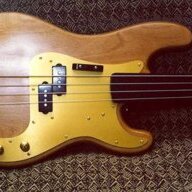
Addendum: I'm thinking about selling the bass pictured in my profile pic. Originally a Tokai '57 P-Bass copy, I stripped the body and put on a gorgeous unlined fretless Jazz Bass neck. I hand formed the brass nut. It was my first and only bass for a couple of years, then decided I needed frets so moved on. Consequently, even though I built it in 1996, it is in great condition. Question: Suggested price?
 
It is hard to beat that big tube sound and power. I had a Magnavox era SVT, but I can speak for most of the other older players out there after awhile it causes wear and tear on the old back. So recently i went super light with a Mark Bass 800 watt head weighing in at 6.6 pounds. (a lot nicer on the back, not to mention it kicks pretty good)
 
  • Like
Reactions: Fuzzbass
Class D's have come a long way, and there are several that are really great. That said, if the tone you seek is that of a tube amp just starting to break up..... there is no tube pre or pedal that will get you 100% there. I probably would have never shelled out the cash for the boutique tube amp I have, but it was offered in a local trade. Playing through it was a revelation. I am not in a cover band, and I only aim to gig a couple times a month. That said, I will lug this amp (45lbs) along with a 410 (50lbs) for as long as I have gigs that can utilize it. It will then be passed down, because being a hand wired tube amp it will always be valued by someone. I have played through MANY tube preamps, but overdriven preamp tubes are not the breakup I look for. Its when you start to push the power tubes and you get just a bit of natural compression and bounce. A bit of fur and extra thickness. That combined with the extra harmonics and overtones is what makes it inspiring to me. If my tone inspires me, then my playing with show it and thus inspire others. Will the audience have any appreciation for the killer rig I have assembled? Not unless there is a Talkbass member in attendance. But, I guarantee that they know when I am playing well, locked into a groove, and enjoying myself. Different strokes for different folks. This rig is not uber versatile, but it gives me my favorite bass tone of all time. It is the perfect tool for this job.
 
  • Like
Reactions: squish