
• TalkBass has been independent since 1998. Add your voice.
    Create a free account to reply to discussions, view embedded media, and browse with fewer display ads.
    Join freeLog in
    Want zero display ads or expanded classifieds tools? Compare plans.

Why did Ampeg changed from 6146's to 6550's in the SVT?

Does anyone know the real reason?
There are alot of rumors and half truths floating around.
It seems everyone has their own theory.
I would imagine haveing that plate voltage above the chassis and going to the top of the tube had to pose a safety concern.
Were they given a better price on 6550's?
Was the output higher with 6550's?
Are the 6146's an inferior tube?
What facts do you have?
Jerrold, what do you know?
PBG, I really value your insight.

 
it was before me, and I don't know for sure. I THINK there was some slight explanation in the change-over instructions, I did a couple of them around 1975 or so.

PBGs explanation is one.

Another is that getting a 6146 was a hassle for the user, and matched ones were not available easily. The 6146 was an industrial tube, used in transmitters etc, and not really widely available relative to the 6550. I don't think ANY other amp ever used the 6146, but the 6550 has been used quite a bit in consumer stuff of one sort and another.

To judge, see how many sources you can get a 6550 from, and then try to get a 6146. Better yet, try to get 6 matched 6146...... You can easily do it for 6550s. Shows the relative popularity.
 
To judge, see how many sources you can get a 6550 from, and then try to get a 6146. Better yet, try to get 6 matched 6146...... You can easily do it for 6550s. Shows the relative popularity.
My tube guy in Orlando took an hour and a half to match two sets of three 6146's. Craziness. Yeah, they're certainly not popular with current makers but they're readily available at NOS stores and the supply's not likely to run out for a long time since there's no real demand. That's what he said anyway.
 
+1 for PBG, they were unstable because---
+2 for JT, they were really meant for class C transmitters, harder to get a hold of then 6550's.
As far as matching, we didn't do that back then unless you were an anal HiFi geek. I realize designs became tighter but I still am not convinced about the real worth of matching. Just IMO IME
As someone else states "Your mileage may vary."
 
Bassman Paul says the same thing about matching. Said nobody ever did it until the mid 70's or so. I've used non-matched tubes (not on purpose) and never could tell a difference in tone. But I figure if you don't need to do it, most honest amp techs would say you don't, and they mostly say you do, so I do. What do I know?
 
i usually use matched tubes but it isn't always absolutely necessary. on some amps you get a noticeable hum at the output with the volume set at zero if they are pulling different currents. an SVT has bias controls for each set of three 6550's to minimize this. and many of the later 70's fender's have an output tube matching (balance) control instead of an actual bias control.
 
Bassman Paul says the same thing about matching. Said nobody ever did it until the mid 70's or so. I've used non-matched tubes (not on purpose) and never could tell a difference in tone. But I figure if you don't need to do it, most honest amp techs would say you don't, and they mostly say you do, so I do. What do I know?

As I stated just IMO, it never hurts and at least you know the tubes have been "run tested" in the matching process? Beyond that if it makes anyone feel good, more power to you! :)
 
The matching thing............

back when, the manufacturers all got the good tubes..... the ones from the middle of the distribution. What they shipped in the amp people used until they didn't work.

Replacement tubes were whatever the manufacturers didn't use, the tail of the distributions.

But, back then the manufacturing was very tight, and the entire range of tubes available was such that there weren't that many seriously "out there" tubes, they were all fairly closely grouped on a bell curve around the standard values.

These days, with tubes from (yes these are stereotypes, but taken from reality) drunk russians, underpaid chinese, and wherever, you don't know what you may get, and matching serves the purpose of getting them all close to each otehr spec-wise.

Now, what does it do for you?

Sound-wise, not a lot, a matched set usually will produce more power than a non-matched set, although maybe not by much.

What it does tend to ensure is that the tubes share the load. That way, one does not fail early from being overworked.

Matching tends to be more important with a design such as SVT or the Mesa 400, where the tubes are worked hard, and near their limits. The mesa, with no bias adjustment, almost requires matched tubes with a certain set of parameters.

The SVT makes it unimportant to get a full six matched tubes, since only each group of 3 really needs matching. Each group has it's own separate bias control. But I doubt anyone sells groups of 3.... I generally only see 4 or 6.

For most lower power amps, matching is not a big deal, although it may help with certain types.
 
Great post and thank you all for the education; now for the hijack.
Much difference in tone between the tubes, or, did the circuit change with the tubes as well?
 
Great post and thank you all for the education; now for the hijack.
Much difference in tone between the tubes, or, did the circuit change with the tubes as well?
You might get a slight power boost with the 6146's. I've heard the 6146's will put out 320w RMS as opposed to 300 with the 6550's. Big deal ;) Naturally some values relating to the 6550's necessitated a change, but as far as I'm concerned, they might as well be the same amp.
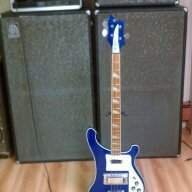
 
An interesting twist to the OP's original question (not trying to hijack but it just got me to thinkin'...). Why DID Ampeg originally use the 6146 in the SVT instead of the 6550 from the get go? The 6550 was designed in the 1950's originally by Tungsol (I think) for high power audio applications and had already been used in audio power amp designs years before the SVT was introduced. As Jerrold and B-String mentioned, the 6146's were originally intended for RF transmitter service (case in point... My dad was a ham and had an old Johnson Viking Ranger transmitter with a 6146 final).
 
There have been so many reasons given for the change but they appear to be guesses.
There has to be a reason why.
Why design a amp then change it so much so soon after introduction. A single year isn't going to affect the availability of one tube over the other. Why not just go with an established audio tube? I'm sure Roger Cox and Bill Hughes were no idiots.
They had to have a reason to favor the 6146 over the 6550.
 
I'll take a run at it. I wasn't there but I am an Extra Class Ham Radio Op with an EE degree.

The 6146 was designed for VHF radio transmitters and can probably amplify full power up to a 1 GHz. The main application was police and Taxi radios (the days before solid state obviously).

If you don't design your circuit well and use neutralization, these things will oscillate like crazy and put out a lot of radio frequencies.

The 6550 was used for industrial switching applications. They have a lot of internal capacitance that limits their useful frequency. Plenty good for audio.

The 6146s need plate caps and that must add a little cost. The plates run about 575 Volts and these wires have to run through the chassis. So I think the 6550 just made a little more sense.

I have 1969 SVT with 6146s and I was just playing it! I bought Little Mark II last month and am quite proud of it. Then hooked up the SVt and what a difference.
 
+1 to Geoffb from yet another Extra class Ham and semi-retired RF geek.

The 6146's love of high plate voltage and the plate cap gizmo make perfect sense as reasoning for its demise. It is a rugged tube, and in the RF world, you aren't for real until you've been whacked by the plate voltage of a 6146 circuit. We all get there eventually. I got bit as a young pup working on a KWM-2. Never got bit again.

RCA loved the 6146's in TV transmitter exciters. Collins liked them too. The 6146 is as common in RF amps as the 6L6 is in audio amps. FWIW, every amp I ever worked on with a 6146 was a class A or B circuit, never touched a class C.

All this attention to techs lately has gotten me thinking; how much work is there for us classically trained electronics mechanics? I'm toying with the idea of firing up a business concentrating on gear repair. Is there enough demand out there for one to take a swing at it?
 
That's one of my retirement fantasies as well. I can remember the pinouts to just about every tube. Most guys my age were building cars as teenagers but I was making amps and transmitters.

The other retirement fantasy involves a small sailboat in the Caribbean but the wife isn't interested....