• TalkBass has been independent since 1998. Add your voice.
    Create a free account to reply to discussions, view embedded media, and browse with fewer display ads.
    Join freeLog in
    Want zero display ads or expanded classifieds tools? Compare plans.

Double Bass Why do most bassists i've seen do this?

It's not always the case that bass is played that way, it is just the more traditional style.

If you check out Rufus Reid, he plays the whole bass.

Scott Lafaro played the whole bass, Gary Peacock, John Clayton, Christian McBride all play the whole bass.

Go get the Rabbath books (or work with him like Rufus also Ray Brown was interested in Rabbath and everything he could do to learn more about playing the bass) and a teacher that can help you learn to play the whole bass. Just remember music comes before technique. All your technique does is help you serve the music.

You also need a setup that allows you to play the whole bass and get a good sound. That was harder with high action and gut strings. I personally think Gut may work, but moderate string height off the fingerboard is a must.
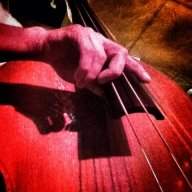
 
What i've seen a lot of bassists do, while walking, or soloing, is stay withing the first few positions of the upright, and then go up the G string.

Why is that?

I think it is more accurate to say many players stay on the G and D string as they go up. There are certain intervals that are just impractical to shift like crazy for.

To respond to Alex, I am watching the Rufus Reid Evolving Bassist DVD right now and on the concert special feature he does very little of what you are talking about. He does pretty "traditional" vertical kind of stuff. I'm not trying to prove you wrong. Quite the contrary. I thought maybe I was missing something.

A genuine question... I've always thought of horizonal (across the bass) as more of an EB thing. Do you think that technique had any influence on effecting the appraoch to the DB?
 
across the bass horizontally just requires practice. If you learn it, you have more ways to do things, make more choices etc.

Why not?- well a lot of stuff works good enough, and there is a learning curve :hiding: to playing across the string too

Regarding Rufus and Orchestral players, yeah, you want to do the easiest fingering, in the orchestral probably everyone will do the same fingering. When you really need to do something that doesn't work though, you might want to go across the string.
 
A genuine question... I've always thought of horizonal (across the bass) as more of an EB thing. Do you think that technique had any influence on effecting the appraoch to the DB?

It certainly did for me. I played fretless electric professionally for years before playing the upright. It was very natural for me to play across the neck. It was the transfer of some of the fretless technique that allowed me to buy a DB and play a jazz gig on it the next day (not very well as you might expect but certainly passable). I've long since stopped playing EB. It took a few years to learn to play vertically. It was well worth the effort to learn to play vertically because there are things I can do vertically that I can't do across the neck. And playing vertically has a certain traditional bass sound to it which is appealing.

I don't limit myself to vertical playing though. That option is ALWAYS open to me but I see no reason to limit myself to playing like the old guys who were playing high action gut string basses. THEY didn't have the option of playing horizontally. I do.

I actually like the sound of all of my basses all over the neck. The whole middle sounds nice and has a different texture than first position but very usable and sometimes even more desirable. Play there enough and you'll know when it is time to go the middle for sonic reasons. Playing the A and E in thumb position opens up whole worlds of technical possibilities. All kinds of patterns are available up there for side slipping and sequence playing. I just think it's silly to ignore those possibilities because the old guys didn't use them.

Once again, this all pizz playing. There are others here who can cover arco better than I can.
 
A genuine question... I've always thought of horizonal (across the bass) as more of an EB thing. Do you think that technique had any influence on effecting the appraoch to the DB?

The only reason DB is traditionally not played across the neck in upper positions is because string technology and setups did not allow for it. People learned to play that way, and as technology advanced it left some players in the dust. Contemporary playing allows us to play the whole instrument, and IMO that means more freedom to make music.
 
A genuine question... I've always thought of horizonal (across the bass) as more of an EB thing. Do you think that technique had any influence on effecting the appraoch to the DB?

Ron Carter talks about the across the neck concept in terms of being influenced by J.J. Johnson. (WARNING - Non-trombone player about to attempt to explain trombone technique). Apparently J.J. moved up and down the slide less often than most trombone players, changing notes more often by manipulating his embouchure while staying in the same position on the slide, or moving it as little as possible. Ron latched on to the economy of motion at the heart of that approach, and translated it to the bass, i.e. less up and down/north-south movement on the neck, more across/east-west. That was some serious paraphrasing on my part, but that's the jist of what he was talking about.
 
The only reason DB is traditionally not played across the neck in upper positions is because string technology and setups did not allow for it. People learned to play that way, and as technology advanced it left some players in the dust. Contemporary playing allows us to play the whole instrument, and IMO that means more freedom to make music.

Are we talking the Double Bass here? I will agree that string technology and the like helped. Sure. And maybe my bass sucks... but notes sound fuller, bigger, more resonant, with more sustain, etc. in certain places. Play notes wherever. The OP was asking why guys play vertically. To quote Dr K "That's the way the realbass is played." There is a reason why the bass has been played that way and will continued to be played that way and it ain't tradition.
 
Are we talking the Double Bass here?
Yes. This thread is in Jazz Technique [DB], and while I play electric too I'm talking mainly from a classical background on DB with some jazz tossed in for fun.

There is a reason why the bass has been played that way and will continued to be played that way and it ain't tradition.
I disagree - tradition is the main factor at play here, at least when we're talking about dogmatic ideas like playing vertically regardless of whether it is ideal for the given situation or not. I understand what you're saying: you like the tone in first position so you play your B there rather than at the heel on the E string. I prefer to have both options, so whatever the music calls for I do. The fact that in jazz a certain tone is preferred which leads to vertical playing is a tradition. It's not better or worse, but it has its roots in tradition, not a well rounded logical approach to the instrument.
 
Jeff. Just so I'm clear your answer to the question posed buy the OP is 'tradition'.
If you're forcing me to put it into one word, sure. Where that tradition came from is worth knowing too.

I don't think we disagree so much on how to play the bass, but more on why we do the things we do. I don't do much of anything just because someone told me to, including a teacher. It's valuable for the student to question why they are being told to do something, or better yet for the lesson to be presented that way in the first place.
 
Playing up the G string has a better tone - in general, in my youtube clip I think the growl I get on the E is a nice sound - but crossing strings is far preferable to declaring something unplayable.

I had to play a score the other day, mostly graphic, by a Chicago saxophonist Paul Hartsaw, it had only a few lines of music but what was written was rough!
I think Ausberto has played the piece if he is lurking. It had double stops like Bb against Ab, and a line that went F# on G string down to Bb up to Ab.
The only way it really worked was thumb on the F# (G String) and Second finger on Bb (on the A string) and Ab (G string).

So low thumb position and string crossing was the order of the day. I also like to change it up sometimes to get away from licks (which was Red Mitchell's reason for tuning in 5ths).
 
If you're forcing me to put it into one word, sure. Where that tradition came from is worth knowing too.

I don't think we disagree so much on how to play the bass, but more on why we do the things we do. I don't do much of anything just because someone told me to, including a teacher. It's valuable for the student to question why they are being told to do something, or better yet for the lesson to be presented that way in the first place.

I did a workshop with the great L.A. trumpet player Bobby Bradford.
He said, "If you want to play something - Play it! Do you think Sonny Rollins gives f*** what you think when he plays that Carribean s**?"

I also use Rauschenberg's Goat as an example when telling students if they are driven to play something a certain way then do it.
http://images.artnet.com/images_US/magazine/features/saltz/saltz1-11-4.jpg
The guy put a taxidermied goat (with a tire around it) in the middle of his painting in the late 1950s, now it is worth around $30,000,000 and you cannot deny the fact that it exists!

We should all make our own choices where our work is concerned but my feeling is they should just that - a choice.
 
If you're forcing me to put it into one word, sure. Where that tradition came from is worth knowing too.

Go to yer bass and play a C Maj triad pizz at 40bpm up the G string. Then play those same notes in one position from the A string, to the D and then the G. For most players on most basses playing it up the G sings much more. Now speed it up to 120bpm and the difference is still very noticeable, yes? Speed it up again to 300bpm and the difference is much less noticeable. It has nothing to do with blindly following "tradition" and everything to do with individuals finding through trial and error (in other words thorough practice) what sounds best to express a given musical thought.
 
Ah, but you've only helped to reinforce my point! At 300 bpm the focus becomes less on timbre and more on playing the lick. Now make it something much harder than the triad in the example, and you're not going to care how you have to finger it as long as you can pull it off.

Add to that the fact that you might not want it to "sing" as much and you have more than one reason to play across rather than up a string.

From there it's easy to see that having more tools than less is a good thing. Yet the answer provided when asked why one would go up one string: "that's how you do it". See I'm not attacking the technique at all, but the message that you should simply do something because that's what you're supposed to do. If going up one string is the sound you want, then play that, but that was not the reason given in this thread until questions were raised.
 
i actually think the reason is simandl. most players studied it, and thats how simandl does things. (i know there are other methods, but especially 20 + years ago, simandl was the predominant method) i can't believe that after 57 posts, i'm actually the first person to bring this up. someone should invite tom gale to this thread.
 
What i've seen a lot of bassists do, while walking, or soloing, is stay withing the first few positions of the upright, and then go up the G string.

Why is that?


I think we are getting way to esoteric in answering this simple question.

Sure Jeff (Moote). Agreed. I'm not sure I exactly understand your point but yes, find what works for you. Don't just do things 'cause you were told to. Fight the power.

The bottom line though is we are not reinventing the wheel here. The reason why this playing style exists (simandl if you will) is it has been used successfully for years. No question we should constantly be looking for other ways to play stuff (and I do) and exploring our instrument (that too) but after 18 years of playing I'm only going to spend so much of my time questioning authority. There is so much other stuff to work on.

Speaking of which I'm, gonna have some coffee and hit the shed.
 
See I'm not attacking the technique at all, but the message that you should simply do something because that's what you're supposed to do. If going up one string is the sound you want, then play that, but that was not the reason given in this thread until questions were raised.

Sound is the reason I gave right off the top.
You ASSUMED fingers was talking about purely dogmatic tradition when if you read back through his posts within the context of the whole thread I think you'll clearly see he's talking about sound. :eyebrow:
 
Sound is the reason I gave right off the top.
You ASSUMED fingers was talking about purely dogmatic tradition when if you read back through his posts within the context of the whole thread I think you'll clearly see he's talking about sound. :eyebrow:
I'm not accusing fingers of saying this, but just responding as he's still participating in the discussion and didn't leave it after a post or two (as are you and I). Consider the first 2 answers that were supplied for the OP:
They're not called the "money positions" for nothing.
That's the way the realbass is played.

:hmm: :hmm: :hmm:

That isn't the same thing as the reasonable explanations that have surfaced as the discussion went on, and it is that kind of answer that I was responding to in the first place.