I cannot edit the OP, so I will just add onto it here. The point of the thread is this, which I didn't know I had to explain a one-sentence premise:
Why do some people prefer clearly clashing aesthetics on their instruments?
I'm not talking about people who don't care about aesthetics, why would they even matter in a discussion about aesthetics. I am talking about people who DO care about aesthetics but consciously pick things that are flawed. It's a very strange venn diagram between people who know what good looks are and appreciate them, and those that purposely like the opposite.
To the dismissive people: Taste is subjective, Beauty is Absolute. Taste is abstract, but the feelings each color gives in relation to each other is concrete.
In other words, you can think spiders look cool but even the people who think spiders look cool have their stomach churn at the sight of them they just choose to give into it. Some people eat feces, still makes them vomit but they do it anyways.
I've seen this discussed for over a decade, and the prevailing answer I've picked up is that it's a mix of "magical thinking" / superstition with a little bit of "I never thought about it before." In other words, it's either people who cannot tell the difference between manipulation of symbols ("it's what was done by all the greats man!" "it's MOJO!" "IT'S WHAT I DO STOP MAKING ME THINK!!!") and actual work being done to the symbolized (ie. WHY it was done in the past, how there were few other options, where it works in one specific context but why it doesn't otherwise, etc), or people who are at least somewhat aware of looks but want to look plain/unassuming/forced-"humble" intentionally.
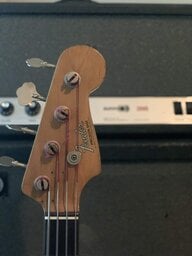
I could go into a very long explanation of why unpainted headstocks are ugly, go into color theory, etc. but the replies show this is not the site for intellectual conversations about art.
I will just say this simple explanation:
The bare maple headstocks are a beige-ish yellow, which does go with a lot on its own, but creates very strange friction when you add in the brown of the fingerboard (least of all because there is so much of it). Yellow doesn't go with brown well so it sticks out badly. Yellow with a color tends to create a different feeling than brown with that same color, and so you have two emotions that don't fit. Not many things are yellow either, so the random splurge of color at the end is just out of place.
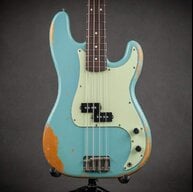
A black painted headstock works well because it removes the sudden interjection of a third, garish color we need to worry about. Black does not go with brown at all, but at a two-way conflict is preferable to a three-way conflict. One poster here was freaking out about how the example used a powder blue bass, ignoring that powder blue is one of the few colors that compliments light brown; I also purposely chose the white guard because both powder blue and light brown go with white. If I used a black bass with light brown board and white guard, you might have vomited on your screen even if you otherwise claim to like that combo (why white doesn't work in that case whereas it works in the other would push this art/fashion seminar into a thesis). It's involuntary.
Again, Taste is subjective, Beauty is Absolute.
I would liken the unpainted headstock to wearing a suit but going barefoot. Or seeing a woman with unshaven legs wearing a short skirt. Slaps you right in the face when otherwise you wouldn't even notice it.
Think of a "third wheel" on a date. Two guys and one girl. One boyfriend/girlfriend and the boyfriend's rowdy friend. boyfriend + friend = boisterous raucous fun, boyfriend + girlfriend = fragile tender romance, girlfriend + friend = no fun with the boys + romance mood killer + someone getting strangled. Then we get even more complex with how boisterous and fragile don't go together, raucous and tender don't go together, and fun (lighthearted) and romance (serious) don't go together. One might be able to get away with one of these inconsistencies and may be able to make a great story off that friction, but having all of them at once is like having an argument with your wife and then someone cuts you off on the road; problems are never additive but exponentially multiplicative.
you've ALL thought about this kind of thing even if you've never consciously considered it. you ALL have rejected otherwise compatible relationships because of this. In fact you probably contrived an otherwise nonexistent "incompatibility" to cover up the aesthetic revulsion in your memory of the event. That you can admit it or be aware of it or not has no bearing on solid theory. The sky is blue, and not one bit of your approval or awareness is necessary for that fact. Same idea here.
One can ignore slight inconsistencies (think about how you've never really considered how black hardware with nickel/steel frets don't match) as long as there is something to make up for it (usually black hardware is on guitars with darker boards, so the black hardware compliments the ebony instead of the frets, and frets being reflective tend to look a bit black from farther away, etc), but not major ones. Like already noted, small problems become major when they happen simultaneously.