

Enjoy the benefits of a premium membership!
Upgrade Account
-
TalkBass has been independent since 1998. Add your voice.
Create a free account to reply to discussions, view embedded media, and browse with fewer display ads.
Join free Log in
Want zero display ads or expanded classifieds tools? Compare plans.
You are using an out of date browser. It may not display this or other websites correctly.
You should upgrade or use an alternative browser.
You should upgrade or use an alternative browser.
Why do SHORT SCALE bass string sets have LIGHTER GAUGE than their long scale version?
- Thread starter cyberprimate
- Start date
More options
Who Replied?
To achieve the same pitch a shorter string length needs to have a lower string tension. Smaller strings are required to keep this tension from being too floppy.
Edit: source: pretty sure this is how the physics works
Edit: source: pretty sure this is how the physics works


I've thought the same, and got a 50-100 La Bella set for my Hofner, but ended up hating the tension and thickness (Hofners have narrow strings spacing), mostly on thick strings. I've had a 104 set of same flats on my long scale for some years and it wasn't feeling that stiff. a set with a 100 string was almost floppy to my liking on my 34". but not on my 30".
on the other hand, my 43" double bass had really thick strings of the same kind (stainless flats) and tuned to same pitch, but they were not that stiff at all. so there must be something explaining all this.
on the other hand, my 43" double bass had really thick strings of the same kind (stainless flats) and tuned to same pitch, but they were not that stiff at all. so there must be something explaining all this.

True.To achieve the same pitch a shorter string length needs to have a lower string tension.
Uhh... pretty sure not. ^^Smaller strings are required to keep this tension from being too floppy.
Edit: source: pretty sure this is how the physics works
There are diminishing returns, as a number of factors are at play, but using thinner strings on short-scale instruments restores upper-fret tone and practical usability (having same tension as a long-scale, through heavier gauge, would mean stiffer strings that sound darker and chorusy earlier on the fretboard).
Of course, using not only the same gauges but even thinner yields a lot less tension compared to the longer scale. However, less total length of string creates less stretch, which compensates the lower actual tension, to an extent; also: gradual, natural adaptment to different conditions often is enough to close the gap.
Not an accident I added the, "I think I knowTrue.
Uhh... pretty sure not. ^^
There are diminishing returns, as a number of factors are at play, but using thinner strings on short-scale instruments restores upper-fret tone and practical usability (having same tension as a long-scale, through heavier gauge, would mean stiffer strings that sound darker and chorusy earlier on the fretboard).
Of course, using not only the same gauges but even thinner yields a lot less tension compared to the longer scale. However, less total length of string creates less stretch, which compensates the lower actual tension, to an extent; also: gradual, natural adaptment to different conditions often is enough to close the gap.
 ."
."
All double bass strings have some damping (a silk inlay between core and inner windings, meant to reduce shrillness when bowing), which brings up diameter but adds very little mass (unit weight, i.e. mass for a given length of string, being lower than in a bass guitar flat, gauge being equal, and so is tension - of course, gauge is not necessarily equal), ergo tension; the presence of such silk damping also reduces stiffness (as is the case with Thomastik-Infeld Jazz Flats, which also have a silk inlay).on the other hand, my 43" double bass had really thick strings of the same kind (stainless flats) and tuned to same pitch, but they were not that stiff at all. so there must be something explaining all this.
Also, upright bass strings often have stranded ("rope") cores, which are a lot more flexible than solid cores.
Finally, the plucking position is a lot more distant from the bridge than on bass guitar, which also reduces perceived stiffness.
got a 50-100 La Bella set for my Hofner, but ended up hating the tension and thickness (Hofners have narrow strings spacing), mostly on thick strings. I've had a 104 set of same flats on my long scale for some years and it wasn't feeling that stiff.
I know that some players solve the problem by tuning all strings down to DGCF (2 semitones down). I'm tempted to do that on a short scale with the La Bella 760FM-S (I only have short scale basses right now). They're 49-109… I may dislike the result though.
Last edited:


I know that some players solve the problem by tuning all strings down to DGCF (2 semitones down). I'm tempted to do that on a short scale with the La Bella 760FM-S (I only have short scale basses right now). They're 49-109… I may dislike the result though.
I did this recently and like the result. Tuning to Drop C can get a bit floppy. It may end up being temporary as within hours I started thinking about BEAD.
I started thinking about BEAD.
Would you hear anything that low? I mean do you play for dogs or whales?

Would you hear anything that low? I mean do you play for dogs or whales?
5 string basses exist, so yeah, it'll be fine.

Wait, I don't think this is how any of this work. Shorten the length and you need less tension to tune to the same pitch. Increase the mass (via increase in gauge) while leaving scale length the same and you need more tension. So OP is right, shorter scale instruments should have thicker gauge strings to increase the mass to counter act the reduction in tension from the shorter scale.
I suspect real strings (esp for bass guitar) behave quite differently than ideal stings so the simple explanations are insufficient to explain the whole picture.
I suspect real strings (esp for bass guitar) behave quite differently than ideal stings so the simple explanations are insufficient to explain the whole picture.
I suspect real strings (esp for bass guitar) behave quite differently than ideal stings so the simple explanations are insufficient to explain the whole picture.
Yes i think structural stiffness of a string is maybe a factor. If strings didn’t have any natural stiffness but only tension then shorter scale would require heavier gauge.

To achieve the same pitch a shorter string length needs to have a lower string tension. Smaller strings are required to keep this tension from being too floppy.
Edit: source: pretty sure this is how the physics works
For the same pitch, a string with the same core and windings, but wound shorter, will end up with less tension. For the same tension (which would be a good idea), string makers should (but usually don't) make strings with more mass per linear foot, which usually means a bigger gauge string (you could also do it with a more dense metal, but nobody is going to put that much research into a string set that's a very small fraction of their sales). Bigger strings are what you do to make it not floppy - smaller gauge strings are the wrong direction.
Very sure this is how the Physics works.

I really haven't seen thinner strings on short scale basses. Usually it's 45-105 on four strings and add a 125 for 5 strings.
Sometimes, within a product line, short-scale strings are only available in extra-light (e.g GHS Precision Flats) or, anyway, not the heaviest option (D'Addario Chromes); some are instead heavier than long-scale (GHS Brite Flats). It depends.I really haven't seen thinner strings on short scale basses. Usually it's 45-105 on four strings and add a 125 for 5 strings.

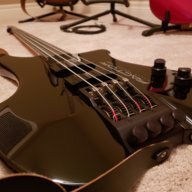
Get GHS balanced strings. They were a god send for my shirt scale ampeg and made the bass so much better. The tension feels just like all my other normal basses and they aren't too heavy or floppy or light.
Get GHS balanced strings. They were a god send for my shirt scale ampeg and made the bass so much better. The tension feels just like all my other normal basses and they aren't too heavy or floppy or light.
Are shirt scales all the rage now? Im so behind.....


