
I've had a top load Mustang for a little over a year now. It sounded pretty good when I got it so I just set it up and played it. When it needed strings I had a spare set I use on my 34" scale basses (d'addario XL nickels 105~45) and I just cut them down so they fit my Mustang. They have been on there now for at least six months and so far so good. No issues with weird sounds or floppy feel or any problems with my neck not taking or holding my favorite setup.

Enjoy the benefits of a premium membership!
Upgrade Account
-
TalkBass has been independent since 1998. Add your voice.
Create a free account to reply to discussions, view embedded media, and browse with fewer display ads.
Join free Log in
Want zero display ads or expanded classifieds tools? Compare plans.
You are using an out of date browser. It may not display this or other websites correctly.
You should upgrade or use an alternative browser.
You should upgrade or use an alternative browser.
Why do SHORT SCALE bass string sets have LIGHTER GAUGE than their long scale version?
- Thread starter cyberprimate
- Start date
More options
Who Replied?

I had a spare set I use on my 34" scale basses (d'addario XL nickels 105~45) and I just cut them down so they fit my Mustang.
D’addario have 3 short scale sets in the XL nickel series. 40-95, 45-100 and 50-105. So you’re pretty much playing with their short scale Medium gauge set with just slightly thinner D and G. Your E string is flexible enough to turn around the pole.
I got some Newtone custom made ones for my Maruszczyk 30" scale, I had a set of 48 68 88 108 roundwounds made and for me they are perfect not too floppy and not too stiff.

BECAUSE the NECK is SHORTER! AND THAT MEANS that THE STRINGS have to be SHORTER TOO. BUT if the STRINGS are SHORTER they NEED MORE TENSION to PRODUCE the SAME SOUND.
TRY hitting 2 DIFFERENT BOWLS in your KITCHEN, SEE how DIFFERENT size MAKES different SOUND.
TRY hitting 2 DIFFERENT BOWLS in your KITCHEN, SEE how DIFFERENT size MAKES different SOUND.
Basvarken
Commercial User
- Dec 3, 2010
- 1,743
- 10,606
- Disclosures
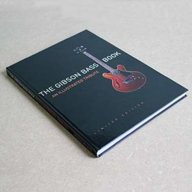
- Hobby Luthier / Gibson Bass Book
I've been using extra heavy gauge strings on all my short scale basses, for years.
I find light gauge string too floppy for my fingers. And I miss a profound bottom in the tone.
The strings I use are 50-115. It takes a bit of extra care when you string the bass. Especially the E-string.
But it is worth it. It helps to give the E-string a more authoritative sound.
I find light gauge string too floppy for my fingers. And I miss a profound bottom in the tone.
The strings I use are 50-115. It takes a bit of extra care when you string the bass. Especially the E-string.
But it is worth it. It helps to give the E-string a more authoritative sound.

Pyramid probably. They have a set like that: 055-075-100-115What strings exactly?
EDIT: Those are tape wounds.

BECAUSE the NECK is SHORTER! AND THAT MEANS that THE STRINGS have to be SHORTER TOO. BUT if the STRINGS are SHORTER they NEED MORE TENSION to PRODUCE the SAME SOUND.
TRY hitting 2 DIFFERENT BOWLS in your KITCHEN, SEE how DIFFERENT size MAKES different SOUND.
Shorter scale requires less tension to achieve the same pitch as longer scale if the strings being tensioned are the same mass per same unit of length. If you want to try an experiment to show this, tie a long rope or wire to a stationary object a grab the rope 10’ away from where it’s tied off. Pull it tight where it has no sag. Now grab the rope 30’ away & pull it tight where it has no sag. The greater length requires more pull to get rid of the sag. If you had 100’ of rope, you probably couldn’t pull it hard enough by hand to get rid of all the sag.
The bowl analogy doesn’t really apply. There is no tension being applied to anything other than gravity. Larger objects tend to resonate at a lower frequency than smaller objects if both objects are made of the same material or similar density material.
Last edited:
Basvarken
Commercial User
- Dec 3, 2010
- 1,743
- 10,606
- Disclosures
- Hobby Luthier / Gibson Bass Book

I flunked physics. And I guess I'm still flunking it. Many years ago, when I bought a 31" scale bass, it was strung with Curt Mangan nickel-wound 45-105s, regular size. Over the years I've bought and sold a number of short-scales, and I've always used the same strings. To no ill-effect. Thanks, I'll see myself out.
DAMNIT i MESSED IT up.Shorter scale requires less tension to achieve the same pitch as longer scale if the strings being tensioned are the same mass per same unit of length. If you want to try an experiment to show this, tie a long rope or wire to a stationary object a grab the rope 10’ away from where it’s tied off. Pull it tight where it has no sag. Now grab the rope 30’ away & pull it tight where it has no sag. The greater length requires more pull to get rid of the sag. If you had 100’ of rope, you probably couldn’t pull it hard enough by hand to get rid of all the sag.
The bowl analogy doesn’t really apply. There is no tension being applied to anything other than gravity. Larger objects tend to resonate at a lower frequency than smaller objects if both objects are made of the same material or similar density material.

I use to use thicker strings on my shorties, then one day I decided to try some 95's and never went back. I feel like I have my complex overtones that way, and just a fuller sound overall. This sounds completely backwards of what I think should happen, and I don't know the science behind it, but it works for me.

Tomastik-Infeld long scale flats (43 56 70 100) are lighter gauge than their short scale flats (43 56 70 106). The only difference is the E string. I have the long scale flats on my Precision and the Short scale flats on my Musicmaster.

Turnaround
Commercial User
No, this is backwards. If the string has more mass it will require more tension to bring it to a given pitch compared to a string with less mass. Or conversely, you need more mass to retain tension on a string that is shorter, i.e. heavier gauge for the same pitch on a shorter scale.To achieve the same pitch a shorter string length needs to have a lower string tension. Smaller strings are required to keep this tension from being too floppy.
Edit: source: pretty sure this is how the physics works

Ric5
Inactive
- Jan 29, 2008
- 29,772
- 30,452
- Disclosures
- I like 5, 8, 10, and 12 string basses
They either should be the same or heavier, no?
yes that seems logical ... but my experience says the lighter strings work better ...

Some of you need to go back to physics class others have it just right. It is highly entertaining though.
Ric5
Inactive
- Jan 29, 2008
- 29,772
- 30,452
- Disclosures
- I like 5, 8, 10, and 12 string basses
I use these strings on my 34" 33" 32" and 30" basses ...
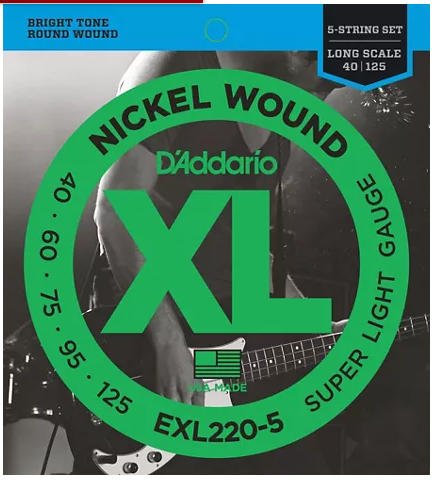
and on my 30" scale 10 string bass I use a .120 low B
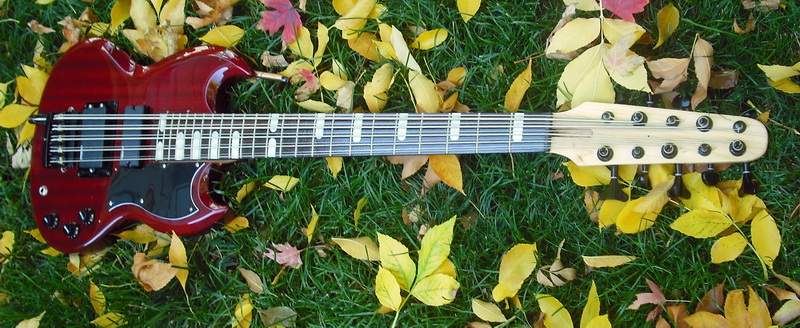
And I use an extender at the bridge to make the B a little longer ... this helps by keeping the none tapered part of the string out of the tuner.
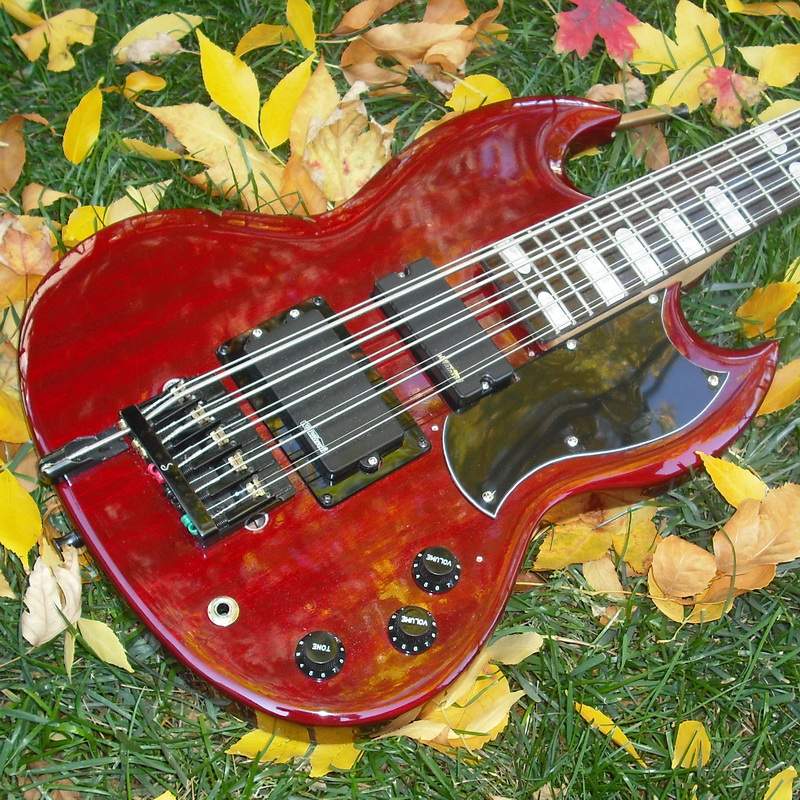
and on my 30" scale 10 string bass I use a .120 low B
And I use an extender at the bridge to make the B a little longer ... this helps by keeping the none tapered part of the string out of the tuner.

I should have deleted when the first person quoted meNo, this is backwards. If the string has more mass it will require more tension to bring it to a given pitch compared to a string with less mass. Or conversely, you need more mass to retain tension on a string that is shorter, i.e. heavier gauge for the same pitch on a shorter scale.
 . It's too late now.
Why is the E string a lesser diameter? The same reason Italian harpsichord makers did the same thing in the 1600's: the shorter the string the more difficult it is to match it tonally to the rest of the strings. In other words, it thumps if you make it as thick as the math might otherwise indicate. A thinner string vibrates in overtones better, given the same general construction, so a lighter E string will match better tonally. Fender did this with one of their original sets, 50-100. The double bass string company Pirastro still does this with their orchestral strings: the E string is lighter than you might anticipate.

Three things will affect the pitch of a string:
The material and construction of the string do play a part in this, but not as much as the basic 3 physical properties.
- Length - longer = lower pitch
- Tension - looser = lower pitch
- Diameter - larger = lower pitch
The material and construction of the string do play a part in this, but not as much as the basic 3 physical properties.


