NOTE: I am primarily a 4 string player that sometimes plays 5 string, but my 5 strings are always tuned E-A-D-G-C (no low B).
I never bonded with a low B string (I've tried). Regardless of bass, it has always sounded flabby and undefined to me. Lately I have been watching some excellent 5/6 string players, and I've been paying very close attention to how they use of their low B string.
To my surprise, a huge percentage of these players barely use the low B. It's not uncommon to see some monster players that will go the entire tune without hitting the low B string a single time. I'm confused why anyone would use a 5 or 6 string for even one tune, if they weren't going to use the B string anyway.
This is an odd, but serious question. Does anyone know why people are doing this? What am I missing? Why are guys doing this?

Enjoy the benefits of a premium membership!
Upgrade Account
-
TalkBass has been independent since 1998. Add your voice.
Create a free account to reply to discussions, view embedded media, and browse with fewer display ads.
Join free Log in
Want zero display ads or expanded classifieds tools? Compare plans.
You are using an out of date browser. It may not display this or other websites correctly.
You should upgrade or use an alternative browser.
You should upgrade or use an alternative browser.
Why do so many 5 & 6 string players NEVER use their low B?
- Thread starter foothilla
- Start date
More options
Who Replied?
NOTE: I am primarily a 4 string player that sometimes plays 5 string, but my 5 strings are always tuned E-A-D-G-C (no low B).
I never bonded with a low B string (I've tried). Regardless of bass, it has always sounded flabby and undefined to me. Lately I have been watching some excellent 5/6 string players, and I've been paying very close attention to how they use of their low B string.
To my surprise, a huge percentage of these players barely use the low B. It's not uncommon to see some monster players that will go the entire tune without hitting the low B string a single time. I'm confused why anyone would use a 5 or 6 string for even one tune, if they weren't going to use the B string anyway.
This is an odd, but serious question. Does anyone know why people are doing this? What am I missing? Why are guys doing this?
For me, I love the low B. And not being a soloist, I couldn’t see myself going to a high C (unless I got a great deal on a 6... otherwise, I stop at 5 strings).
The first guy I saw live using a low B was Patitucci in ‘86 with the Elektric Band at Pine Knob (Clarkston, MI). Earth shaking. Runs from high to low, used the whole bass. Changed my life (in a joking manner... it’s a good phrase, though).

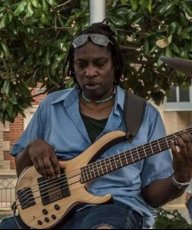
Haha. Maybe.
I could find 50 examples of great players doing this, but here are two random examples.
This cat has a ton of 4 string basses, but plays this on a 5 string, and never touches the low B. Seems like this would be a hell of a lot easier without that B string in the way?
Using that as an example it's like trying to explain an entire movie by looking at one frame. You don't know what he played next. Or maybe he's comfortable with that bass.
I knew a girl who bought a new 5 speed manual transmission car. So we're riding along and she's shifting up through all the gears so now she's in 5th and we're going 35 mph and the engine is lugging like hell. And I'm like why are you in 5th and doing 35? She says, I paid for all these gears and I'm gonna use them all.
You kinda sound like that... Just because it happens to be there, doesn't mean you have to use it.
Last edited:
Depends on rep.
If you're mostly playing cover tunes in a guitar-based rock or blues band, many of those songs were written on guitars in guitar-friendly keys, which fit on a 4-string bass because of how the tuning aligns.
Outside that world, they're used a lot more. Pop for instance is more often composed either on keyboards/synths, so it has no reason to hold to guitar-friendly keys - so you're more likely to see Eb's, D's, C's, and B's. Jazz often features wind-instrument-friendly keys that include Eb's or go down to D, or else use non-open-string tonality so having more notes in a given position is helpful. Musical theatre goes for singer-friendly keys, which are all over the place. Heck, if you're reading sheet music sometimes a composer gets confused about the range of the instrument (some notation programs consider 5-string low-B tuning normal for a bass guitar, and C-extension notes normal for an upright).
As for the examples you call out - I can't say why those specific guys aren't using them on those specific videos. Flashy-riff showoffs tend to favor higher notes for any number of reasons, even on a 4-string, and I suspect if they had a high-C they'd use it. Maybe the key they chose to play in that day just doesn't need the fifth-string. Maybe they're in the "35-inch thumbrest" school of thought but actually like the thumbrest.
But at the end of the day, it's individual circumstance and preference. If you don't feel like you need a 5+-string, don't buy one, but keep in mind other people wind up on different sides of that decision. There's not a right answer, or a wrong one.
((NB: I play low-B 5's pretty exclusively, because I mostly play in jazz and musical theatre; the notes show up enough that I find it useful. There are plenty of people I know in the same genres that don't make the same decision. To each their own.))
If you're mostly playing cover tunes in a guitar-based rock or blues band, many of those songs were written on guitars in guitar-friendly keys, which fit on a 4-string bass because of how the tuning aligns.
Outside that world, they're used a lot more. Pop for instance is more often composed either on keyboards/synths, so it has no reason to hold to guitar-friendly keys - so you're more likely to see Eb's, D's, C's, and B's. Jazz often features wind-instrument-friendly keys that include Eb's or go down to D, or else use non-open-string tonality so having more notes in a given position is helpful. Musical theatre goes for singer-friendly keys, which are all over the place. Heck, if you're reading sheet music sometimes a composer gets confused about the range of the instrument (some notation programs consider 5-string low-B tuning normal for a bass guitar, and C-extension notes normal for an upright).
As for the examples you call out - I can't say why those specific guys aren't using them on those specific videos. Flashy-riff showoffs tend to favor higher notes for any number of reasons, even on a 4-string, and I suspect if they had a high-C they'd use it. Maybe the key they chose to play in that day just doesn't need the fifth-string. Maybe they're in the "35-inch thumbrest" school of thought but actually like the thumbrest.
But at the end of the day, it's individual circumstance and preference. If you don't feel like you need a 5+-string, don't buy one, but keep in mind other people wind up on different sides of that decision. There's not a right answer, or a wrong one.
((NB: I play low-B 5's pretty exclusively, because I mostly play in jazz and musical theatre; the notes show up enough that I find it useful. There are plenty of people I know in the same genres that don't make the same decision. To each their own.))

Bottom line: doesn't matter what strings are being used or unused. What matters: is the bassist supporting the song properly?
All my basses have five strings, and I use the low string (a) sometimes to get consistency of tone that I can't always get when I'm hitting open strings (for example on Soul to Squeeze by RHCP, which is in F), and (b) to broaden my sound in tunes the tenor instruments are soloing or I just think that the audience needs to FEEL it (but that's usually just adding the lower octave to a note I'm already playing somewhere on the other strings). I've been playing five strings long enough that I think I'd probably get confused on a four string.
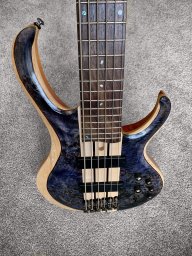
I never bonded with a low B string (I've tried). Regardless of bass, it has always sounded flabby and undefined to me.
I just watched a great video from Damien Erskine (sp?) on 6-string. When setting up the bass, he gets a standard 4-string set and orders the B and C separately, getting the thinnest B string and thickest C string he can find. That way the high C doesn’t sound too thin and the low B doesn’t get too muddy. Keeps a more even and consistent feel across the range. I’m due for a re-string and that’s my plan for my 6.
BTW, came to 6 from a 4 and I always tuned my 4 in drop D. Now with my 6, I’m always on that B. Just love the deep rumble so hit it whenever I can. I’ll play the octave up for a bit then on a repeat of the phrase drop down into the low register. Makes a nice texture and keeps grooves that repeat more interesting.
My 2c. Nobody would ever make the mistake of thinking that I'm a 'pro', so this is the opinion of a low-gig-time amateur.
I think thatit can be the philosophy of the musician. Some (me) are 'hold down the bottom' types, others like to play lead on their bass...maybe because thats what the song requires. I use my 'b' all the time, and using the different positions IS easier on my hands.
I think thatit can be the philosophy of the musician. Some (me) are 'hold down the bottom' types, others like to play lead on their bass...maybe because thats what the song requires. I use my 'b' all the time, and using the different positions IS easier on my hands.
i play in a deathmetal band, we tune down to full D. so i have the E down to D and the low B down to an A and use it primarily for bass drops(when the guitars dive bomb i follow in suit, plucking the B string on the 2nd fret bent up 2 steps and bringing it down.) when done correctly, HOLY poopie!!! hope that makes sense.
Very valid and interesting question IMHO.This is an odd, but serious question. Does anyone know why people are doing this? What am I missing? Why are guys doing this?

I did this for several years, play a 5-string in a rock band but almost never used the B-string. I was 17 or 18 when i bought my first Larrivee 5-string and the reasoning i had was that "the B-string is nice to have" or "five strings must be better than just four strings". 5-string basses were the new thing then, 1987-1988, and soon i traded it for a new Music Man 5-string. Fantastic bass, but the B-string was rarely used other than as a great thumb rest. So for me it was some kind of childish "my bass has more strings than yours..."-thing. Sad, embarrassing and pathetic at the same time. At least i am aware of it today.
After some time, around 1993, i matured and was kind of disturbed of the tight string spacing and the fact that a de-tunded E-string tuned down to D sounded much better than a low D on the B-string. I started to question myself and why i still clinged to my 5-string while other great players such as Chris Squire/Geddy Lee/Billy Sheehan, etc, etc has done and are doing totally amazing things with 4-string basses.
I then swithced back to a 4-string and has never looked back. I still have the Music Man 5-string since it is a great bass, but i play it maybe once a year to check it out. I will never buy a 5-string again. Lesson learned.
That´s my story based on just me and the kind of music i play, so i do not patronise any of the 5-string players out there.
Card-carrying geezer here, who switched from 4 to 5 while taking beginner lessons and never looked back. Love and depend on my low B and use it at every opportunity. We have a Sunday afternoon casual jam that has been on-going for about nine years now in Dallas' fabled "Deep Ellum". Our participants are mostly very senior folk who like to get together for a few hours and play purely for the fun of it. Some of us are simply hobby players and some have actual on-the-road, pro playing in their past - but the name of our game is 'fun'. Our material comes from the "music of our lives", meaning that we tend to stick to stuff from the 60s through the 80s, but we don't have rules about it and anyone can suggest anything. Probably not that helpful to you and your question, but there it is.

I couldn’t tell you why others don’t but I always do. I use it a lot for the lower notes which sound just fine on my basses but also because it gives me a nice hand position for access across the neck from the 5th fret and above. I also prefer the fatness of E on the 5th fret. Mine gets used.NOTE: I am primarily a 4 string player that sometimes plays 5 string, but my 5 strings are always tuned E-A-D-G-C (no low B).
I never bonded with a low B string (I've tried). Regardless of bass, it has always sounded flabby and undefined to me. Lately I have been watching some excellent 5/6 string players, and I've been paying very close attention to how they use of their low B string.
To my surprise, a huge percentage of these players barely use the low B. It's not uncommon to see some monster players that will go the entire tune without hitting the low B string a single time. I'm confused why anyone would use a 5 or 6 string for even one tune, if they weren't going to use the B string anyway.
This is an odd, but serious question. Does anyone know why people are doing this? What am I missing? Why are guys doing this?

As Groove Doctor said, it’s there when you need it. It’s helpful if you 1) play out a lot, 2) play a variety of genres, 3) cover pop music, 4) work with horns, 5) work with vocalists who tend to sing in B or F# or Eb. As a musical arranger, I sometimes find it frustrating when a bass player can’t deliver the big thud the song needs, in fact I’ll choose someone else. As for me, I look at the set/sets in front of me. I’ll always default to my pbass, but if there’s heavy lifting involved, I’ll grab the five. Of course, a good player can navigate any key, but if a bass player likes being hired, having a five string in the arsenal is helpful.

Bottom line: doesn't matter what strings are being used or unused. What matters: is the bassist supporting the song properly?
What if he is a solo player?

Hhmm...I've rarely seen that.
Most if not all 5 stringers use that Low string to whatever tuning they use.
I have a 5 string and that lowend gutteral B string does not leave the twiddling of my fingers.
I'm downtuned to A for the metal music I play.
Most if not all 5 stringers use that Low string to whatever tuning they use.
I have a 5 string and that lowend gutteral B string does not leave the twiddling of my fingers.
I'm downtuned to A for the metal music I play.

I play mostly 4's. But I have a 34" scale fiver strung E to C and tuned D G C F Bb. Strung with flats no less. It plays and sounds great, and covers almost the full range of a six string. Just missing two notes at the very top and three notes at the bottom. For my needs, I don't need any more bass than that, range-wise.
The D string gives me the low D and also a low Eb, which is super useful when playing in the keys that horn players like.
Detuning also helps take the twang out of the G and C strings, which is a big help.
The D string gives me the low D and also a low Eb, which is super useful when playing in the keys that horn players like.
Detuning also helps take the twang out of the G and C strings, which is a big help.
I play a 5 in a hard rock band that uses regular tuning. i use the 5 in probably half of our songs. rather than gig with multiple basses, i play a 5 and use it as necessary. also, sticking with a single 5 keeps me familiar with the neck and using the same technique consistently.
cheap plug: check us out on Band-camp- Drivetrain out of Portland, ME. The low B is featured mostly in our songs “Cajun Queen” and “Cross” off our debut album which is currently free for download.
cheap plug: check us out on Band-camp- Drivetrain out of Portland, ME. The low B is featured mostly in our songs “Cajun Queen” and “Cross” off our debut album which is currently free for download.

I tune my 5 string with a high C also but I have a Hipshot Detuner on my E string. I rarely go below D on live gigs. In the studio I have a small arsenal of 4, 5 and 6 strings (Low B to High C),
I'm the same way with my 5 string. Rarely would I go lower than a D but it's their if needed. Sometimes I get a bigger sound when I play on the E string and boost the bass a little.

I used to use a five string all the time for when the band played in drop d or lower my old band played a running that was in b before also for a song so it came in hand these days I don’t use a five string that often at all once in a blue moon for a few drop d songs if anything. I use a line 6 helix to drop tune to a b standard on my 4 string and that does it for me I feel like the future of music will be more like that just people need to Accept it more. E a d g c is a good tuning for a bass also I’ve used it for some stuff and it comes in hand more than using the low b


