
Enjoy the benefits of a premium membership!
Upgrade Account
-
TalkBass has been independent since 1998. Add your voice.
Create a free account to reply to discussions, view embedded media, and browse with fewer display ads.
Join free Log in
Want zero display ads or expanded classifieds tools? Compare plans.
You are using an out of date browser. It may not display this or other websites correctly.
You should upgrade or use an alternative browser.
You should upgrade or use an alternative browser.
Why do so many 5 & 6 string players NEVER use their low B?
- Thread starter foothilla
- Start date
More options
Who Replied?

Most of what you hear is a lot of harmonics vs fundamentals on lower notes, anyway.Most PA systems cut off low frequencies on some 35-40Hz. Open B-string's basic tone is ~30Hz... Open E-string is ~41Hz.
An Ampeg 8x10" usually starts sharply dropping off in the low end around 60Hz, and is often -10dB by 40Hz. However, it sounds pretty tight and even with 4 or 5 string basses.

Basses are merely tools -- you use the correct tool for the job.
If you need a 6-string, you use a 6-string.
If you need the tone of your 6-string but you only need to play one single note over and over, you use the 6-string.
I have a bunch of basses, but primarily I choose them for a particular application based on tone and not number of strings. I don't pay attention to how often I use the low B or the high C... I just play what I need to play.
Also that argument about it being better to be able to fret a low E than play an open string... I absolutely disagree with that. It almost *never* sounds better to play a fretted E than an open string. Easier? Maybe. But I care about tone way more than I care about ease. But that's also just my opinion.
If you need a 6-string, you use a 6-string.
If you need the tone of your 6-string but you only need to play one single note over and over, you use the 6-string.
I have a bunch of basses, but primarily I choose them for a particular application based on tone and not number of strings. I don't pay attention to how often I use the low B or the high C... I just play what I need to play.
Also that argument about it being better to be able to fret a low E than play an open string... I absolutely disagree with that. It almost *never* sounds better to play a fretted E than an open string. Easier? Maybe. But I care about tone way more than I care about ease. But that's also just my opinion.
I can't speak for others of course, but not only isn't any of that true for me, it isn't true of the 5-string players I've watched. I switched to 5-string many years ago because I decided it was better (for me, anyway). That hasn't changed just because 5-strings aren't in style. Reasons: 1. I never play the open E unless I think it's one of those times where it's cooler to let the open string ring out, or a difficult figure is easier with an open string. 2. Having a low B allows both better low range (obviously), and when you're playing up the neck, a low note isn't too far away, so in that way it facilitates upper range playing as well. I also sing, and it's easier for me to check my hand position straight down then down and to to the left. That has me on the B string a lot. 3. Whatever the bottom string is, it's a better feeling for me to backstop onto the next lower string. Doesn't apply to the B string notes, but when you have the B, you can play up two positions on the upper strings. 4. Some songs (90's I guess) actually call for notes below E. I was recently singing (only) in a band, and the bass player, who said he couldn't stand 5-strings had a Hipshot E string tuner so he could drop to D. I'm not a fan of changing the interval relationship of the strings, but whatever works. We also played a song that called for a low C# that sounded lame without it. I would consider those things as validation of the low B as a good option. I'm not criticizing work-arounds, but it seemed silly ridiculing 5-strings considering that he wasn't really getting the job done with his 4-string in those cases. As for 5 and 6 string basses with the high C: I'm just not going for notes in that range. If you don't think the low B string can sound good, it's a defensible opinion, but I think that especially .125 stings are fine (not flabby), especially if you're not rolling the low end off all the way. This all reminds me of low-A bari saxes. Old ones are down to Bb. Then they started writing charts that call for the low A, but it's quite an acoustical compromise to add that extra half step (the bell would be too big if they did it right). If you compare two identical bari saxes, one keyed to Bb and one to A, the Bb one has a way better low end despite not going down that extra half step. If it's mic'd, proximity effect takes care of that, but it's just not as fat. But I digress. I guess my point is that cost-benefit-inconvenience comparisons yield different results. Most of the great music recorded and performed on electric bass was done with 4-string instruments. hard to argue with that. But, having transitioned to 5, I feel less comfortable on 4. Your milage may vary. But I assure you, most of us are using our B string when we have it.
Sometimes I like to play notes usually reserved for the E string on the low B, just for the thicker, pluppy timbre. That's a huge advantage of playing a stringed instrument, you can find the same pitched note in several places on the neck and pick the note for the timbre.

uWell, supporting the song isn't relevant in that case.It would make sense for a soloist not to use the low notes (unless they could play bass line and melody simultaneously). Never say never, but it's hard for low notes to carry melody, people feel them more than hear them, so that's why it's logical for a solo player to stick to the mid and upper registers.
I wanted to mention that with a multiscale bass u can get a better and punchier sound from the B string and also drop it to A without losing the tension . Dingwall is one of the best brands for modern sounds . Good choice . I wish I had oneI switched to 5 string early in my playing out of curiosity, and found that even though I didn’t use my low B very often,
So I kept buying 5 strings, but I’ve often been frustrated by how flabby and dull my B sounded, even on a 35” scale 5 string.
- was glad to have it when I needed it
- I’m not a slapper, so I didn’t care about that
- I got used to using the B string for my rest stroke on my E, and floating thumb feels better on a 5 to me also
Then I got a Dingwall and my relationship with my B string changed. I am playing on my B string above the 5th fret regularly now because it sounds so good and even with the E string. This is what I thought I was getting when I bought my first 5 string. This is what it was always supposed to be. I’m not affiliated with Dingwall in any way. Just a happy customer.

For E A D G C , what gauge of strings u use? I wanna try this tune , I use barely the B string and not very satisfied of the tone.
For fretted basses I currently use a Fodera "5 string high C" set, that runs .34 thru .110
For fretless I use the Thomastic Jazz flatwound 6 string set. I keep the .33 thru .100, and I just sell the .136 low B string on eBay.
I can't answer for others but for me it depends on the tune and the key the tune is in... but I DO use it. The whole B 5 string isn't really about the B thou. You have the whole scale thing up and down the neck (extra notes and positions) and 5 notes under the open E on a 4 string and all the scales and patterns that go with that. Not used every time but all there if I need/want it!
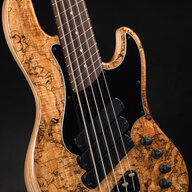
I go out of my way to use the B string (up and down the neck) on my Dingwall. But it has a 37" B string.
I was curious. Do they prefer the wider neck? Do they think the neck extra mass gives them better tone? Do they like the tighter string spacing? I didn't know? But as a bass player, I am interested in why other bass players do the things they do.With so many other issues in the world of music and beyond, I'm puzzled by why someone not using a B string would urge you to ask this question.
Don't worry,...it's hardly the only "issue in the world" that I concern myself with.
A bigger puzzlement would be why someone would use a five string with a high C rather than a low B when most of those "extra" notes are available on the G string. This puzzlement doesn't, however, bring me close to asking why.
LOL,.....and what if I want to play a chord using notes on the C string and the G string?
Typically bass chords are the most usable when using higher notes. As such, the high C string opens up a world of beautiful chording opportunities that are not there without that string.
If you have no interest in chords or soloing, then the high C string would be much less useful.
Last edited:
I don't know if this has been brought up already because I did not read all 18 pages of comments but isn't the player in the first video using his thumb on the B string to fret an E?

I use my low B all the time. When you think about it though, the only “different” notes you’re getting are a low Dflat down to a B. But what makes it really useful is to be able to stay in a position and have the lower string for added notes in a scale pattern.
Other than that, I’m convinced a lot of 5-6 string guys are doing it for the vanity...
;-)
Other than that, I’m convinced a lot of 5-6 string guys are doing it for the vanity...
;-)
I can't go through all these posts and I'm sure someone has said it but I can't resist:
Jaco and Jamerson only needed 4 strings!!!
Carry on!


Jaco and Jamerson only needed 4 strings!!!
Carry on!
Also that argument about it being better to be able to fret a low E than play an open string... I absolutely disagree with that. It almost *never* sounds better to play a fretted E than an open string. Easier? Maybe. But I care about tone way more than I care about ease. But that's also just my opinion.
Funny how different players are,.....I avoid open strings like the plague. Open notes have a much different ring than fretted notes. I only use open strings for those rare times that I really want a note to sustain,...or when I have no other choice (i.e. You need to lowest octave available, or the riff is too difficult without the open string).
Don't think so....he is just muting the B string.I don't know if this has been brought up already because I did not read all 18 pages of comments but isn't the player in the first video using his thumb on the B string to fret an E?

I don't know if this has been brought up already because I did not read all 18 pages of comments but isn't the player in the first video using his thumb on the B string to fret an E?
I resemble that remark. There's another thread running on the topic of hand size - I have huge hands, and can "thumb" my B or E string (whichever is lowest) without putting my hand into an unergonomic position. Your mileage will probably vary, but at times, it's the best way to get all the notes I want. At other times, it's just poor planning - hey, it'd sound cool if I added a low note, but I'm up here already, and to get that note, I need to thumb it.
I use the B string a few ways:
To walk from low D to E.
To occasionally add a low octave to C or D
To play low F while playing A minor at the 5th fret.
I don’t play the B string a lot, but more than the G string.
To walk from low D to E.
To occasionally add a low octave to C or D
To play low F while playing A minor at the 5th fret.
I don’t play the B string a lot, but more than the G string.
Also, I like to own just one good bass. I didn’t want to buy a 4 and a 5.

A couple of years ago I went and traded for a 5 string just so I could use the lower register for one song that we had. It was a hiphop group I was playing for and I needed that low B. There just wasnt any way around it. I didn't ever wanna bring two basses to our smaller gigs so a lot of the time that 5 string was my main squeeze. The main complaint that I had with it was completely throwing away all of my four string muscle memory to let one song shine. Our other songs were a breeze on my 4 string but without the new 5 string muscle memory they were tedious to play. Looking back, I should've nutted up and brought the other bass with me.
That 1 song! Lol
That 1 song! Lol


