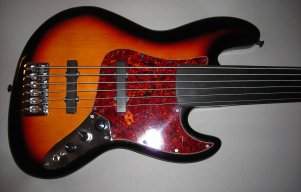
Alternate tunings, different voicing and output level for different genre or style, fretted and fretless. I have 4 and have a different use for all of them.

TalkBass has been independent since 1998. Add your voice.
Create a free account to reply to discussions, view embedded media, and browse with fewer display ads.
Join free Log in
Want zero display ads or expanded classifieds tools? Compare plans.

Well, give me some sound reasons so that I can justify buying another J. I have a Geddy with a DiMarzio Area set.

Well, give me some sound reasons so that I can justify buying another J. I have a Geddy with a DiMarzio Area set.

Well, give me some sound reasons so that I can justify buying another J. I have a Geddy with a DiMarzio Area set.

I know, it's like having two same-shaped girlfriends. Crazy!!!
I was going on a vacation and didn't want to check one of my costly and/or sentimental basses in the airplane cargo so I bought a $250 squire, making my Fender Jazz count 2. This was two weeks ago. [Un]fortunately, the Squier is ridiculously awesome and even at "only" $250, I don't want to lose it. I'm going to have to pick up a real $50 dog next time.
To answer your questions: Now that I have 2 Jazz that sound the same and have the same output, I keep one tuned to Eb, the best key for metal.

That's some mighty fine rationalizing.The more basses you have, the less fretwear you will have to deal with.
At least that's my rationalization.


Lick my love pump if you think D minor is metal!But... but... everyone knows that D minor is the saddest key! \m/

Well, think of it as E flat, flat!Lick my love pump if you think D minor is metal!



"Why do you have mulitiple Jazz basses?"
I would so like to direct this question to Geddy Lee

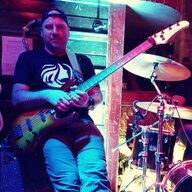
One active, one passive tuned eadg and dgcf.