• TalkBass has been independent since 1998. Add your voice.
    Create a free account to reply to discussions, view embedded media, and browse with fewer display ads.
    Join freeLog in
    Want zero display ads or expanded classifieds tools? Compare plans.

Why do you think there are so few passive 5 strings?

Yeah I think most 5 players are willing to forgo traditional basses and pickup configurations.

That being said, I have a 5 string P bass and a 5 string PJ that sounds just as good in active as it does in passive.
 
Talking about the ill-fated Fender Jazz Bass V, I think the fact this bass was not a hit contributed to the lack of interest for passive fivers.
I remember Roscoe Beck, when talking about his signature bass, saying that a regular Jazz Bass pickup does not sound good with a B which I believe is true. A Jazz Bass V pickup has to be engineered differently than Jazz Bass lV pickup in order to retain more definition on the B string. As a result the instrument does not sound like a Jazz Bass four string on which you just added a B.
I have never really liked a 5 string Fender. The necks feel like a wide plank compared to my ESP LTD and other basses I have played such as Ibanez 5 and Ernie Ball's.
 
  • Like
Reactions: bassbenj
I had a pair of SB-5000 basses for a while. One had Carvin's active/passive preamp and the other was active-only. I ran the former in passive mode 99% of the time. I pulled the preamp out of the latter bass and ran it VVT. The Carvin preamps both had lower midrange bump to them which I suppose made the basses sound better but IMHO they sounded more open and detailed with the preamps out of the circuit.
 
  • Like
Reactions: Frenchy-Lefty
I think you see this effect even more with 6 string basses. The only passive 6 string bass I own is my SX 6ers. And all my 5 string SX are passive too. But of course they are all Fender-style clones even the 6ers. All my other 6ers are active and "modern".

Which brings me to my main axes: 3 G&L L2500 5ers. As you may know they are a bit odd with both active and passive with passive EQ controls (except for the high boost). This allows you to choose between active and passive in actual playing rather than in just a passive as an emergency measure when the battery dies and the EQ with it. The point is that when I first switched to 5 string basses I was all active and was convinced that people saying passive was a special sound were misguided. Now I am enlightened. The G&Ls have proved to me that passive basses do indeed have a certain special "something" to their tone. And the money quote here is that in my playing of the G&L basses I find that I use the passive and active settings about 50-50. Both are useful and both can work well in certain situations. And best of all I don't have to choose between buying an active or passive bass.
my G&L L2500 has a killer B string passive or active neck or bridge or whatever. this is rare to have the B sound great in all combinations.
- a testament to the engineering.
 
  • Like
Reactions: bassbenj
my G&L L2500 has a killer B string passive or active neck or bridge or whatever. this is rare to have the B sound great in all combinations.
- a testament to the engineering.

As people like to say here: Leo got it right!

While it may be true as JimmyM says that people who like 5s also like active. Well I like 5s and I also like active. But not to the point that I ignore passive. As I noted in a previous post, my L2500 sounds great (but different) both ways and I choose active or passive about 50-50. Like them both.

On the other hand my Ken Smith which just has an "emergency" passive mode that kills all EQ never gets used because as Khutch says without the passive tone control it just doesn't do it.
 
I have never really liked a 5 string Fender. The necks feel like a wide plank compared to my ESP LTD and other basses I have played such as Ibanez 5 and Ernie Ball's.

I agree. My fender V neck is my least favorite neck. Most favorite is probably my G&L L2500 Also favorite is the neck on my Squier PJ 5er which is actually much wider than the Jazz. Go figure! Love my thin Ibby necks too so it's not just width or thickness but something about the shape.
 
I have a Warmoth Gecko 5 string I built with an EMG active configuration that is really amazing. Absolutely the best bass I have ever heard or played. I am in the process now of building a Warmoth 5 string Jazz with a passive configuration using Bartolini pickups. The Jazz will be 34" scale the gecko is 35". The Jazz will have round wounds the gecko has flats. if anyone is interested I can post comparisons when I'm done.
 
  • Like
Reactions: Frenchy-Lefty
My only basses are passive 6 strings- Warmoth Gecko fretted and fretless. Both built that way with great pickups (Delano/Villex) and a classic/contemporary sound. They make me very happy. I love active systems, as well- but am happy to save the extra $100 plus (min cost of a good preamp) and apply it on another bass/cab/pedal.

Do what thou wilt- but stay off my lawn!
 
  • Like
Reactions: Frenchy-Lefty
A/P wiring potentially offers the best of both worlds in the right bass. This:

My Ken Smith experience is that passive mode is glorious, and that bass has a ton of distinctive, righteous tone baked right in. Tone, as usual, can be specific-bass/model dependent, hence opposite opinions like this:

I've owned a Ken Smith BT-6 and it was AMAZING in passive mode. I'd love to build a bass around a pair of those pickups- neck thru with pups in that classic "turbo" position.

Also owned a KSD 705 that kicked serious booty passive.

A great bass is a great bass unplugged and pickups/preamps only serve to capture and color to taste.
 
  • Like
Reactions: Frenchy-Lefty
On of the advantages of an active system is the lesser loss of signal through the cable. As a result, even with a transparent preamp, there is a wider frequency spectrum (more extreme lows and highs). So obviously it enthralls the extreme low seeker hence many 5 string bass players.
In my case I often tend to trim those frequencies below 40Hz and above 5kHz so I don't necessarily seek that as I feel it either muddies the lows or gets your bass to disappear in the mix ( extreme highs). But there are different ways to look at things.

Jonas Hellborg (extreme bass player/audio freak) now uses passive basses with low-impedance pickups and cables (XLR cable) which actually resolves this signal loss issue. I find this very interesting.
IMO low-impedance pickups are the best thing since slice bread but don't become more widespread as it requires to have an amp with an XLR input.
 
Last edited:
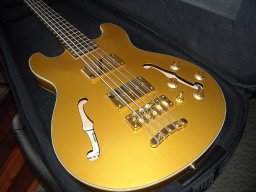
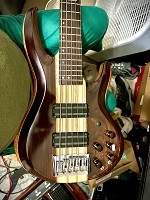
image.jpeg
My PJ is passive - I typically just run Vol -Vol, but I added a tone on this one so that I'd have flexibility with control options in case I felt the need to add a preamp - I don't. Tone is big, clear, and warm down to Bb. I'm running 500k volumes and a 250k tone - plenty of clarity. Just like with a four string, it's all about getting the right pickups, strings, and a proper setup.
 
Last edited:
  • Like
Reactions: Frenchy-Lefty

Yes, I have major GAS for one of those.

Anyway, I think active electronics match well with fivers because a well-matched preamp can provide good control over potentially unruly lows from a B string. The preamps in amplifiers aren't engineered for specific basses, but the preamps in active basses can be.

I think the pre in my G&L M-2500 works extremely well, but I would like a passive mode and passive treble control to have more traditional tones available.