• TalkBass has been independent since 1998. Add your voice.
    Create a free account to reply to discussions, view embedded media, and browse with fewer display ads.
    Join freeLog in
    Want zero display ads or expanded classifieds tools? Compare plans.

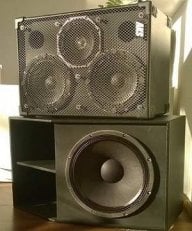
Why does putting the cab on the floor make it sound so huge?

With using two seperate cabs, you have a lot more net internal volume than with two speakers in one small cab. Will drastically change the low end.

Also true. I don't know how much the OP wants to disassemble his cabs but you can throw chunks of styrofoam in there to take up space. Of course that would alter the port tuning as well. Can also use stuff to plug ports, etc.
 
Others know more about this than me but...

I always thought it was about low frequencies being less directional than higher frequencies. This is why you can always hear bass booming from a club or bar from some distance even though it isn't that loud.

If that's right then it is more about the cab being low down than the fact it is on the floor. Lie down in front of the lower cab and it might not sound as boomy.

Feel free to contradict me if that is just plain wrong.

On the right track....

It's about the speaker being close enough to the boumdry to get inside a 1/4 wavelength in the non-directional low frequencies. Generally somewhere around 2 feet.
 
I don't see anyone addressing the sensitivity differences, so--

1) A sealed cab gives up a lot below 200hz on the average vs. a ported cab, and a lot of the meat of bass guitar is from 80-200hz, so it follows that it wouldn't seem as loud.

2) The 4x10 might have just flat out less efficient woofers

3) The impedance could be different (if the 4x10 is 8 ohms and the 2x10 is 4 ohms, the latter would sound a lot louder up until distortion sets in)
 
Good points from rspands. Also, the mids/highs from the bottom cab will be hitting you in the knees instead of the ears and there'll be a floor boumce/reflection thing happening too. Try laying a rug in front of the stack.
 
When a cabinet is placed at a room boundary, be it a wall or floor, you get two effects. One is that you eliminate cancellation that occurs when a wave reflected off the floor arrive back out of phase withe the direct wave. In addition, every room has a number of natural resonances, and the nodes of these resonances occur at room boundaries. Thus placement near boundaries makes it easier for the speaker to excite the resonances.

Both these things happen but this description talks around the core phenomena in the first case and in the second case sorta changes the subject of the question...

Reflection of the signal off room boundaries occurs no matter where you place your cab - and they may or may not cancel a particular frequency range depending on the difference in path length - they are just as likely to act make the signal louder as cause cancellation for any given randomly chosen location and frequency. Putting the speaker against one boundary will remove the first reflection artifacts in that case but may well cause an increase in the disturbances [perhaps both additive and subtractive] in the case of other boundary reflections.

As to the 2nd point, room modes* don't make the original signal louder to the listener - they are something that happens later = you get more excitation of the room's reverb field. More room mode means you get more rumble but that doesn't add to the initial bang.

*if the room is very small [like your car] you get appreciable "cabin gain" but that's a different horse.

The reason the cab gets louder in the lows when placed against a boundary is because lows propagate omnidirectionally - like a giant ball - UNLESS THEY CAN'T.

When placed against a boundary [like say an infinitely large floor] then the speaker's propagation is constrained... now instead of the energy spreading out to fill a sphere it spreads out to fill a half sphere = same amount of energy spread over half the surface area.

This intensifies if you place the cab against more boundaries [a corner or even more so in a tri-corner where three boundaries intersect].

If you place two subs in a room with highly reflective walls: one on the floor in a corner, and the other an equal distance away from you but hanging from a chain - you get a giant bass boost out of the one in the tri-corner because instead of propagating spherically to fill the room, and bounce around, the coupled boundaries force the "corner loaded" sub to propagate a coherent initial wave front in a much more directional pattern [its coming right at ya!]. The room's boundaries are acting like the flanges of a horn.

This doesn't happen enough to be worth speaking of with mids and tweets because they are already highly directional.
 
Soloing one cab on top leaves the bottom one sponging up bass also.

Manipulatiion of your sound with cab placement is sorely underappreciated. Depending on the depth of your cab you can kill your low E by pulling the cab out from the wall 1 to 2 ft. Handy if low E is making your DB feed back, generally not good for reggae.
 
If the floor is hollow, all kinds of weirdness can happen. I have been on a hollow stage and had my amp sound like it was drowning in a toilet. Blocking it up or putting a pad under it to decouple it from the stage floor solved the problem. It is just another variable.
 
I don't see anyone addressing the sensitivity differences, so--

1) A sealed cab gives up a lot below 200hz on the average vs. a ported cab, and a lot of the meat of bass guitar is from 80-200hz, so it follows that it wouldn't seem as loud.

2) The 4x10 might have just flat out less efficient woofers

3) The impedance could be different (if the 4x10 is 8 ohms and the 2x10 is 4 ohms, the latter would sound a lot louder up until distortion sets in)
Let me try to hit a few of these replies to help move the discussion forward.

Both cabs have the exact same part number as far as speakers go. Both cabs are 4ohms.
 
The reason the cab gets louder in the lows when placed against a boundary is because lows propagate omnidirectionally - like a giant ball - UNLESS THEY CAN'T.

Correct.
The giant ball is 4*pi(whole sphere), half the ball is 2*pi(half sphere), etc.

When placing a cab near a boundary (floor, wall, ect) the frequency at which the transition form 4*pi -->2*pi starts to happen, lowers. This will make your cab sound more beefy ;)

In theory you'll get an increase of 6dB when going from 4*pi to 2*pi (put the cab on the floor).
You can gain another 6dB when you place it on the floor AND near a wall (a quarter sphere). Another 6dB when placed on the floor AND in a corner (1/8th sphere) :smug:
 
Wow ... excellent discussion, folks! I hope it keeps some momentum for a bit. I, for one, have already learned a lot from the wisdom and experience shared here by many. Thank you all.

Let me try to hit a few of these replies to help move the discussion forward.

1.) Ported 210 vs Sealed 410 SPL differences:

I don't see anyone addressing the sensitivity differences, so--

1) A sealed cab gives up a lot below 200hz on the average vs. a ported cab, and a lot of the meat of bass guitar is from 80-200hz, so it follows that it wouldn't seem as loud.

2) The 4x10 might have just flat out less efficient woofers

3) The impedance could be different (if the 4x10 is 8 ohms and the 2x10 is 4 ohms, the latter would sound a lot louder up until distortion sets in)

Both cabs have the exact same part number as far as speakers go. And as I eluded to in the opening post, both cabs are 4ohms. I have tried swapping cables, swapping amp channels, swapping every conceivable combination possible, the results are ALWAYS the same ..... the 210 is just plain old LOUDER than the 410. As metioned the 210 is shelf ported and the 410 is totally sealed. But both cabs use the only 10 inch speaker Carvin offers.

2.) Speaker Placement and the OddBall Idea:

With using two seperate cabs, you have a lot more net internal volume than with two speakers in one small cab. Will drastically change the low end.

My description of the experimental idea was just a mental diagram. If I were to actually try this out, it would be using two separaate cabs. To me, it is only obvious they'd have to be separate in the prototyping stage if for no other reason to simplify changes and refine tuning. However should this turn into some type of production situation, it's impossible to say how it would end up. It could go either way .. two spearate cabs or one larger cab with two chambers sealed off from one another. But that type of thinking is really putting the cart in front of the horse at this time. Right now I don't even know if the main concept is even viable.

What sortof inspired me was that situation where I was standing next to my bass cabs (no matter whether the 210 was on top, or on bottom) and I heard what I heard (It sounds SO GOOD that I usally play standing right there anymore). The other thing that piled on top of the inspiration is my experience as a Hammond player. The Leslie cab has the woofer facing straight down. It is housed in it's own sealed up downward ported cab. The low end may be evenly heard anywhere in the room (it should also be noted that stock Leslies use an 800hz crossover network, with everything below 800hz going to the woofer. However many Hammond players will have their Leslies modified so the woofer is producing full-range). The woofer's output is open on all four sides of the cab. Yes, there is a rotary ~drum~ below the woofer, but many Hammond players either have it removed or simply run it "braked" so it is not rotating.

The upper cab has the famous rotary horn that spreads everything from 800hz on up around and around in a 360 degree pattern. The upper cab is open on 3 sides BUT most Hammond players will remove the rear baffle board so that the upper horn is releasing sound in a full circle.

So, combining those two experiences (1. - Leslie use and 2. - the standing next to my bass cab thing) I began thinking about a bass cab setup that is designed on the principle of facing the low end straight down (but not a totally necessary thing) and facing a secondary cab straight up with the sound hitting a flat surface to spread the upper stuff in a more radiant pattern rather than straight forward. Perhaps a 15 inch on the bottom and a 10 or pair of 10s facing upward.

The "deflector board" (for lack of a more refined term) on the top would start out as a simple flat piece. But I can see it developing into a sortof shaped inverted cone, much like the base of an art-deco lamp or designer chair or something.

I was thinking to start out, just to experiment with it, of facing perhaps my 2x10 downward for the bottom section, and maybe using a little practice bass amp (Line 6 or whatever) .. maybe like a 1x10 or something of that nature .. as the upper facing cab. The use of two separate cabs on two separate amplifier feeds would permit a LOT of tuning and tweaking ability. I'm guessing that the distance between the face of the speaker cones and the "deflectors" would have great affect on how it all sounds and works. I'm also guessing that using two amp feeds with individual processing is a must as well.

The whole idea may be a large bag of crap, and then again ..... perhaps not. Thomas Edison made 2,000 attempts at making a working lightbulb, and in his estimation he did not have 2,000 failures, but in fact learned of 2,000 ways "how not to build a light bulb". I suppose things like this are all about the attitude one assumes.

I have a rather extensive processing setup, a couple of Mackie FR1400i amps, a few guitar amps (some rather small), several (many?) EQs/processors, and a pretty cool modular synth based parallel processing system that allows me to process up to 8 separate channels in parallel with one another. I also have a Leslie (that .. ironically ... someone along the way installed a 15 inch speaker from an very old Ampeg B15 in as the lower woofer). So I have ~some~ of what it MIGHT take to try out some of these goofy ideas.

On a side note, I just took delivery about two weeks ago of an Alesis DEQ830 ... 8 channels of 31 band EQ per preset, and 100 presets! Each EQ channel has it's own separate 1/4 inch I/O jacks as well. It's easily the most powerful EQ I have ever owned as far as ability to process. It also has full-on ADAT I/O as well as full midi control over program changes. All in 1U of rack space.

So anyhow ... these replies should cover the two largest looming questions that address the two paths this thread has taken.

It's after 2am in my part of the world, I was unable to participate in the discussion earlier due to probaably the worst sinus headache I have ever had in my entire 52 year life (we have had 50mph winds all day, maybe that has something to do with it). So anyhow I am only now getting around to participating. I don't expect much in the manner of forward motion for the rest of the night, so I expect I'll ~bump~ the thread sometime after Sunup. After which I need to leave again to go to the hospital all day for some testing (600 mile round trip to the VA hospital) so I'll not be able to participate again. Dang me! Great GREAT conversation so far, I wish I could be here to move it forward. Oh well, maybe I can start another one when I get back if this one craps out.

Thanks again. (Let me take one more look to see if I missed anyone's posts that need me to reply right away).

Best wishes, Hasta Lasagne! :hyper:
 
Correct.
The giant ball is 4*pi(whole sphere), half the ball is 2*pi(half sphere), etc.

When placing a cab near a boundary (floor, wall, ect) the frequency at which the transition form 4*pi -->2*pi starts to happen, lowers. This will make your cab sound more beefy ;)

In theory you'll get an increase of 6dB when going from 4*pi to 2*pi (put the cab on the floor).
You can gain another 6dB when you place it on the floor AND near a wall (a quarter sphere). Another 6dB when placed on the floor AND in a corner (1/8th sphere) :smug:
This is great stuff ....

I might ask someone to qualify what "near" a wall means? 1 foot, 4 feet. 6 inches?
 
"Near" is close enough to avoid 1/4 wavelength reflections being out of phase with the direct wave. If you consider 100 hz as the limit of omni directional bass that is 2.8 ft from the wall to the woofer. The further out you go from the wall the lower the frequency that is worst affected.

Your rotational cab sounds like a disaster btw.
 
to adress the issue with the 2x10 being louder:
To my understanding, the 2x10 speakers do have to
work a lot more when exposed to the same ammount of power
than the 4x10 speakers - because they are more. So, roughly, the
2x10 speakers get double the watts to share between them, thus, moving a lot more to convert the electrical power into movement and warmth. So, the 2x10 will produce a lot more volume in the higher frequencies while the 4x10 will move more air which will result in more lowend. Due to the nature of our Ear, we will percieve the 2x10 to be a lot louder in these circumstances.
I'm no engineer, but that's what my toneguy told me and it sounds reasonable.
 
Kllipschorn

I've often daydreamed about a ported bass cab that had one driver facing straight down, about a foot from a base board, with four open sides where the air can radiate in all directions. ...

It seems as though something like that (properly tuned) would eliminate focal hot spots (or unfocused dull spots), and even the drummer would hear what the audience hears.
 
If the floor is hollow, all kinds of weirdness can happen. I have been on a hollow stage and had my amp sound like it was drowning in a toilet. Blocking it up or putting a pad under it to decouple it from the stage floor solved the problem. It is just another variable.

There ya go. Your close. Not to negate the science the of modern cab design but the old timers who usually played on wood risers or stages knew how to use the stage. Ever seen cabs laid on there side so that it will contact more of the stage?

I went to see a local blues guy play when I was a kid at a joint in Leland Mississippi(Delta). This was in 76 and this guy was over 80 years old. He walked out and the mike and a chair were in the center of this stage but when he got to it he kind of stomped the stage with his right foot while walking in a circle. Once he found a spot that resonated like he wanted he slid the chair and mic over, sat down placed his brown liquor bottle on his left stomped out one, two, three, on that booming stage floor and began to wail. Just him and acoustic guitar and that stage floor. I got a chance to talk to him later that night about the floor and he said (his words) " Boy dat stage ain't nothin but a big ole bass drum, you gots to find the middle of those joisties where thar ain't no crossblockin. Ifn a man gonna build a stage right, them joisties gots to be running at the crowd not side to side"

So to this day I'm no casters and if it is wood I find the spot. Unless those joists run horizontal to the crowd or I'm on metal or concrete then I use an isolation pad. If you sounded like you were in a toilet my guess would be you were on a stage where joist ran horizontal from where you were standing or you were on a cross block between the joists. Or maybe the stage was built with too many cross blocks that muddy the sound.
 
to adress the issue with the 2x10 being louder:
To my understanding, the 2x10 speakers do have to
work a lot more when exposed to the same ammount of power
than the 4x10 speakers - because they are more. So, roughly, the
2x10 speakers get double the watts to share between them, thus, moving a lot more to convert the electrical power into movement and warmth. So, the 2x10 will produce a lot more volume in the higher frequencies while the 4x10 will move more air which will result in more lowend. Due to the nature of our Ear, we will percieve the 2x10 to be a lot louder in these circumstances.
I'm no engineer, but that's what my toneguy told me and it sounds reasonable.
Well, first off ... the 2x10 produces a LOT more low end than the 4x10. But I write that off on the shelf ports. In facy I bought the 410 with the idea of shoring up the midrange.

But I'm not sure I agree with the idea you're presenting about how the 2x10 is getting double the watts. For both cabs to ~sound~ roughly the same the channel with the 210 has to have about 25% less power output than the 410 channel does. Since both are 4ohm cabs it's just not adding up quite right in my "groggy" head right now.

Let me throw this out there .....

Doesn't the fact that the 210 (being a shelf ported cab) allow for a lot more air to move towards my ears as the cones are "pumping" air out of the cab on both directions of movement (sound is coming out whether the cone is moving outward, or inward). In effect sortof near double the volume of air that the cab produces?

Or ... is it that the cones are allowed to move more freely (as in with great excursion) because the air in the cab can move both in and out, allowing it to "breathe" and allowing the cones to move with less restriction? (I've always prefered ported cabs, ever since I had my Ampeg 610HLF .. which is a ported 6x10. That thing was an animal, but at 115 pounds it was too much for me to deal with especially since I stopped playing in a band 4 nights per week for 5 years straight -- we once played 15 nights in a solid row, 3 sets per night -- -all of us had day jobs too!)

Anyhow, war stories aside ... Obviously my ignorance about cab and speaker stuffs is showing, so take that into consideration when anyone replies.
 
There ya go. Your close. Not to negate the science the of modern cab design but the old timers who usually played on wood risers or stages knew how to use the stage. Ever seen cabs laid on there side so that it will contact more of the stage?

I went to see a local blues guy play when I was a kid at a joint in Leland Mississippi(Delta). This was in 76 and this guy was over 80 years old. He walked out and the mike and a chair were in the center of this stage but when he got to it he kind of stomped the stage with his right foot while walking in a circle. Once he found a spot that resonated like he wanted he slid the chair and mic over, sat down placed his brown liquor bottle on his left stomped out one, two, three, on that booming stage floor and began to wail. Just him and acoustic guitar and that stage floor. I got a chance to talk to him later that night about the floor and he said (his words) " Boy dat stage ain't nothin but a big ole bass drum, you gots to find the middle of those joisties where thar ain't no crossblockin. Ifn a man gonna build a stage right, them joisties gots to be running at the crowd not side to side"

So to this day I'm no casters and if it is wood I find the spot. Unless those joists run horizontal to the crowd or I'm on metal or concrete then I use an isolation pad. If you sounded like you were in a toilet my guess would be you were on a stage where joist ran horizontal from where you were standing or you were on a cross block between the joists. Or maybe the stage was built with too many cross blocks that muddy the sound.

Well, I live in a double-wide mobile home. It's got a wooden floor with a steel frame, and dozens upon dozens of jackstands beneathe it that each sit on little cement foundations of their own. The bottom of the house is roughly two feet above the Earth, but the house sits over basically a hole that was dug beneathe it so the home sits at street level. Cement driveways surround all four wides, with 4ft-x-4ft covered access holes, one on each side of the home, so it looks like a regular "house". The cabs sit on the carpeted (with padding under the carpet) floor. If I set up the EQ just right, the entire 1700 sq/ft home turns into a speaker cone. A 1700 sq/ft ported speaker cab .. heheh :)

So, doesn't the padded carpeting decouple enough or will those cab pad products actually do anything more?

And FYI --- Our ceilings are also multi-angled and all of them have that lunar-surface looking acoustic spooge. The studio is 25ft x 25 ft --- basically our entire home has been converted into a recording and jam studio that happens to have two bathrooms and two bedrooms and a kitchen, every room has recording/playing gear in it, and there's alsoa 10x15 soldering bench area. The main studio (where my bass rig is located) has floor length drapes, several fully stuffed bookshelves (mostly engineering, fabrication, math, music related stuff) a few overstuffed chairs, and the room is plotted full of Hammonds, Rhodes pianos, speaker cabs, and so on. Bascially your normal 25 x 25 studio. There are almost no 90 degree corners that do not have something in them (bookshelves, cabs, something) to break up the corners. And as I said the ceilings are all "cathedral" pitched ceilings .. so nearly no hard right angles anywhere.

Just sayin', in the event any of that makes any difference.