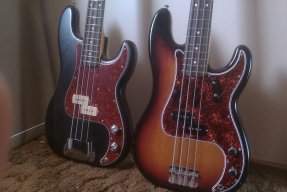
Began on a standard P style bass and it is what I came to know as my foundation, for scale, tone, ergonomics, etc. Tried to deviate with short/medium scales, more frets, different shapes, etc. I ALWAYS come back to a P style bass for everything and I quit fighting it after twenty years. Short scales just seem to be less in most categories for me. As others have said on here, there's just something that doesn't feel right and the tones seem less colorful to me. I have small hands too, but I'll take a 34" any day. I like the space on the neck.

Enjoy the benefits of a premium membership!
Upgrade Account
-
TalkBass has been independent since 1998. Add your voice.
Create a free account to reply to discussions, view embedded media, and browse with fewer display ads.
Join free Log in
Want zero display ads or expanded classifieds tools? Compare plans.
You are using an out of date browser. It may not display this or other websites correctly.
You should upgrade or use an alternative browser.
You should upgrade or use an alternative browser.
Why DON'T you play a short-scale?
- Thread starter topo morto
- Start date
More options
Who Replied?
My left hand is jacked up from work related injuries. I wonder if a short scale would be easierto deal with than my trusty Precision?

I dont get why some people act like a short scale bass is so much better for chops. Most solos are usually happening above the 7th fret or so where fret distance is not really an issue.
Also you can go high on the neck and the frets are not right up against each other like a guitar.
Plus I like the option of a 5 string.
Also you can go high on the neck and the frets are not right up against each other like a guitar.
Plus I like the option of a 5 string.
I dont get why some people act like a short scale bass is so much better for chops. Most solos are usually happening above the 7th fret or so where fret distance is not really an issue.
Also you can go high on the neck and the frets are not right up against each other like a guitar.
Personally I have little interest in bass playing that isn't focused on the bottom octave of the instrument's range - so what I want is comfort (always) and speed (if necessary) in that range, and also is I do go high up, the ability to get back down there quickly!
If you want to be up high for the most part, then sure, there's probably no advantage in a short scale.
If I may ask,
- can you play the riff to 'when I saw her standing there' starting on fret 2 of the D string as easily as starting on fret 7 of the A string?
That's a given, but it can also be a slow process, hence an exchange of ideas can be useful.
I don't know the riff so I can't say. The spacing between the first and second frets on a 34 is slightly less than a quarter inch different from a 30. Is that really a huge difference to you? Most of the frets on a 30 are spaced the same as on a 34 two frets closer to the bridge. I just don't see any big difference here. Of course I do tune in fifths and since that forces you to move your hand more I really don't care how far apart the frets are. I don't stretch to reach a fret, ever.
And maybe it is more technique than anything else. On a short scale you may not have to move your hand to play most things. But people with no wider finger span than you, I am sure, play a 43 inch double bass quite well. Mine is 5.75, btw. If you cannot reach a note without moving you just move. People who tune their double basses in fifths often speak of "pivoting" on their thumbs. I think that by that they mean they keep their thumb in one place on the back of the neck as much as possible while their fingers move up and down the neck to reach notes. I honestly do not know if I do that or not.
I wasn't trying to squelch the exchange of ideas. I was just suggesting that we put the control rods back in the reactor before it melts down. It is a problem some were having more than others.
Cool! Although cello scale length is 27 and a half inches typically. So the comparison is curious to me.
You might assume that since a bass is tuned about an octave below a cello it should have twice the scale length to sound similar. That would put it at 54 inches and 38 is closer to 54 than either 34 or 30.
Ken

Personally I have little interest in bass playing that isn't focused on the bottom octave of the instrument's range - so what I want is comfort (always) and speed (if necessary) in that range, and also is I do go high up, the ability to get back down there quickly!
If you want to be up high for the most part, then sure, there's probably no advantage in a short scale.
This is where five strings confuse the picture even more. I find on a 5er I'm more likely to be playing across the neck around the 5th fret or higher, so the amount of stretch required is reduced compared to playing everything in the lowest positions.
I use the full range of my 5-string and find that 34" gives me a good balance of comfort and tone from open B to 24th-fret G. Maybe a short-scale would - I haven't given one more than a few minutes of play - but I don't have a burning desire (or the funds) to change.

I actually like how the high B and E sound on my 32" scale fretless, which was why I ordered the bass at that scale length.
So, that means you tune BEADGBE - never played anything over 6 strings myself, and with guitar tuning that must be pretty cool.
I think 32" is a great scale length. Killer tone, easier on the fingers even if you have monster "chops" - and dead spots are pretty rare or non-existant at that length.
Killer looking bass.
Personally I have little interest in bass playing that isn't focused on the bottom octave of the instrument's range - so what I want is comfort (always) and speed (if necessary) in that range, and also is I do go high up, the ability to get back down there quickly!
If you want to be up high for the most part, then sure, there's probably no advantage in a short scale.
Agree. One of the guys here was saying in another thread that you have better chops with short scale. I can see that in a way. Kind of like when you go from a telecaster to a les paul. The les paul is a little easier, but its a PITA to play in the upper register..no space between the frets. If you are more of a rhythm player, that does not matter - like you are saying.
He insinuated that everyone should play short scale and that people that don't are clueless..something derogatory. To me that was a sign of ignorance, or just an ego comment.
The sweet spot on a 5 string bass really to me is the 5-9 fret area. It is where you can do so much with a lot of clarity. Very motown style in a way. Key of G is easy and clearer..etc.
So for many people, it can be a disadvantage to play short scale necks.
I am open minded..if I find something I like, I try it. I don't judge people for their choice.
I do not believe you need large hands to play a 34 or 35 scale. If that was the case, I would be screwed. You just need developed left hand technique and you need to have proper intonation - meaning you use the tips of your fingers to intonate, anchor properly with your thumb, and are properly bending your fingers with a good angle to the fretboard.
I don't know the riff so I can't say. The spacing between the first and second frets on a 34 is slightly less than a quarter inch different from a 30. Is that really a huge difference to you?
Ken
Yes. I fully realize it shouldn't make that much difference but it does. The same way you would notice if you cut a board 1/4" too short for a deck. It may still work but you notice it every time you walk on it.
I don't know the riff so I can't say. The spacing between the first and second frets on a 34 is slightly less than a quarter inch different from a 30. Is that really a huge difference to you? Most of the frets on a 30 are spaced the same as on a 34 two frets closer to the bridge. I just don't see any big difference here. Of course I do tune in fifths and since that forces you to move your hand more I really don't care how far apart the frets are. I don't stretch to reach a fret, ever.
To hold fret 1 and fret 4 on a 30", is a distance of about 3 3/4 inches. on the 34", it's about 4.5 inches. That is the difference between me having to move my hand about half an inch, and not having to move it at all, which makes a big difference when it comes to getting my next finger in position. (Thinking of it that way, the difference = 0.5/0 = infinity!)
Of course that kind of fingering isn't what I do all the time (ahem) but it's still useful. From another thread I've realised that my handspan is a little small, so for some people the 34 may be as easy as the 30 is for me.
EDIT: if you don't know the riff, it will take you approximately 0.0026 seconds to find the song on the net... Beatles innit!
And maybe it is more technique than anything else. On a short scale you may not have to move your hand to play most things. But people with no wider finger span than you, I am sure, play a 43 inch double bass quite well. Mine is 5.75, btw. If you cannot reach a note without moving you just move. People who tune their double basses in fifths often speak of "pivoting" on their thumbs. I think that by that they mean they keep their thumb in one place on the back of the neck as much as possible while their fingers move up and down the neck to reach notes. I honestly do not know if I do that or not.
All true, (I did play upright for a while). I guess for me, somewhere between 34 and 30 there's just a jump in how easy life is down at the bottom of the fretboard.
This is where five strings confuse the picture even more. I find on a 5er I'm more likely to be playing across the neck around the 5th fret or higher, so the amount of stretch required is reduced compared to playing everything in the lowest positions.
I use the full range of my 5-string and find that 34" gives me a good balance of comfort and tone from open B to 24th-fret G. Maybe a short-scale would - I haven't given one more than a few minutes of play - but I don't have a burning desire (or the funds) to change.
I've suggested a 5 as an alternative to a shorty before for this reason. A shorty 4 has the advantages of easier muting and probably being smaller/lighter. The 5 has the advantage of the low B-D and the additional range without moving up/down the neck.

Im actually considering going all shorty right now
What shorties are you considering?

"Why DON'T you play a short-scale?"
Because I've never seen one and I don't think any of the brands I like make an off the shelf model that is 30" scale.
Because I've never seen one and I don't think any of the brands I like make an off the shelf model that is 30" scale.
EDIT: if you don't know the riff, it will take you approximately 0.0026 seconds to find the song on the net... Beatles innit!
I am sure you are right but since I tune in fifths I think the riff will be of no value in answering your questions. I won't finger it anything like you do. I paid a lot of attention to how cellists finger passages both before and after I switched to fifths. They can cover a lot of ground from a single hand position by jumping from string to string to string. When they have to move however, it is often a sizable jump. And they just do it quickly and effortlessly. That is what encouraged me to try and stick with tuning in fifths even on the longer scale. And over the last year moving to reach a note has just become second nature. The only time I really need to stretch to cover multiple frets is when I chord. I don't do that a lot and when I do I stay well down the neck. I still give some thought to getting a 30 inch bass VI for when I really want to chord but in fact a 34 inch five string does that so well that the bass VI urge is starting to fade a little bit.
Ken
I am sure you are right but since I tune in fifths I think the riff will be of no value in answering your questions. I won't finger it anything like you do. I paid a lot of attention to how cellists finger passages both before and after I switched to fifths. They can cover a lot of ground from a single hand position by jumping from string to string to string. When they have to move however, it is often a sizable jump. And they just do it quickly and effortlessly. That is what encouraged me to try and stick with tuning in fifths even on the longer scale. And over the last year moving to reach a note has just become second nature. The only time I really need to stretch to cover multiple frets is when I chord. I don't do that a lot and when I do I stay well down the neck. I still give some thought to getting a 30 inch bass VI for when I really want to chord but in fact a 34 inch five string does that so well that the bass VI urge is starting to fade a little bit.
Ken
Maybe I should try fifths - I love me a 5add9 chord! isn't it trickier to reach thirds though? or do you usually play the 3rd an octave up?
Maybe tritone tuning could be a good compromise...
"Why DON'T you play a short-scale?"
Because I've never seen one and I don't think any of the brands I like make an off the shelf model that is 30" scale.
What are the brands you like?
What shorties are you considering?
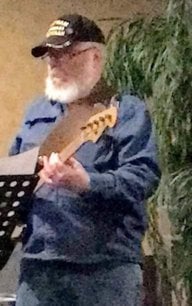
I already have a Pawnshop Mustang. I'll either add a Squier VM Mustang or an Epiphone Allen Woody. Assuming I can find a Woody to try.
I play a 69 Mustang, a Classic Fender Japan Mustang and a Gibson SG Reissue. I play them because they are light, easy on the shoulder, easy to carry and are fun to play. Mate any one of them with a Micro Bass amp and you have one small, easy to transport set up.


