• TalkBass has been independent since 1998. Add your voice.
    Create a free account to reply to discussions, view embedded media, and browse with fewer display ads.
    Join freeLog in
    Want zero display ads or expanded classifieds tools? Compare plans.

Why DON'T you play a short-scale?

This thread is becoming reminiscent of the twilight zone. The lack of knowledge here is stunning. The 'Tweed' line of amplification in the early 50's is a golden standard that many companies are still chasing to this very day. Plenty of experts will tell you that those hand wired amps still sound better than anything being put out today. Companies like Victoria go so far as to even making these brand new amps look like the ones from the 50s. British amp platforms like Vox and Marshall were derived from these amps as well.

Not only that but the original amps themselves are as important now as they have ever been with the advent of large in-house PA/sound and mic systems. Many top musicians are now able to use the amps they grew up on from the 50s right on stage. The players loved the way these amps sounded and are happy to keep them maintained so they can be used on stage. Even sound from a little 5w Fender Champ can now fill a concert hall. And they are doing it all the time.

Oh, and speaking about checking a book in a library once, I don't have to go very far. I am a music and instrument historian (I do appraisals). I have about $5000 invested in books, DVDs and other media of this nature, its a must.

The whole point about amplification is mute anyway, it has almost nothing to do with the topic in this thread.

Congrats on your career. That being said, you've haven't proved a thing. You've talked about Tweed guitar amps(the fact that older players love the amps they grew up with is not shocking) and p-basses and everything else but I haven't seen anything to show me where a 30 or 32" is inferior to a longer bass. Especially in the modern era. I will concede that in the early days it was easier to build and play a 34" that sounded good.

 
Congrats on your career. That being said, you've haven't proved a thing. You've talked about Tweed guitar amps(the fact that older players love the amps they grew up with is not shocking) and p-basses and everything else but I haven't seen anything to show me where a 30 or 32" is inferior to a longer bass. Especially in the modern era. I will concede that in the early days it was easier to build and play a 34" that sounded good.

This post had nothing to do with the whole short scale topic. You said there was no good amplification. I presented an argument that debunked that. The fact that MOST short scales cannot produce notes as articulate and rich as long scale basses has already been proven and put to rest.
You use deflection and misdirection to try to defend your points.
Changing topics, cherry picking a single statement from a post and redirecting the focus of the conversation.
Very much like my Ex. Too creepy in here now. I won't be back to bother ya. Best of luck.
 
It is simple physics.

Given the same strings, the shorter scale tuned to the same note produces less harmonics.

Put a thicker string on that short scale (and thusly increasing the tension to bring it back up to tune) and the harmonics come back.

For really thumpy fundamental tone, you can't beat a short scale.
 
This post had nothing to do with the whole short scale topic. You said there was no good amplification. I presented an argument that debunked that. The fact that MOST short scales cannot produce notes as articulate and rich as long scale basses has already been proven and put to rest.
You use deflection and misdirection to try to defend your points.
Changing topics, cherry picking a single statement from a post and redirecting the focus of the conversation.
Very much like my Ex. Too creepy in here now. I won't be back to bother ya. Best of luck.

I can see why she left. Again, you have proved nothing. You brought up old guitar amps as proof of good amplification. I very much doubt they were as good as a modern bass amp. And I believe that is relevant as to why 34's sounded better back then. So good riddance if you want to throw a fit and go away.
 
I can see why she left. Again, you have proved nothing. You brought up old guitar amps as proof of good amplification. I very much doubt they were as good as a modern bass amp. And I believe that is relevant as to why 34's sounded better back then. So good riddance if you want to throw a fit and go away.

What the heck are you guys fighting about?

Just wrote a song on my 30, practiced the heck out of it on my 34, and did the final recording with a 32.

They were all the best.
 
The fret spacing on a 30 is the same as the spacing 2 frets lower on a 34.

This is the best answer to the OP's question. Most of us have absolutely no trouble at all playing the top two frets on a long scale bass. For us there simply is no reason to play a short scale. My first bass, which I still own, was a short scale. If there were any reason at all why the short scale was superior, for me, then surely I of all people would know that. But it is not superior, for me, it is just meh, for me. If it's the cat's pajamas for you then I am delighted that there are many fine short scale basses on the market for you to choose from. So why don't we all just agree that we are all capable of choosing the best bass for our own personal needs and tastes and get back to making music!?

Ken
 
I play 30" and 32" scale basses. I started out on a 34" Squier Jazz Bass, but I strained my fingers from playing the kinds of things I wanted to play on it, which didn't change after almost a year of playing, so I moved down to a 30" Squier Mustang Bass and I had also acquired a 32" Ibanez AEB5E acoustic bass a few months prior to that. Had the Squier Vintage Modified Telecaster Bass been available at the time I upgraded, I probably would have gotten that over the Mustang Bass (not that I don't like the Mustang)
 
Why DON'T you play a short-scale?

--------------------------------------------------------------------------------

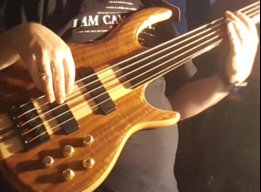
I play 5 string basses.

cb7.jpg


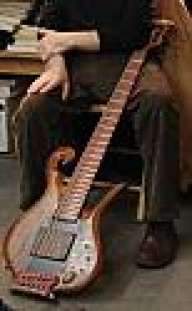
Cliff Bordwell's 32" scale 5+ string basses do not disappoint. Sure, they only qualify as medium scale, but they're great.
 
I can see why she left. Again, you have proved nothing. You brought up old guitar amps as proof of good amplification. I very much doubt they were as good as a modern bass amp. And I believe that is relevant as to why 34's sounded better back then. So good riddance if you want to throw a fit and go away.

SHE left did she? How do you know that. How do you even know if I am a she or she is a he. Did I throw I fit? Wow. Just wow. 34" back then is no different than a 34" now. Isnt there a training wheels forum so that folks like you can practice before getting over your head. Got a plane to catch.... again, good luck. Peace.
 
Although I own short scale and medium scale basses... I also own this 38" Monster.


100_3055.jpg


There's a fundamental that you don't get from a shorter scale instrument. I really appreciate the extra length on the high C- it's not a fat, mushy bass sound, but rather a big, open, piano sound that almost feels cello-like.

Different tools for different jobs IMO.
 
Although I own short scale and medium scale basses... I also own this 38" Monster.


100_3055.jpg


There's a fundamental that you don't get from a shorter scale instrument. I really appreciate the extra length on the high C- it's not a fat, mushy bass sound, but rather a big, open, piano sound that almost feels cello-like.

Different tools for different jobs IMO.

Cool! Although cello scale length is 27 and a half inches typically. So the comparison is curious to me.

It must sound amazing but how long is it from nut to first fret?

And are those knobs from a boss stomp box?? Beautiful bass no matter...
 
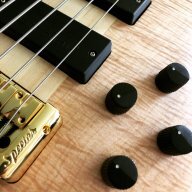
The knobs are Pink Ivory, colobolo, and ebony.

CIMG4640.jpg


I haven't measured the distance from the nut to the first fret, but I'm not sure how it matters really... I can understand how the distance from first to second fret would matter, but you don't fret at the nut so it won't change playability between the 1st and open, catch my drift?

I think the extra string length allows for more tension on the string, and as a result, less fatness and more of that tight+deepness I hear from a cello. A cello, although shorter scale, has smaller strings at a higher register, so the length of this instrument seems to lend itself to those sounds better than a traditional bass guitar. Not sure if that makes any sense, but it's a different sound for sure.