The better your technique, the more you can do on a given instrument. But with a given level of ability, couldn't you do more on a smaller instrument with the same range?[/QUOTE
No, generally not. Even some small guys feel really clostraphobic working a short scale. I like to see people playing short scales tho, it would be dull to have everyone playing cookie cutter sizes. In actuallity , i think you can do less on the smaller instrument. Just as less can be done on a ukalele. But by all means, keep rockin the short scales.

Enjoy the benefits of a premium membership!
Upgrade Account
-
TalkBass has been independent since 1998. Add your voice.
Create a free account to reply to discussions, view embedded media, and browse with fewer display ads.
Join free Log in
Want zero display ads or expanded classifieds tools? Compare plans.
You are using an out of date browser. It may not display this or other websites correctly.
You should upgrade or use an alternative browser.
You should upgrade or use an alternative browser.
Why DON'T you play a short-scale?
- Thread starter topo morto
- Start date
More options
Who Replied?Na, thats not it at all. There was no amplification for guitars either, and they were relegated to the rhythm section of swing bands until they could be heard. The bands got smaller and the guitar moved up front when people could hear them. A lot of this is physics and Leo Fender became a physicist thru trail and error.
But however hard a time a higher-pitched acoustic instrument has getting heard, a bass instrument has a much harder time. That IS the #1 reason why the upright bass is so big. When you've got amplification, the resonance of the body is way less important (at least as far as being heard goes), which is why Leo F was able to make the bass guitar so much smaller that the upright bass.
BTW I do agree that a 34" bass generally sounds better than a 30".
Sure folks can adapt , and some guys/gals mite be able to really run up their execution and speed on the smaller piece, but the returns really begin to diminish, chording may be less crisp, and you even mentioned how slapping is diminished. You mite check out one of the Fender histories. I beieve it gets into some detail about the types of things that Leo found began to degrade once the scale was dropped to under 34.I am surprised to hear people say that they feel cramped on a 30" bass. I don't think a competent player (who isn't a giant) should feel cramped on a 30, or a u-bass for that matter - or feel stretched on a 35 (or a 42" upright) - you should be able to adapt your technique to anything, within reason. But I'm still not really seeing why the majority of non-giant people wouldn't be able to cover more musical ground on the 30 scale than a 34. One thing I have found with my current shorty though is that it's not so forgiving of poor slap tecchnique (though it could be the flats..?)
Sure folks can adapt , and some guys/gals mite be able to really run up their execution and speed on the smaller piece, but the returns really begin to diminish, chording may be less crisp, and you even mentioned how slapping is diminished. You mite check out one of the Fender histories. I beieve it gets into some detail about the types of things that Leo found began to degrade once the scale was dropped to under 34.
Leo wasn't building the ultimate bass, he was building a bass he could mass produce. Get a decent SS and you won't have problems with your returns. Didn't we have a thread where people couldn't tell the difference between a mustang and some other 34" basses? After making statements about what they "know." Maybe I'm thinking of another website.
You mentioned about being able to "adapt your technique to anything". Well man that can work both ways. I suggest if you are ever called upon to duty on a double bass, I submit your technique will suffer much less by coming off larger scale electrics.
Not entirely true. Leo had to convince the toughest crowd ever to come down off their double basses. Not only at that time was he trying to build the ultimate electric bass, he was trying to build the only ultimate bass. And some folks to this day, feel that he did. Read what some of the bass gods of yesterday and today have to say about that little thing known as the P-bass.Leo wasn't building the ultimate bass, he was building a bass he could mass produce. Get a decent SS and you won't have problems with your returns. Didn't we have a thread where people couldn't tell the difference between a mustang and some other 34" basses? After making statements about what they "know." Maybe I'm thinking of another website.
The word Presicion comes from the results of his constant experimetation on Fret Distances and overall scale. Had Fender launched the bass in 1951 with a 30 or even 32 scale, the evidence suggests the whole effort may have failed. Prabubly having to wait an xtqta few years until someone else got it rite
Not entirely true. Leo had to convince the toughest crowd ever to come down off their double basses. Not only at that time was he trying to build the ultimate electric bass, he was trying to build the only ultimate bass. And some folks to this day, feel that he did. Read what some of the bass gods of yesterday and today have to say about that little thing known as the P-bass.
The word Presicion comes from the results of his constant experimetation on Fret Distances and overall scale. Had Fender launched the bass in 1951 with a 30 or even 32 scale, the evidence suggests the whole effort may have failed. Prabubly having to wait an xtqta few years until someone else got it rite
Yeah I've heard of a P-bass before. So, even if you were right, all you've proved is that the 34" might have been better in 1951.

Betrayer_Bass
Profanity Fish.
- Sep 24, 2011
- 1,381
- 854
- Disclosures
- Endorsing: Spector basses, Winspear Picks, Spector Formula 603 strings


The word Presicion comes from the results of his constant experimetation on Fret Distances and overall scale.
The word "precision" had less to do with scale, and more to do with the fact that the bass had frets and therefore allowed for "precise" intonation.
The word "precision" had less to do with scale, and more to do with the fact that the bass had frets and therefore allowed for "precise" intonation.
Exactly... Precision was the first easily portable, easy to play in tune, mass produced bass. Marketing on the fender history site talks all about it
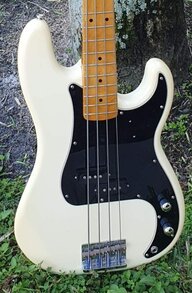
I thought I needed a short scale bass. I'm 5'7" with small hands. Then I found my Aria SB 1000 with super parallel string spacing. Supposedly this was made for the Japanese market, ie: smaller hands. I don't know if its true but I've never played a more comfortable bass neck before. If you have large hands I could see this neck being uncomfortable but for me it's darn near perfection.
- Sep 4, 2010
- 3,304
- 2,730
- Disclosures
- Endorsing: Martin Keith Guitars
My #1 is a great sounding 34' fretless. So I want any fretted bass to be 34' also, to keep the sense of positions intact.
Ignorance ?, yes perhaps. Mostly my opinion based on my personal exp. I suppose some of us mite be able to hold down the low end with a Uke tuned appropriately. Our basses are descendants of double basses, the instrument was large and had a long scale for reason. The farther we get from that formula , the less effective becomes the role of the instrument. If we make due with a 30 scale, why not a 24 then or an 18. And while a 30 might not be just a novelty, its getting closer.


IME the physics correlate with what I hear. It takes thicker strings to tune a short scale EADG and I find the sound more thuddy and less defined. I also like a B string. I also prefer 35" over 34" scale and the uber long-scale Dingwalls I have played had the best sounding E and B strings I have heard. For me the ultimate way to test differences between scale lengths is to play double stops or chords below
the 5th fret and see if you can distinguish the individual tones. . I wish I liked the way shorties sound, but I don't.
the 5th fret and see if you can distinguish the individual tones. . I wish I liked the way shorties sound, but I don't.

The word "precision" had less to do with scale, and more to do with the fact that the bass had frets and therefore allowed for "precise" intonation.
Fender had to choose a scale length. He could have decided on anything, but chose 34" for multiple reasons, one of which was for better intonation all the way up the neck. He later improved intonation by adding individual saddles to the bridge.
This is something Gibson totally overlooked with their little bass guitars in 1953, almost as if proper intonation was irrelevent.
And it probably was irrelevent to their target customers....guitar players who got relegated to the dubious role of "bass player" in their band. (how humiliating!)
The whole notion that 34" scale basses are somehow "more difficult" to play is spurious. 34" is the accepted full scale length for a reason, not luck, not marketing hype. It just works well for most bassists.
It is also wrong to assume that full scale bass players are somehow ignorant of the alleged "advantages" of little basses. It's usually the other way around...owned some, played many, not seeing any advantage, prefer full scale.
There's nothing wrong with shorty basses or the players who prefer them. But trying to make a case that they are somehow "better"? Peel an onion, eh?

Fender had to choose a scale length. He could have decided on anything, but chose 34" for multiple reasons, one of which was for better intonation all the way up the neck. He later improved intonation by adding individual saddles to the bridge.
This is something Gibson totally overlooked with their little bass guitars in 1953, almost as if proper intonation was irrelevent.
And it probably was irrelevent to their target customers....guitar players who got relegated to the dubious role of "bass player" in their band. (how humiliating!)
The whole notion that 34" scale basses are somehow "more difficult" to play is spurious. 34" is the accepted full scale length for a reason, not luck, not marketing hype. It just works well for most bassists.
It is also wrong to assume that full scale bass players are somehow ignorant of the alleged "advantages" of little basses. It's usually the other way around...owned some, played many, not seeing any advantage, prefer full scale.
There's nothing wrong with shorty basses or the players who prefer them. But trying to make a case that they are somehow "better"? Peel an onion, eh?
1. You can intonate a Gibson bridge these days. Really, it's not hard if you've got the motor skills necessary to turn a screwdriver. I seem to remember Leo's original bridge designs being flawed. A thousand pardons if the first electric bass designs weren't absolutely perfect.
2. No one's saying short scales are "better." There's no inherent advantage or disadvantage to playing a short scale over a long scale or vice versa. Some of us just enjoy using them in addition to long scales.
3. Believe it or not, 34" is not the end-all, be-all of scales. There's lots of basses made in lots of scales. 28.6", 30", 32", 33.25", 35", 36", 38", and 34". They all seem to intonate and work pretty well.


Because i have a short scale bass (60's ibanez) and as much as ive tried to love it i just dont. Wish i could just sell it.
My finger don't have the memory muscle for short scale
So do you not play past the second fret? The fret spacing on a 30 is the same as the spacing 2 frets lower on a 34.


