• TalkBass has been independent since 1998. Add your voice.
    Create a free account to reply to discussions, view embedded media, and browse with fewer display ads.
    Join freeLog in
    Want zero display ads or expanded classifieds tools? Compare plans.

Why is this notated like this?

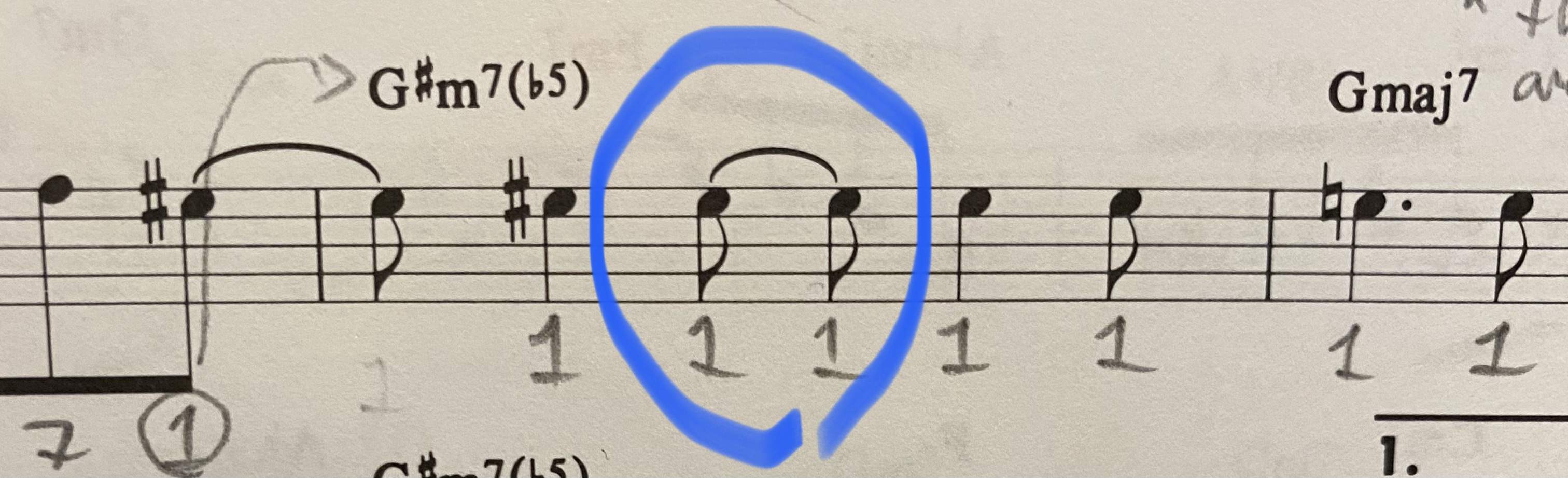
In SITSOM’s (Standing in the Shadows of Motown) notation for Marvin Gaye’s & Tammi Terrell’s “Ain’t No Mountain High Enough”, there is a tie connecting two eight notes of the same pitch (G#), in the middle of a few quarter notes of the same pitch.

I always thought with a tie, you would hold the first note for the duration of all of the tied notes, which would make this essentially a quarter note... But there are already quarter notes surrounding this, so why is this one notated differently? Is it played differently?

Is it because the second tied note falls on beat 3, and that’s their way of indicating the third beat in 4/4 time?
31B6EB9F-A072-4E59-AE3C-E828AF5B8866.jpeg


edited to revise uploaded image
 
Last edited:
  • Like
Reactions: zie
All I could suggest is that they were notating it to follow the syllables in the lyrics. You wouldn’t be hitting the exact same beats since the eighth notes are tied. But if you were sight reading it, it might make it a little easier to follow in the song.
 
  • Like
Reactions: Matthew_84
It’s basically because the notes are effectively shifted an eighth note off the beat.

If you were playing straight eighths you’d have 1 & 2 & 3 & 4 &.

If you were playing straight quarter notes you’d have 1 2 3 4.


Instead you are sustaining through the 1 and are basically playing & & & &.

So why the slur? Because the notes before the slur take care of beats one and two, and after the slur you have beats three and for. The slur helps you place the phrase within the normal metric grouping of the song.
 
Sorry I wasn’t clear. I’m talking about the second tie, the one in the middle of the G#m7(b5) measure.

View attachment 4278775
I was always told that, when writing arrangements, to imagine that there’s a bar line between beats 2 and 3; any note held over that imaginary bar line should be written as two notes tied together.
It’s not done universally, but when it is, it’s a heckuva lot easier to read the rhythms!
 
In SITSOM’s (Standing in the Shadows of Motown) notation for Marvin Gaye’s & Tammi Terrell’s “Ain’t No Mountain High Enough”, there is a tie connecting two eight notes of the same pitch (G#), in the middle of a few quarter notes of the same pitch.

I always thought with a tie, you would hold the first note for the duration of all of the tied notes, which would make this essentially a quarter note... But there are already quarter notes surrounding this, so why is this one notated differently? Is it played differently?

Is it because the second tied note falls on beat 3, and that’s their way of indicating the third beat in 4/4 time?

View attachment 4278777

edited to revise uploaded image
The tied note is crossing the "middle line" of the bar. Imagine there's an invisible line dividing the bar in two halves.
Every time you play/hold something over that bar it's better to use a tie, because it's easier to identify rhythmic values and to play them that way
 
In SITSOM’s (Standing in the Shadows of Motown) notation for Marvin Gaye’s & Tammi Terrell’s “Ain’t No Mountain High Enough”, there is a tie connecting two eight notes of the same pitch (G#), in the middle of a few quarter notes of the same pitch.

I always thought with a tie, you would hold the first note for the duration of all of the tied notes, which would make this essentially a quarter note... But there are already quarter notes surrounding this, so why is this one notated differently? Is it played differently?

Is it because the second tied note falls on beat 3, and that’s their way of indicating the third beat in 4/4 time?

View attachment 4278777

edited to revise uploaded image
Because the middle of every bar has to be visible. You can't have a note right in the middle of a bar........don't quote me on that though.
 
Because the middle of every bar has to be visible. You can't have a note right in the middle of a bar
It actually doesn't, and yes you can ... but imagining the split in the middle of the measure and writing the way it was done in the example does make things easier to read for most people.

Of course things get trickier if you're writing in 3/4, 5/4, 7/4, etc, because those don't have midpoints falling on downbeats.
 
I was taught that you should be able to easily distinguish the middle of the bar, so when notes are held across the middle of he bar you should use a tie. That doesn't always make the most sense, like if you have a measure where you play a quarter note and then a note held for the rest of the measure, I’d write it as a quarter followed by a dotted half note.