
Enjoy the benefits of a premium membership!
Upgrade Account
-
TalkBass has been independent since 1998. Add your voice.
Create a free account to reply to discussions, view embedded media, and browse with fewer display ads.
Join free Log in
Want zero display ads or expanded classifieds tools? Compare plans.
You are using an out of date browser. It may not display this or other websites correctly.
You should upgrade or use an alternative browser.
You should upgrade or use an alternative browser.
Why Jimi Hendrix is so Important
- Thread starter mellowinman
- Start date
More options
Who Replied?
Stick_Player
Inactive
- Nov 13, 2009
- 4,149
- 937
- Disclosures
- Endorser: Plants vs. Zombies Pea Shooters


OK, Jimi live.
Sometimes, the performance would sound muddy, and seem a bit noisy and incoherent. Other times he was a master.
Jimi's recorded work.
He did three really great albums, then did a fourth, live recording with Band of Gypsys. But he did a bunch of other recordings, some great; some sub-par that were never meant to be released. Of the great, some are exceptionally great.
As a guitar player, what he did that made me so awe-struck was BUILD A SOLO.
By that, I mean, he would actually let the solo develop, and so many of them made total musical sense, and never devolved into wankery, or sheer showing off of chops. And the sounds he got! People forget how many things he did on a Strat, which can be a very thin, non-aggressive guitar. He made it sound like humbuckers a lot of the time!
I honestly think that the only people who claim he isn't at least a CONTENDER for Greatest Rock Guitarist of all Time simply haven't heard everything they need to hear to make a valid judgment.
Experience II - San Francisco - Red House Jimi, Mitch and Billy Cox
Experience II - Electric Lady Studios 1970 - Freedom Jimi, Mitch and Billy Cox
Experience II - Electric Lady Studios 1970 - Stepping Stone Jimi, Mitch and Billy Cox
My opinion is that in 1970, Jimi had really started to mature, (at the ripe old age of 27.) He was doing less psychedelic and more just great rock and roll, with a soul feel.
Remember, he started off the year with Buddy Miles, and Billy Cox and this amazing performance:
Invalid Link Removed
Sometimes, the performance would sound muddy, and seem a bit noisy and incoherent. Other times he was a master.
Jimi's recorded work.
He did three really great albums, then did a fourth, live recording with Band of Gypsys. But he did a bunch of other recordings, some great; some sub-par that were never meant to be released. Of the great, some are exceptionally great.
As a guitar player, what he did that made me so awe-struck was BUILD A SOLO.
By that, I mean, he would actually let the solo develop, and so many of them made total musical sense, and never devolved into wankery, or sheer showing off of chops. And the sounds he got! People forget how many things he did on a Strat, which can be a very thin, non-aggressive guitar. He made it sound like humbuckers a lot of the time!
I honestly think that the only people who claim he isn't at least a CONTENDER for Greatest Rock Guitarist of all Time simply haven't heard everything they need to hear to make a valid judgment.
Experience II - San Francisco - Red House Jimi, Mitch and Billy Cox
Experience II - Electric Lady Studios 1970 - Freedom Jimi, Mitch and Billy Cox
Experience II - Electric Lady Studios 1970 - Stepping Stone Jimi, Mitch and Billy Cox
My opinion is that in 1970, Jimi had really started to mature, (at the ripe old age of 27.) He was doing less psychedelic and more just great rock and roll, with a soul feel.
Remember, he started off the year with Buddy Miles, and Billy Cox and this amazing performance:
Invalid Link Removed
OK, Jimi live.
Sometimes, the performance would sound muddy, and seem a bit noisy and incoherent. Other times he was a master.
Jimi's recorded work.
He did three really great albums, then did a fourth, live recording with Band of Gypsys. But he did a bunch of other recordings, some great; some sub-par that were never meant to be released. Of the great, some are exceptionally great.
As a guitar player, what he did that made me so awe-struck was BUILD A SOLO.
By that, I mean, he would actually let the solo develop, and so many of them made total musical sense, and never devolved into wankery, or sheer showing off of chops. And the sounds he got! People forget how many things he did on a Strat, which can be a very thin, non-aggressive guitar. He made it sound like humbuckers a lot of the time!
I honestly think that the only people who claim he isn't at least a CONTENDER for Greatest Rock Guitarist of all Time simply haven't heard everything they need to hear to make a valid judgment.
Experience II - San Francisco - Red House Jimi, Mitch and Billy Cox
Experience II - Electric Lady Studios 1970 - Freedom Jimi, Mitch and Billy Cox
Experience II - Electric Lady Studios 1970 - Stepping Stone Jimi, Mitch and Billy Cox
My opinion is that in 1970, Jimi had really started to mature, (at the ripe old age of 27.) He was doing less psychedelic and more just great rock and roll, with a soul feel.
Remember, he started off the year with Buddy Miles, and Billy Cox and this amazing performance:
Invalid Link Removed
For the part about the strat often sounding like humbuckers, who's to say that those songs/tracks weren't played with humbucker guitars like his SG or Flying V?
For the part about the strat often sounding like humbuckers, who's to say that those songs/tracks weren't played with humbucker guitars like his SG or Flying V?
Sometimes its live footage, and you can see him playing a Strat. He got the fattest tone out of a Strat that I have ever heard.
Sometimes its live footage, and you can see him playing a Strat. He got the fattest tone out of a Strat that I have ever heard.
I see, fair enough. It was under the "recordings" part, so I figured you were talking about those specifically. Yeah, he would get some fat tones out of a Strat. Stephen Stills gets/got some damn fat sounds out of single coils also.
- Sep 4, 2010
- 3,304
- 2,730
- Disclosures
- Endorsing: Martin Keith Guitars
I feel exactly the same way, but it's hard to put into words why and I think you made a very valiant effort to explain it, Mellowinman. To me, it is the Tone and the phrasing, the openness of mind and the fearlessness in his playing leaning towards the mind of a great improviser, coupled with the expressiveness of a great bluesman. The man had Vision and pursued it relentlessly wherever it took him. Hendrix is that rock guitarist who to me he ranks with Coltrane , Miles Davis, Ornette Coleman, Charles Mingus in the pantheon of great American musicians of the 20th century, and that is to me why he stands out among the other rock guitarists. I discovered him when I was like 16, 17 it blew me away then & while I am in the following 30 years have become engrossed in Messiaen, Stockhausen, Sister Rosetta Tharpe, Morton Feldman, Charles Mingus, Albert Ayler, etc, I still love Hendrix to bits. Albert Ayler and Hendrix making a record together, wouldn't that have been something.? Or try to listen to Miles Davis' Black beauty/Live at the Fillmore West and try to NOT hear that as an open invitation to Jimi to come down and jam-really, I don't think one can overstate Hendrix' influence on American music enough.
Why Jimi Hendrix is so Important
The guitar.
It's that simple. The guitar.
Not his songwriting, lyrics, stage presence, tricks, singing, flashy clothes, or anything else. It's the guitar.
I've been thinking off and on for a few months about something...who among the big name rock stars will be widely remembered 100 years from now? Been thinking about it because there are thousands of guitar players who don't know who Chuck Berry is.
A hundred years from now nobody's going to give a damn about Mick, Keith, Chuck, Elvis, Michael Jackson, Led Zep, James Brown, Neil Young, Springsteen, etc.
I'd guess the Beatles and Dylan might still draw some interest, but the truth is most current icons will be forgotten.
No so with the Man. He's been dead going on 44 years, seven years longer than Elvis (The King of Rock and Roll), and is still at the top of the heap. Why?
The guitar.
Back around 1980 I was talking to guy and said something I was really proud of, something profound, and still stand by it today.
"Jimi Hendrix was the best thing to happen to the guitar since electricity." Me
The guitar.
It's that simple. The guitar.
Not his songwriting, lyrics, stage presence, tricks, singing, flashy clothes, or anything else. It's the guitar.
I've been thinking off and on for a few months about something...who among the big name rock stars will be widely remembered 100 years from now? Been thinking about it because there are thousands of guitar players who don't know who Chuck Berry is.
A hundred years from now nobody's going to give a damn about Mick, Keith, Chuck, Elvis, Michael Jackson, Led Zep, James Brown, Neil Young, Springsteen, etc.
I'd guess the Beatles and Dylan might still draw some interest, but the truth is most current icons will be forgotten.
No so with the Man. He's been dead going on 44 years, seven years longer than Elvis (The King of Rock and Roll), and is still at the top of the heap. Why?
The guitar.
Back around 1980 I was talking to guy and said something I was really proud of, something profound, and still stand by it today.
"Jimi Hendrix was the best thing to happen to the guitar since electricity." Me

Jimi Hendrix is the greatest rock guitarist of all time.
People often dispute that statement. This guitarist has more technical skill. That guitarist is faster. On and on it goes. It's not a worthy argument. What does "greatest" mean? It certainly means something, but it can be difficult to define.
The Jimi Hendrix Experience was jamming in London in 1966. When you look at the sound, style, and innovation of that band, you can see how far ahead they were from everything that had happened so far, and it would take some time for the rest of the world to catch up to them. But that's not why Jimi Hendrix is so important.
The Jimi Hendrix Experience is difficult to define. They played psychedelic rock. They played blues. They played hard rock. What few people seem to recognize is that they were a progressive band. You won't find them on any list of progressive bands, however they incorporated all the elements. Extended song times. Experimental time signatures. Lyrics that went beyond normal boy meets girl; psychedelic or party themes. Experimental song structures. There is no question that the Jimi Hendrix Experience meets many of the criteria for a progressive band, but they can't be defined as a progressive band, just as they can't be defined as a hard rock band, a blues band, a pop band, or a psychedelic band. They were their own, unique thing, with a unique sound that had never been heard before. But that's not why Jimi Hendrix is so important.
Jimi was an unusual character. Painfully shy in many ways, but a player with women. Bold and confident on stage, but almost aggressively insecure. He was the last guy to think he was the greatest guitar player, or singer, or songwriter, or anything else. But it wasn't a false humility; nor was it born only out of insecurity. He had an almost pathological need to stay hungry, because he always wanted to be better. He played and practiced almost constantly, even after becoming a big star. He was afraid of becoming fat and complacent, and although he was proud of work he did, he was equally sure it just wasn't good enough, because he could do more.
As a lyricist, he was brilliant. It's easy to poke fun at his more naive, psychedelic, trippy or even sometimes silly lyrics, but if you examine the entire body of his work, he wrote a lot of lyrics of quality, introspection, soulfulness and honesty.
Jimi captured my imagination many years after he had died. I was a young teenager, who had discovered rock music, and it was taking me out of my shell, and teaching me things I would carry with me the rest of my life. Jimi was important because of the way he influenced millions, and reached deep into our souls, and gave us something unique that asked us to be more. You have to remember, I grew up in the era of stadium rock, when the idea of the counterculture, of opening minds, and trying to make a difference had given way to nihilism, navel-gazing, and just plain shallow partying.
Jimi recorded music from 1967 until 1970. He had only three years to assemble a body of work that is simply astounding. He played a lot of different styles, making each his own. He was always looking for something more.
He wasn't simply the greatest rock guitarist of all time. He was the greatest rock guitarist off all time by such a large measure that you can take the next ten guys on the list, and they still don't add up to more than a fraction of what he was; what he meant; what he left.
NOT ONE SINGLE ROCK GUITAR PLAYER has come up since him that hasn't delved into his songbook, and bag of tricks. That's the biggest deal. And he was never "the guitar player" in a band. He was the singer, lyricist, songwriter, visionary, and leader, and the only lead singer in the history of famous rock stars who actually wanted his vocal LESS prominent in the mix.
Jimi Hendrix is important because not only did he change rock music forever; his life actually had an effect on society, and mostly for the better. If he influenced people to abuse drugs, then that is the downside, but he hardly could've done that on his own. The positive things he brought about, in regards to performance, songwriting, electronic effects, depth in looking at styles and social consciousness easily outweigh the negatives.
Jimi Hendrix is the greatest rock guitarist of all time.
Nobody else even comes close.
I'm probably going to get a lot of poopie for this, but Vernon Reid is Jimi's heir apparent. A lot of qualities you ascribe to Hendrix can also be heard in Reid's playing and songwriting.
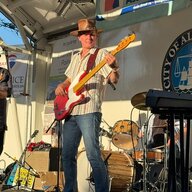
Look what I found on Twitter - I bet you that's Tommy Shannon's Jazz Bass. Interesting to see it in such good condition, it didn't look like that when he was with SRV.
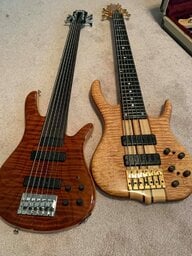
hasbeen
Commercial User
- Sep 23, 2004
- 4,806
- 2,668
- Disclosures
- Executive Vice President, The Adam Hall Group
Ritchie Blackmore said something to the effect that Hendrix was simply playing like a loud Buddy Guy when he came to England. He further said that it wasn't until Hendrix saw Jeff Beck that he started to take a new direction. He said everyone (Townsend, Page, Blackmore, Hendrix, Clapton etc.) were often in the front row studying what Beck was doing.
hasbeen
Commercial User
- Sep 23, 2004
- 4,806
- 2,668
- Disclosures
- Executive Vice President, The Adam Hall Group
One other thing, Jimi was a great artist and he did change rock music, but he was not a very good guitarist in an absolute sense. Great guitarists are people like Steve Morse and Brent Mason -- If you put either of those guys in a Hendrix band they kill it. I'd like to see Jimi try his hand at Cruise Missile!
there are never any absolutes in these discussions, but you're assuming "great" is the same as "technical proficiency". More and Mason are certainly that. From my point though, they don't hold a candle to Hendrix as far as creativity and being influential though.
Cool..Look what I found on Twitter - I bet you that's Tommy Shannon's Jazz Bass. Interesting to see it in such good condition, it didn't look like that when he was with SRV.
View attachment 441252
I'll add
Link Removed
Ritchie Blackmore said something to the effect that Hendrix was simply playing like a loud Buddy Guy when he came to England. He further said that it wasn't until Hendrix saw Jeff Beck that he started to take a new direction. He said everyone (Townsend, Page, Blackmore, Hendrix, Clapton etc.) were often in the front row studying what Beck was doing.
I remember reading an article with Jeff Beck in a Hit Parade magazine back in '69 or '70. He was talking about the "who's the best guitarist" stuff that was going around. Beck said something like it's hard to say who's the best because Clapton could have a better gig than him, Page could have a better gig than Clapton, etc, but it really didn't matter because Hendrix blew them all away anyway.
I didn't read all the pages so sorry if I say something redundant.
I think looking at him in the context of history is important. He absolutely was a great guitarist. The fact he was so zoned out on drugs half the time would explain at least in part the mixed quality bag he presented.
My point is that electric rock guitar was a new instrument and genre. In the light of that, he was a founding father. Sure now there are flawless technical geniuses supported by incredible technology. But at that point in time, what he did and what he did it with was incredible, and laid the foundation for much to follow.
Sort of like Jamerson, He was amazing in the same context and circumstances. Compare him to Jaco or Wooten or ??? I don't see the point. Another founding father, on a new instrument and genre, who laid the groundwork for what would follow.
My $0.02, from the perspective of having watched it all unfold.
I think looking at him in the context of history is important. He absolutely was a great guitarist. The fact he was so zoned out on drugs half the time would explain at least in part the mixed quality bag he presented.
My point is that electric rock guitar was a new instrument and genre. In the light of that, he was a founding father. Sure now there are flawless technical geniuses supported by incredible technology. But at that point in time, what he did and what he did it with was incredible, and laid the foundation for much to follow.
Sort of like Jamerson, He was amazing in the same context and circumstances. Compare him to Jaco or Wooten or ??? I don't see the point. Another founding father, on a new instrument and genre, who laid the groundwork for what would follow.
My $0.02, from the perspective of having watched it all unfold.
hasbeen
Commercial User
- Sep 23, 2004
- 4,806
- 2,668
- Disclosures
- Executive Vice President, The Adam Hall Group
I remember reading an article with Jeff Beck in a Hit Parade magazine back in '69 or '70. He was talking about the "who's the best guitarist" stuff that was going around. Beck said something like it's hard to say who's the best because Clapton could have a better gig than him, Page could have a better gig than Clapton, etc, but it really didn't matter because Hendrix blew them all away anyway.
that doesn't surprise me. It is all anecdotal. John McLaughlin call Jeff Beck "the best electric guitarist that ever lived". Jeff Beck's favorite guitarist is Jack White. Carlos Santana and Eric Clapton called Buddy Guy the best.
I simply look at it as "who has something unique to say?"

there are never any absolutes in these discussions, but you're assuming "great" is the same as "technical proficiency". More and Mason are certainly that. From my point though, they don't hold a candle to Hendrix as far as creativity and being influential though.
Creativity is subjective. My point was that a great guitarist can function in any musical environment. You could put a guy like Steve Morse in Metallica, Frank Sinatra's band, George Jone's band, Doc Watson's band, Weather Report, Miles Davis band, or a classical orchestra and he would kill it. Hendrix could not have cut it an any of those situations. That doesn't lesson his influence or interest, but it is what it is.


