They are like Pickup Trucks. Everyone should have one.

Enjoy the benefits of a premium membership!
Upgrade Account
-
TalkBass has been independent since 1998. Add your voice.
Create a free account to reply to discussions, view embedded media, and browse with fewer display ads.
Join free Log in
Want zero display ads or expanded classifieds tools? Compare plans.
You are using an out of date browser. It may not display this or other websites correctly.
You should upgrade or use an alternative browser.
You should upgrade or use an alternative browser.
Why the P bass obsession
- Thread starter JRuben
- Start date
More options
Who Replied?
In the end everything all comes down to taste. The P just doesn't seem to be yours in particular, no issue there. I will say though, there are countless reasons the P is still around, popular and one of the more copied Basses out there. I don't think I have to list them as they are already stated above, and already known among the Bass community.
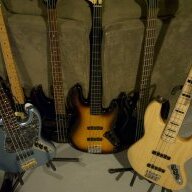
I have nothing against precision bass guitars, they can play very good in the right hands. They aren't anything crazy though. I always felt like they have a very bland tone. They don't have much versitility either. I much prefer the depth and range of a jazz for example. Im just curious about everyone else's thoughts on this.
First things first - let me get the popcorn poppin' - it's going to be a wild ride.
I agree with you, after my own playing/improving/experimenting. However at first I said to myself "I'm getting whatever all my favourite players use(d) - what was used on all those albums I love?" and about 75-80% the answer was P-bass. My first bass which was given to me was a P-bass too. So I disregarded my teacher's recommendation to stick with a jazz (for ergonomics and tonal range) and got the Nate Mendel sig P instead as my fretted.
Well!
(here's a snip of a PM I sent) After playing half of my band practice with my VM fretless jazz, I wanted a break from the fretless and switched to my new P. No one could hear me... and the P is LOUDER than my jazz! As soon as everyone got going, the guitarist was kneeling next to my amp trying to hear me, and I even tried turning the volume up... that's when I realized I should have heeded my teacher's experience more. I thought he was just a biased jazz bass nut lol
Some things just cannot be taken for granted though, such as:
- The human ear hears higher-pitched frequencies much easier than low, bassy ones
- Fundamental bass notes are low frequency, but all the overtones are higher-pitched (brighter), and they cut through the mix and allow you to be heard
- When those overtones are missing, you cannot boost them back in (you must have them to begin with - better to cut something you don't want than try to boost something that isn't there)
- Pickups near the bridge (like a jazz has) are there to pick up those overtones
I'm not going to say "play a jazz, not a precision" because: Play what you want. P-basses work for many people, but to be heard when playing with others without having to turn up too much, IMHO a P-bass needs some help (like lighter gauge strings, roundwounds, stainless steels, or some combination of those). Heavy nickel flats on a P is what I'd call bedroom tone - that would never be heard in either of my bands (I had steel flats on during the anecdote above) unless my 500W amp was turned up and the guitars were much lower.
When the bass turns up too loud, one (or both) of two bad things will happen: You will take away from the drummer's percussive attack, and although your fundamental notes might be heard a little better, you might go into the realm of discomfort for others, but they won't necessarily be able to pinpoint what's wrong. It just boils down to ensuring you have some presence in the frequency ranges the human ear can deal with easily. Cranking the volume for a tone that isn't audible is somewhat counter-productive and puts you into a different volume zone than the rest of the band.
I have a cheap EQ pedal I use for the rare time I play a solo - I have it off until the guitars stop and then use it to boost mids a little and cut a little treble just for the solo, then it's off again as soon as the guitars start again.
The best thing about a p is they can be made into a PJ
Yes!!!
Thanks for the heads-up. I'll be listening to the Stranglers tonight. Prepare to tip your hat.
Your J works better than every P on the planet? And you've played every P in comparison..hold on just remembered why I don't reply to these types for threads..lolI find MIA Jazz Bass's (well mine anyway) just work better than P's. Versatility is endless. The only P-Bass I ever found that played right was the American Standard. But I already have the J so no need.
Random opinion: It's hard to imagine something getting everything so right the first time, and that's what the Precision is. Also, for rock people at least (this may be true for other genres as well), the linear lines of the Precision look absolutely sexy cool when held straight out at hip level. Because of it's offset body, the Jazz bass looks good when tilted up. I suspect this is one of the reasons the more technically capable like to play it. Don't underestimate the way things look. We all go to "see" bands, don't we?
'....................First things first - let me get the popcorn poppin' - it's going to be a wild ride.
I agree with you, after my own playing/improving/experimenting. However at first I said to myself "I'm getting whatever all my favourite players use(d) - what was used on all those albums I love?" and about 75-80% the answer was P-bass. My first bass which was given to me was a P-bass too. So I disregarded my teacher's recommendation to stick with a jazz (for ergonomics and tonal range) and got the Nate Mendel sig P instead as my fretted.
Well!
(here's a snip of a PM I sent) After playing half of my band practice with my VM fretless jazz, I wanted a break from the fretless and switched to my new P. No one could hear me... and the P is LOUDER than my jazz! As soon as everyone got going, the guitarist was kneeling next to my amp trying to hear me, and I even tried turning the volume up... that's when I realized I should have heeded my teacher's experience more. I thought he was just a biased jazz bass nut lol
Some things just cannot be taken for granted though, such as:
- The human ear hears higher-pitched frequencies much easier than low, bassy ones
- Fundamental bass notes are low frequency, but all the overtones are higher-pitched (brighter), and they cut through the mix and allow you to be heard
- When those overtones are missing, you cannot boost them back in (you must have them to begin with - better to cut something you don't want than try to boost something that isn't there)
- Pickups near the bridge (like a jazz has) are there to pick up those overtones
I'm not going to say "play a jazz, not a precision" because: Play what you want. P-basses work for many people, but to be heard when playing with others without having to turn up too much, IMHO a P-bass needs some help (like lighter gauge strings, roundwounds, stainless steels, or some combination of those). Heavy nickel flats on a P is what I'd call bedroom tone - that would never be heard in either of my bands (I had steel flats on during the anecdote above) unless my 500W amp was turned up and the guitars were much lower.
When the bass turns up too loud, one (or both) of two bad things will happen: You will take away from the drummer's percussive attack, and although your fundamental notes might be heard a little better, you might go into the realm of discomfort for others, but they won't necessarily be able to pinpoint what's wrong. It just boils down to ensuring you have some presence in the frequency ranges the human ear can deal with easily. Cranking the volume for a tone that isn't audible is somewhat counter-productive and puts you into a different volume zone than the rest of the band.
I have a cheap EQ pedal I use for the rare time I play a solo - I have it off until the guitars stop and then use it to boost mids a little and cut a little treble just for the solo, then it's off again as soon as the guitars start again.

I've been playing shortscale, but this spring I decided I wanted one each of a 34" scale P and J. Things are coming together now nicely. I bought a Squier Vintage Modified 70s Jazz, plus some parts for a build. Last night I put the VM Jazz neck on a MIM P body with Babicz bridge, and will be mounting a Fender '62 P pup this weekend. I also have a very nice Warmoth neck that is going on the VM Jazz body (which is "soft maple"). I have DiMarzio Model J pups to try in the Jazz, but I need to get some 500K pots first.
If forced to choose one, I'd probably go with the Jazz for its extra "cut," but it would be a tough choice.
If forced to choose one, I'd probably go with the Jazz for its extra "cut," but it would be a tough choice.
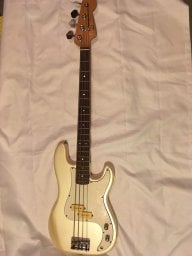
I just like the simplicity of them, they don't necessarily have to be Fender either, There are some great P bass alternatives out there. I just really like the tone of the split coil and the way there's a big gap between the bridge and the pup and the overall layout. You can shove a big lump of foam down there and great a great 60s sound using flatwounds (or just use a plec. and the side of your hand). Using steels and cranking the tone up full gives a great punk tone, just listen to the pixies and the clash, sounds great. And who says you cant slap with a P bass. P bass slap is the funkiest IMO. I think they're plenty versatile, just use different playing techniques, string types and a bit of imagination.

The best thing about a pj is that you can cut the j.The best thing about a p is they can be made into a PJ
Well this thread went as expected. Can't wait for the next one tomorrow!
Sounds like I feel the reverse of a few of you - I like the P for solo and trio stuff, but prefer the J for when there's more than one guitar. Different strokes for different folks I 'spose.

Well put.See that dot in the center of a bulls eye? That’s a P.
All those rings around it are where the "versatility" of other basses allows you to go.
I played my jazz bass for about 20 years, same bass. After joining this forum I bought a tony Franklin pbass from the classifieds.
I spent the next year only playing that bass. I play only the pbass pickup.The neck is huge compared to my jazz bass.
But damn the pbass has a rock, punk, funk tone thAt is just awesome! I play the bass differently, partially due to pickup partially due to the neck.
The jazz bass is still My favorite but I'm so glad I have a pbass.
If I could only have 1 bass it would have a jazz neck and a p/j pickup
I spent the next year only playing that bass. I play only the pbass pickup.The neck is huge compared to my jazz bass.
But damn the pbass has a rock, punk, funk tone thAt is just awesome! I play the bass differently, partially due to pickup partially due to the neck.
The jazz bass is still My favorite but I'm so glad I have a pbass.
If I could only have 1 bass it would have a jazz neck and a p/j pickup