• TalkBass has been independent since 1998. Add your voice.
    Create a free account to reply to discussions, view embedded media, and browse with fewer display ads.
    Join freeLog in
    Want zero display ads or expanded classifieds tools? Compare plans.

Will we all being playing our Gibson's through Behringer's before to long?

Behringer is worth keeping an eye on. With some clever clones and innovations, they have stumbled onto a pretty loyal consumer base. The QC was spotty at first, but seems to be improving, and they are the great chameleon of the music equipment industry. I have purchased three small Behringer mixers recently, and the prices are amazing.
 
Fender killed Genz. Gibson killed Tobias...

NO NO NO, Genz and Tobias killed their own companies when they sold for greed and gain. They knew full well that the brands would die in time. They didn't care, their wallets got FAT.

They didn't care about you. Why shed a tear over a name. Jeez, get a grip.

Small businesses get bought by larger ones all the time, usually at the point where the transition from small business to large enterprise requires an investment in infrastructure that's far beyond their means. Large companies buy smaller ones in order to rapidly acquire product or marketshare that was developed by the smaller business. (And why shouldn't the person who started the business be rewarded for their risk and hard work?)

However, it's up to the new owner to know *** to do with their purchase. Sometimes it works out. Sometimes it doesn't. In Tobias' case, Gibson tried to mass produce a boutique instrument and charge boutique prices, but boutique buyers, having so many other options, didn't follow. I've played some post-Gibson Tobias basses that were great, but most of them fell short of their namesake.

Right before the dot com crash, I was working for a company that was maybe three days from bankruptcy when we were bought by a large telecom company for a ridiculous amount of money. The reason they bought us? They didn't want our product, or our technology. They wanted a presence in Silicon Valley; literally, a place to hang their sign and say "me too". (i.e. Sometimes the purchaser's motives aren't what you think they are.)
 
I watched a Sweetwater video interview with Hartley Peavey several months ago. He related a story in which he was attending a music gear convention (possibly NAMM) and was approached by Leo Fender, who said to him something along the lines of "Peavey, you're doing everything right; don't ever sell your company to anyone..." - That struck me as quite sad...no doubt Mr. Fender made a lot of money by selling his company, but at what cost? When someone spends years, decades even, building a brand that literally bears their name, only to see the company that takes it over start churning out inferior products, it's gotta hurt...

It happens in other industries too. I am a huge fan of the novel World War Z, but was absolutely appalled at the movie adaptation, as it bore practically zero resemblance to the book. I'm sure Max Brooks (the author) couldn't care less what the Average Joe thinks; he probably literally laughed all the way to the bank when the deal was done, but I don't understand how he could have gone through with it, especially if he had an inkling of how different the movie would be. The book was a bestseller, which means he was probably rich off of that alone (actually, he was probably rich from birth, given that he is Albert Brooks' son), so yeah, to sell the rights for it to be turned into a piece-of-crap, generic action flick...sigh...:(
 
While looking over the summer to replace two cheap beginner electric basses bought in the 90's I discovered something fascinating. I took the entire summer, three months, and auditioned over a hundred basses around LA music stores with no particular brand in mind. I made it a point to play high end basses with no intention of laying out the enormous sums asked, in addition to beginner basses similar to the ones I was replacing in the hopes that advanced manufacturing processes had allow for an increase in "bang for the buck" in the past 18 years (it has - to a reasonable degree within context).

What I found as the summer came to a close is that, at a certain price point, things level off to such a degree that the brands associated for so long in the past with "the best of the best" don't hold up to their own history, hype, or asking price. Newer brands or older brands that were once considered "off brands" (some already mentioned in this thread) but have managed to survive in spite of their reputations as "the other brands" are making what I discovered to be, in my admittedly limited experience and for my purposes over the summer, excellent instruments for those interested in playing electric bass guitar as opposed to collecting. Upgrading hardware on any of these basses is a personal preference but none absolutely needed upgrades out of the box and none were over or close to the $1000.00 mark.

I don't plan on selling these basses because I did the research, went through the audition process, and chose wisely, so the oft mentioned "re-sale value" means nothing to me; their musical value is all that matters. Over the years they will cover... wait for it... all the bases I'll ever need to cover (couldn't resist). Well, that is until I feel the need for an upright. If Gibson and/or Fender go under (which they won't) there are enough excellent alternatives currently available that there is no risk of a world filled only with White Stripes, Black Keys, Yeah Yeah Yeahs, and Flat Duo Jets (as good as they all are/were). There is little risk, either, of a world filled only with SGs, T-Birds, Precisions, and J-basses.

At the end of my "Summer of Basses" instead of two basses I ended up buying three, four if I include a gifted one. All are very different, all falling into the class of "workingman's guitar"; a hollow body, a bolt on neck with reverse P/J pups, a neck-through with humbuckers, and a gifted 5-string neck-through. None are Fender or Gibson and all are considered to have poor resale value. They feel great in my hands and have rekindled not just my love of bass but also for non-electronic (aka synth) music. Oh, all three together even with one bridge upgrade and one tuner upgrade, cost less than a single 2015 Gibson Thunderbird.

I thought about comparing Gibson and Fender, Gibson in particular, to Harley-Davidson: status gear for wealthy doctors and lawyers with no relevance to purpose or demographic originally intended. I went with this instead to avoid controversy. ;)
 
Last edited:
It's just the way business is done. I'm not saying it's right but it seems to be expected nowadays. In the last 20 years Ford did this with Volvo, Aston Martin, Range Rover. GM did it to SAAB, AM General / Hummer, killed off their Pontiac, Oldsmobile and Saturn brands. GM has so many brands under their unbreella I can't keep track. But ultimately these companies just like Fender and Gibson kill off brands that don't sell well enough and keep the technologies for the brands they plan to keep. Unfortunately the cost they associate with a ROI versus the number of units sold is probably what makes the decision to kill the brand.

Keep in mind that the music industry suffers from "flavor of the week" and what is popular for a couple of years seems to die off quickly. Especially in the higher end stuff. The innovative stuff always seems to be a flash in the pan kind of thing in the music industry. Take Ovation for example. It was innovative in the '70's through mid '80's. I like them. I still like them and they are a first choice for me as an acoustic guitar but they are on their death bed. How many people play them now? How many mainstream artists endorse them? US production has been stopped and its only a matter of time before they go away completely or become a cheapo import only for beginners. They just aren't cool anymore. I can see this happening to Peavey too of they don't get it together soon.

Small companies don't seem to have the capital to keep innovating and become stuck in their ways and along comes some new product that everyone seems to go nuts over and everyone starts starts buying and they forget about the product or brand (SWR, Genz-Benz, etc.) we were falling all over ourselves to get two years ago. This is the music industry, it's about as trend driven as hair styles and fasion. Basically it's Art and and its constantly evolving. It's not an industry that most companies can rely on a brand loyalty like you see in the automotive, motorcycle, tool and appliance world.

I believe the bass world is probably the hardest to make money in. Lower volume of sales and what I believe is a higher demand for innovation. We expect active electronics, more power, lighter weight, multi string versions, coil splitting, etc. It's a tall order to fill for units that will sell 1/4 of the units a guitar product will sell. If I was the CEO of Gibson I would probably drop the bass line as well. Maybe keep the Thunderbird and SG since these are the only basses that seem to sell and stop investing in new bass product.
 
Last edited:
It's just the way business is done....

It's [bass guitars] not an industry that most companies can rely on a brand loyalty like you see in the automotive, motorcycle, tool and appliance world....

.

:wideyed:Somewhere along the line I must have missed the parallel universe version of Talk Bass where there is no brand loyalty. :nailbiting:
Frankly, I see brand loyalty on TB and in the general bass community as rampant and to the point of absurdity. Same goes for origin of the instrument. Some on here would give up playing all together if it meant they had to play a bass made in XYZ country or by ABC company.
I now return you to your altered state of bliss. ;)
 
Saw an article today about music industry consolidation. Fewer and fewer company's are independent of major market players anymore. Article was mainly about Behringer and Gibson expanding. How long before they own it all? Gonna be kinda weird seeing a Gibson branded p bass lol.

Gibson themselves are in trouble. Their profits have dropped every year since 2008. That would be understandable considering the recession, but I'm saying they have not recovered. Fender also took a big hit in 2008 but they've recovered quite a bit.

This is aside from the fact that Gibson has problems with their CEO and employee morale.

[Invalid or Expired Link Removed]

Invalid Link Removed

I don't think Gibson is going to be on top anytime soon. It's a shame because their instruments can be really great. I'd love an SG(EB-3) bass if they bothered to make them competitively priced. They did for a year (SG Special) but dropped the line it seems.
 
  • Like
Reactions: firechariot
Small businesses get bought by larger ones all the time, usually at the point where the transition from small business to large enterprise requires an investment in infrastructure that's far beyond their means. Large companies buy smaller ones in order to rapidly acquire product or marketshare that was developed by the smaller business. (And why shouldn't the person who started the business be rewarded for their risk and hard work?)

I think that's happening a lot more now. It's the age of globalization, and with so many hurdles to small business development the big guys can out-compete them.

The whole startup culture is basically designed around going hard and fast, getting investors and selling your business off some day (sooner rather than later) to a bigger company that wants to acquire your IP and talent pool. It's the only "small business" strategy that seems to be working aside from some really niche stuff.

Those big companies use the brand while it sells, but have no problem retiring it when it no longer makes business sense. The thing is though they still get the talent and technology incorporated into their business as a whole, so it's not like the people or the technology/IP are lost forever. It's just all absorbed.
 
Last edited:
Fender doesn't have to do much to promote itself........the bass forums everywhere have been doing it for them for years with the fanboy P-bass worship au gratis.

Ditto in the guitar world for the Tele and Strat.

I think Fender smugly knows that they are number one ( because they've got everybody convinced they are thanks to the never-ending adoration)........and gloats over the realization that they
can pretty much run the show.

Gibson (bass-wise) is sort of like that weird grandfather that you know......heard all the great stories he's got but you still only want to see him maybe once a year for Thanksgiving dinner.....
 
Last edited:
  • Like
Reactions: wmhill
Small businesses get bought by larger ones all the time, usually at the point where the transition from small business to large enterprise requires an investment in infrastructure that's far beyond their means. Large companies buy smaller ones in order to rapidly acquire product or marketshare that was developed by the smaller business. (And why shouldn't the person who started the business be rewarded for their risk and hard work?)

However, it's up to the new owner to know *** to do with their purchase. Sometimes it works out. Sometimes it doesn't. In Tobias' case, Gibson tried to mass produce a boutique instrument and charge boutique prices, but boutique buyers, having so many other options, didn't follow. I've played some post-Gibson Tobias basses that were great, but most of them fell short of their namesake.

Right before the dot com crash, I was working for a company that was maybe three days from bankruptcy when we were bought by a large telecom company for a ridiculous amount of money. The reason they bought us? They didn't want our product, or our technology. They wanted a presence in Silicon Valley; literally, a place to hang their sign and say "me too". (i.e. Sometimes the purchaser's motives aren't what you think they are.)

I never said they shouldn't profit I merely stated the motive to sell: profit and greed. You have a problem with me using greed? Greed is simply the emotion that is in opposition to the emotion, in this case, of loyalty: the loyalty to one's customer base. All these company owners obviously didn't feel loyalty.

Of course they're entitled to profit from what they have built. Just as the buyer is entitled to submarine the brand.

A lot of people complaining here as if they were entitled to see a brand survive; they aren't so entitled.
 
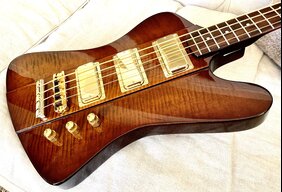
Post a pic of the cousins - lets get some Gibson love in here!

WP_20150930_002.jpg

Here are the cousins
 
  • Like
Reactions: GBassNorth
I don't think so.I seriously doubt either of those will ever acquire Yorkville/Traynor and as long as there are custom luthiers I'll be all set

This is hilarious to a Canadian.

You do realize that Traynor/Yorkville is the L&M house brand, right? They're the equivalent of Acoustic at GC. They will never be going anywhere for that reason.

I also doubt any brand is actually threatened by Traynor/Yorkville sales as well. Ripping off Ampeg only goes so far.
 
This is hilarious to a Canadian.

You do realize that Traynor/Yorkville is the L&M house brand, right? They're the equivalent of Acoustic at GC. They will never be going anywhere for that reason.

I also doubt any brand is actually threatened by Traynor/Yorkville sales as well. Ripping off Ampeg only goes so far.
I was not aware of that as I am from the states.I like the Yorkie gear I've used alot more than any Acoustic I've ever played.Just out of curiosity how did Yorkville/Traynor rip off Ampeg?Was there some sort of copy right infringement that I'm unaware of?
 
I was not aware of that as I am from the states.I like the Yorkie gear I've used alot more than any Acoustic I've ever played.Just out of curiosity how did Yorkville/Traynor rip off Ampeg?Was there some sort of copy right infringement that I'm unaware of?

Oh no, nothing that close. It's just aesthetically and tonally Traynor gear is closest to Ampeg's stuff (in my opinion, at least.) Yorkville stuff isn't so Ampeg-y.
 
  • Like
Reactions: orange joe
the did basically continue the SUNN as a Bassman amp...(I want to say it was the Bassman 300) but it was a few years before the tube revival...mind you, their newer all tube amps get a lot of love..
Although initially marketed with both the Sunn and Fender badges, it had no Sunn legacy in it. It was designed from the ground up in Fender's engineering labs, designed by Bill Hughes (creator of the SVT)
 

Latest posts