
Enjoy the benefits of a premium membership!
Upgrade Account
-
TalkBass has been independent since 1998. Add your voice.
Create a free account to reply to discussions, view embedded media, and browse with fewer display ads.
Join free Log in
Want zero display ads or expanded classifieds tools? Compare plans.
You are using an out of date browser. It may not display this or other websites correctly.
You should upgrade or use an alternative browser.
You should upgrade or use an alternative browser.
More options
Who Replied?
Walnut's as good a neck wood as a lot of others, and with thoughtful neck construction it's nothing to worry about...You don't often see heavy use of walnut in necks for whatever reason, so I'd caution people to build what they feel is best without worrying about fitting into someone else's arbitrary rules.

Warmoth agrees: Invalid Link RemovedWalnut's as good a neck wood as a lot of others, and with thoughtful neck construction it's nothing to worry about...
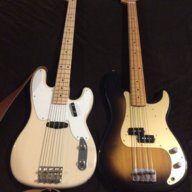
Not saying you're 100% wrong,it's just that I've seen maybe 5 pictures of walnut necked basses in all my life. I figure there's got to be a reason beyond the small premium in price. I agree that some sort of multi piece neck would be the safe bet.Walnut's as good a neck wood as a lot of others, and with thoughtful neck construction it's nothing to worry about...
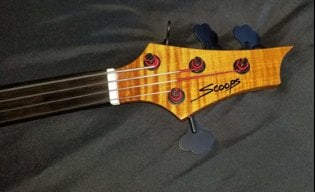
Not saying you're 100% wrong,it's just that I've seen maybe 5 pictures of walnut necked basses in all my life.
OK, let's make that 6
Walnut Jazz
And 7
Winter 2017 Build Off - Flamed Claro
Good to know that by the end of the contest, your view of walnut necked basses will at least double
Last edited:


small premium in price
Where I buy my wood, Woodworkers Source, 6/4 walnut is $13.99 a Bd. Ft., while 6/4 maple is $7.29 a Bd. Ft.. That's pretty much double the price, hardly a small premium.
Which over a 3' 1x4 is going to be 7 bucks. Whether you can actually buy a piece of walnut that size is another story.Where I buy my wood, Woodworkers Source, 6/4 walnut is $13.99 a Bd. Ft., while 6/4 maple is $7.29 a Bd. Ft.. That's pretty much double the price, hardly a small premium.
I'm just trying to give an alternative viewpoint for somebody who's going to put 3-6 months work into something they may have never made before. They could end up with a neck that is either heavy,floppy or doesn't react to climate changes as they'd expect. Never seen a Fodera, Sadowsky,Warwick,Lull etc with a walnut neck.

- Apr 18, 2008
- 16,011
- 1
- 31,720
- Disclosures
- I'm highly opinionated and extremely self-assured
It'll be fine @Fender_Bender , don't fret. Just stay tuned here and see how everybody's build turns out. One of my favorite necks is one I built from walnut.
It won't be a problem. I don't wish to argue, but I also don't want future readers to come along and read your cautionary posts thinking that walnut has either not been used extensively, or that it has inherent problems that make it unusable as a neck wood. I'd suggest trying it first!Which over a 3' 1x4 is going to be 7 bucks. Whether you can actually buy a piece of walnut that size is another story.
I'm just trying to give an alternative viewpoint for somebody who's going to put 3-6 months work into something they may have never made before. They could end up with a neck that is either heavy,floppy or doesn't react to climate changes as they'd expect. Never seen a Fodera, Sadowsky, Warwick,Lull etc with a walnut neck.

Its a beautiful wood, and in fact has been used many times by large manufacturers, although not widely. I don't have hard evidence, but I presume, as @mapleglo did that cost factors in. For large manufacturers, it just makes sense to keep costs down, and small differences in price add up quickly in quantity.
Here are a few widely known manufacturers who have used it: Gibson, Fender, Peavey, Warmoth, Carvin. And a few boutique and small builders: Dingwall, Alembic, Rob Allen, Tom Clement. There are many walnut necks out there that have worked out just fine in the long run - there are just so many basses, and so many builders that you have to look further to see who's used it and what their experiences are. A lot less widely used than maple, but widely used at any rate. You gotta try it!


BassHappy
Supporting Member
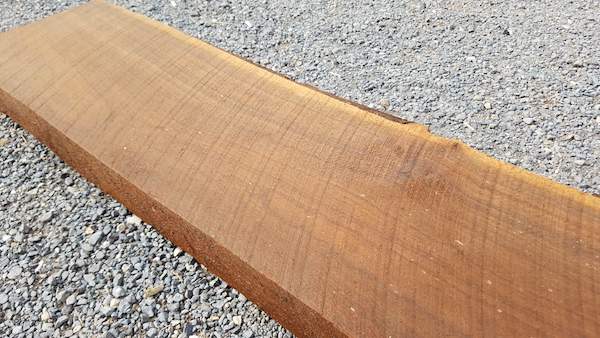
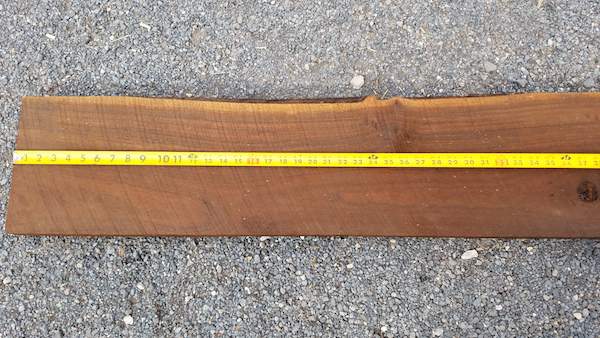
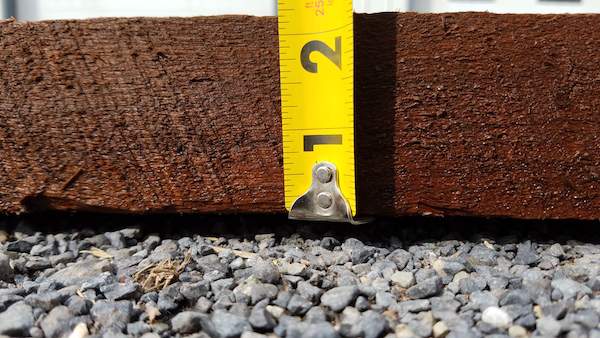
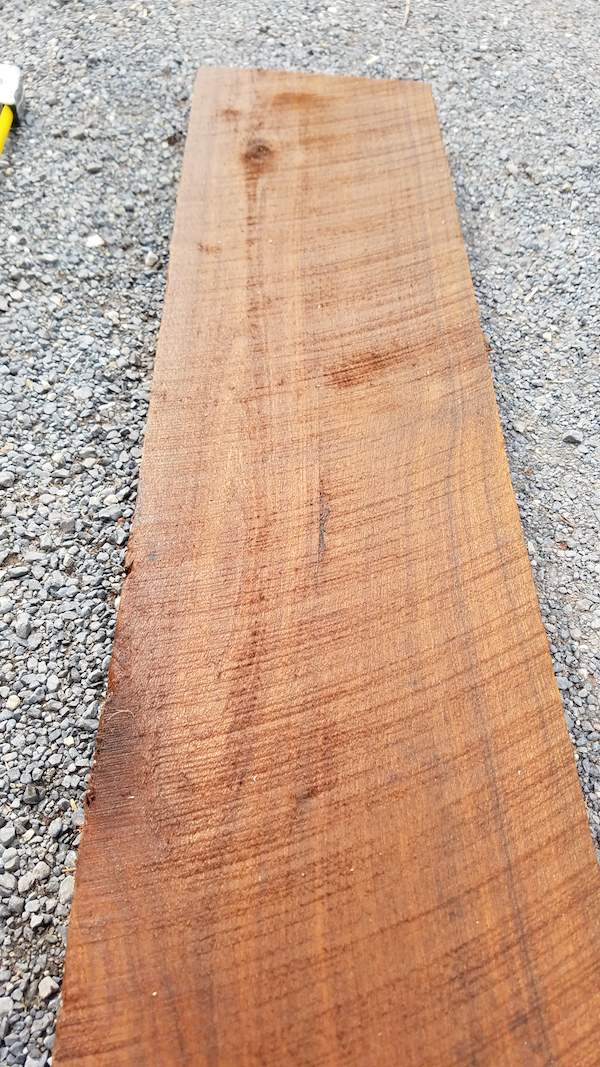
I got a slice of walnut from a tree on my wife's farm in Gettysburg. I think it's big enough to do a neck blank and 65% on the body wood - it's plus 16" wide. It was in the barn drying for at least 41 years that I know of:
Thinking very seriously of doing my own version of a 32" medium scale scroll bass just to mess with Bruce....
LOL....
Thinking very seriously of doing my own version of a 32" medium scale scroll bass just to mess with Bruce....
LOL....
DO IT! You know you want to!I got a slice of walnut from a tree on my wife's farm in Gettysburg. I think it's big enough to do a neck blank and 65% on the body wood - it's plus 16" wide. It was in the barn drying for at least 41 years that I know of:
View attachment 2763524
View attachment 2763532
View attachment 2763525
View attachment 2763531
Thinking very seriously of doing my own version of a 32" medium scale scroll bass just to mess with Bruce....
LOL....
It won't be a problem. I don't wish to argue, but I also don't want future readers to come along and read your cautionary posts thinking that walnut has either not been used extensively, or that it has inherent problems that make it unusable as a neck wood. I'd suggest trying it first!
Its a beautiful wood, and in fact has been used many times by large manufacturers, although not widely. I don't have hard evidence, but I presume, as @mapleglo did that cost factors in. For large manufacturers, it just makes sense to keep costs down, and small differences in price add up quickly in quantity.
Here are a few widely known manufacturers who have used it: Gibson, Fender, Peavey, Warmoth, Carvin. And a few boutique and small builders: Dingwall, Alembic, Rob Allen, Tom Clement. There are many walnut necks out there that have worked out just fine in the long run - there are just so many basses, and so many builders that you have to look further to see who's used it and what their experiences are. A lot less widely used than maple, but widely used at any rate. You gotta try it!
@Fender_Bender /\/\/\/\/\This/\/\/\/\
Here in the LC we are about sharing real life experiences to benefit the rest of the group.
I have shared with you 2 separate builds that I did that made use of Walnut neck. One example was a laminated through body, and the other was bolt on single piece. Not a problem with either. They both have wonderful tone, and haven't had to adjust the TR on either since their inceptions.
If we look at the Wood database, here's what we would find. (see specs below) Now while the listed specs below don't guarantee the stability of a neck, they certainly provide insight as to how they may behave.
I would think you would be better served by telling a LARGE portion of the Gibson and Martin communities that they have questionably necked instruments as Honduran mahogany ranks below Walnut in stiffness.
Black walnut
Elastic Modulus: 1,680,000 lbf/in2 (11.59 GPa)
Engilsh Walnut
Elastic Modulus: 1,568,000 lbf/in2 (10.81 GPa)
Honduaras Mahogany
Elastic Modulus: 1,458,000 lbf/in2 (10.06 GPa)
Hard Maple
Elastic Modulus: 1,830,000 lbf/in2 (12.62 GPa)
Have a nice day
Last edited:

Rôckhewer
Commercial User
- Feb 28, 2015
- 2,922
- 9,028
- Disclosures
- Owner/Builder- RockHewer Custom Guitars LLC
I don't wish to "argue" either...
And I don't fear the question of stability by any means. With careful attention to plank selection, and proper grain orientation, as well as strength complimenting other species selections... the use...even predominant use of walnut in a neck will be ok. I am cool with that.
My (slight) issue is more an aesthetic one.
And is mainly concerning the 65% rule of the body.
I can envision a nice figured walnut top & back bookmatch hippy sammich.... (neck-thru)
with some happy contrasting accent layers...
BUT.... Then I'm not gonna use walnut for the core as well. Just.... well... no.
So... I'm looking at a body (wings) that are approx. 35 to 40% walnut.... max.
My query being.....if I were to participate in the fun, with a bass that is definitely "walnut based"....but my "walnut to other" ratio does not precisely meet or exceed the 65% benchmark..... ???


Not trying to split hairs... or change rules...or cause trouble... rock the boat.... etc...
And I don't fear the question of stability by any means. With careful attention to plank selection, and proper grain orientation, as well as strength complimenting other species selections... the use...even predominant use of walnut in a neck will be ok. I am cool with that.
My (slight) issue is more an aesthetic one.
And is mainly concerning the 65% rule of the body.
I can envision a nice figured walnut top & back bookmatch hippy sammich.... (neck-thru)
with some happy contrasting accent layers...
BUT.... Then I'm not gonna use walnut for the core as well. Just.... well... no.
So... I'm looking at a body (wings) that are approx. 35 to 40% walnut.... max.
My query being.....if I were to participate in the fun, with a bass that is definitely "walnut based"....but my "walnut to other" ratio does not precisely meet or exceed the 65% benchmark..... ???
Not trying to split hairs... or change rules...or cause trouble... rock the boat.... etc...

I got a slice of walnut from a tree on my wife's farm in Gettysburg. I think it's big enough to do a neck blank and 65% on the body wood - it's plus 16" wide. It was in the barn drying for at least 41 years that I know of:
View attachment 2763524
View attachment 2763532
View attachment 2763525
View attachment 2763531
Thinking very seriously of doing my own version of a 32" medium scale scroll bass just to mess with Bruce....
LOL....
I never saw this coming from someone in the "walnut is not a tone wood" camp.
<snip>
My (slight) issue is more an aesthetic one.
And is mainly concerning the 65% rule of the body.
<snip>
So... I'm looking at a body (wings) that are approx. 35 to 40% walnut.... max.
<snip>
Let's ponder this for a day or so.
We'll let the masses express their views as well.
My thought is 50% walnut minimum. After all this is a Walnut free for all.
I don't want to play Walnut Nazi either, so self adherence to to this guideline will be greatly appreciated.
Last edited:
@Rôckhewer you could always use a figured wood top (not walnut) with a walnut core and walnut back with lots of fancy dancy veneers n' stuff between the layers. That would get you there...
I'm already thinking of doing something similar, like one of my driftwood tops and a walnut core with a walnut back. The possibilities are endless...
I'm already thinking of doing something similar, like one of my driftwood tops and a walnut core with a walnut back. The possibilities are endless...
I like the idea of as much walnut as possible. I see it as a challenge to take a single material and create the effects that are typically achieved with multiple woods. Just my .02 as a bystanderLet's ponder this for a day or so.
We'll let the masses express their views as well.
My though is 50% walnut minimum. After all this is a Walnut free for all.
I don't want to play Walnut Nazi either, so self adherence to to this guideline will be greatly appreciated.
I like the idea of as much walnut as possible. I see it as a challenge to take a single material and create the effects that are typically achieved with multiple woods. Just my .02 as a bystander
I understand the challenge presented @Rôckhewer. I face the same conundrum. If I go with a .75" thick core of flamed maple, which I think would look good with the other thin laminates I'm intending, the body would have to be nearly 2" think. I probably won't go the maple core route.



I'm curious about all this hesitation on making mostly walnut necks. Is it for an aesthetic reason? Or has the maple lobby gotten to everyone? I would think a walnut neck with maple stringers would not only be lovely but structurally sound too.


