• TalkBass has been independent since 1998. Add your voice.
    Create a free account to reply to discussions, view embedded media, and browse with fewer display ads.
    Join freeLog in
    Want zero display ads or expanded classifieds tools? Compare plans.

Winter Build Off 2023 - Supersymmetry

Aug 24, 2020
627
2,374
Finland
Welcome to my WBO23 build thread! Gonna get hella nerdy over here. This is going into the non-bass category.

Supersymmetry is an essential concept in many physical and mathematical theories, including quantum mechanics, quantum field theory, string theory (a concept all guitarists and bassists should be familiar with) and many others. More specifically, it is a spacetime symmetry between half-spin fermions and integer spin bosonic particles. The study of Calabi–Yau manifolds has even shown that different string theories of type IIA and type IIB are related through mirror-symmetry, resulting in the same physics. However, specific string theories do not obey typical supersymmetry (such as E7xE7, SU(16) and E8), which require the existence of tachyons (with imaginary mass) or a special case of misaligned supersymmetry. In general, with the maximum of eight supersymmetric copies and a spinor having four degrees of freedoms, 32 kinds of supersymmetry are possible. In d dimensions a spinor is approximately of size 2^(d/2) or 2^((d − 1)/2), limiting the number of possible dimensions in supersymmetric theories to 11.

Now that we’re all caught up on the basics, let me present my own supersymmetric project.

This is my second ever build from a couple of years ago. It has some visual flaws and woodworking mistakes of course, but it plays nicely and sounds good. To this day it is my favorite guitar for recording. Here’s the problem, though: It’s almost impossible to play standing up. It suffers from significant neck dive, and I sometimes hit the long lower horn with my left wrist when playing higher up the neck.

20221222_103721(0).jpg


I think there’s hope for this design if I can reverse it. Oh, now that we’re at it I should reverse the headstock as well to have the whole guitar mirrored. And use a headless bridge to get rid of any neck dive while keeping the headstock. And make it black. Yes, it has to be black. Definitely black.

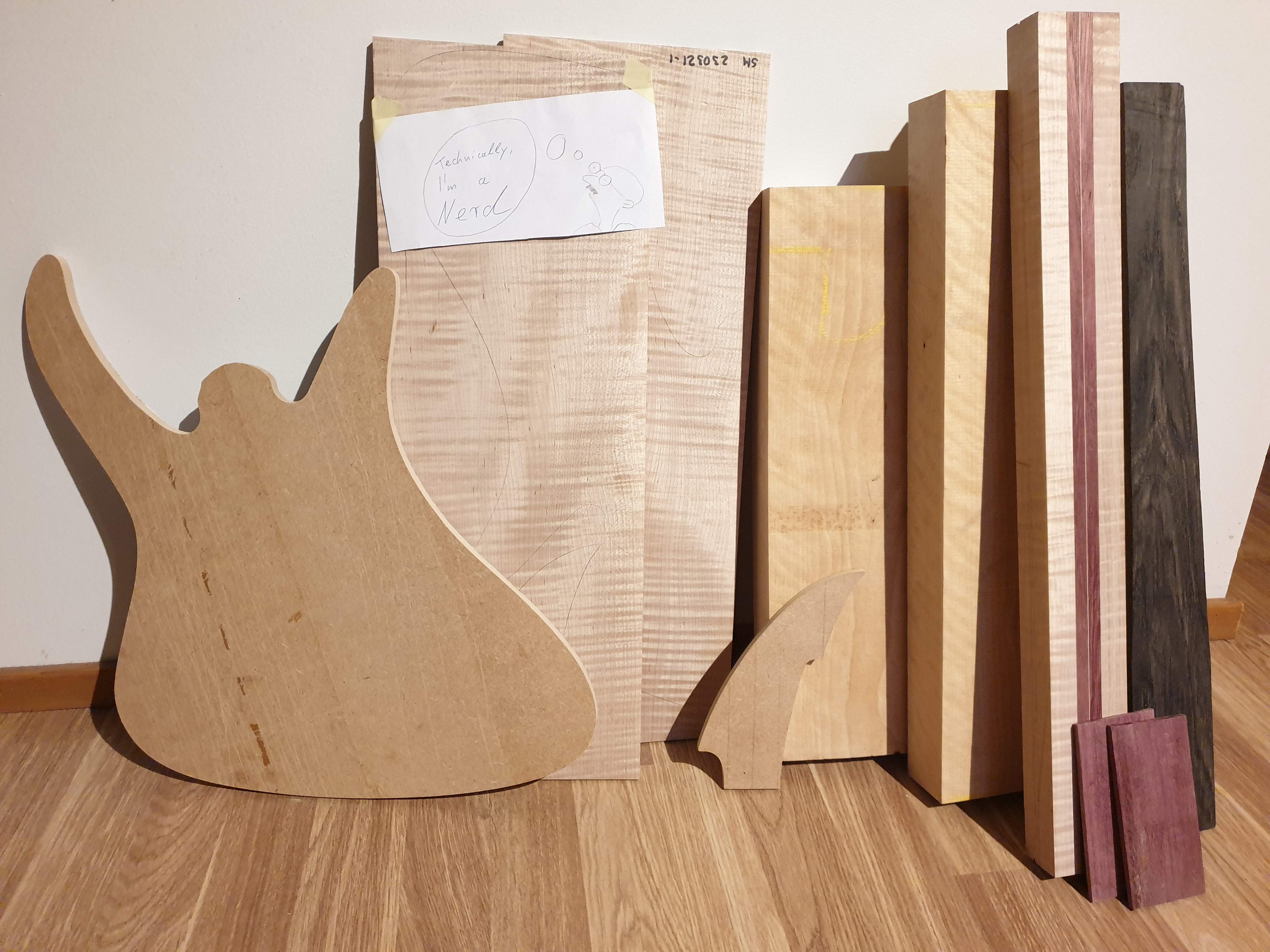
It will be the mirrored shape of my old guitar; besides that, I’m planning the following changes:

- 2pc flamed birch body
- flamed maple top and headstock, stained black with faux binding (and a black veneer underneath)
- multilaminate maple and purpleheart 5 pc neck with a bog oak fretboard
- Seymour Duncan Black Winter bridge humbucker, no neck pickup.
- master vol, master tone, coil split mini toggle switch
- ABM headless individual bridges and headpieces, all black
- longer scale length with slightly fanned frets (vertical nut with slanted bridge)

I recently started recording with a new metal band, and we use low tunings. Very low actually, Bb standard and drop Ab. I’m thinking 26.22” (666 mm:smug:) on the bass string and 25.72” (654mm) on the treble side, so it’s somewhere between a Fender (25.5”) and a baritone (27”).
20221222_103252.jpg


Alright, let’s do this!
 
Here's a bit more information on this build:

This will be a useful quote whenever you botch something up.

My thought exactly! I've slightly tweaked the shape, so it's not going to be perfectly symmetric to my old one. The cutaway at the short horn is extended for high-fret access and the headstock shape is about 10% smaller. Since I'm using headless hardware there is no real need for a headstock, but I just don't like the look of an abruptly ending neck, so I'm keeping the headstock - just a little smaller.

Also, the first pieces of hardware arrived today. Here we have the ABM headless bridge and the small individual headpiece. The headpieces will be screwed onto the headstock where the tuners would usually go. There will be a recess in the body behind the bridge, like the Ibanez headless basses for example.
20221222_201622.jpg


The pickup arrived today as well. It's a Seymour Duncan Blackened Black Winter. The old guitar has normal Black Winter pickups and they already sounds pretty mean. How much more black could this be? The answer is none. None more black. I mean, just look at it.

I also want to give you an update on my workshop situation. Until about three years ago there was a communal woodworking space in my city that you could use for a small fee. It had fantastic machines, a big tablesaw, jointer, planer-thicknesser, router table, two big bandsaws, drill press, belt sanders, you name it. Then it was closed during covid and never reopened. I had just bought a stash of rough-sawn lumber thinking that I could cut and plane it there, so during the last builds I did a lot of strenuous hand tool work at home. If you've ever resawn a wenge body blank or top by hand, then you know what I'm talking about. Last week I found out that the woodshop is miraculously reopening in January, which will of great help during this project.

I will now start working on the neck and fretboard, and later when the woodworking space has reopened I will continue with the body.

FYI, this was the inspiration for my old guitar, some youtube covers by Jassy J. I watched them right around when I started playing guitar. I think hers was a one-off made by MGH guitars in Berlin.
 
After reading through all that, I have to ask, do you work at CERN? :eyebrow:
I'm a physicist, but no, I don't work at CERN. Actually my field of research is quantum mechanics and quantum information/computing, and it's not directly connected to supersymmetry. However, I have visited CERN during my studies to attend a few seminars. It's a nice place.

EDIT: And congratulations that you actually read it all the way through, I didn't really expect anyone to do that.
 
I'm a physicist, but no, I don't work at CERN. Actually my field of research is quantum mechanics and quantum information/computing, and it's not directly connected to supersymmetry. However, I have visited CERN during my studies to attend a few seminars. It's a nice place.

EDIT: And congratulations that you actually read it all the way through, I didn't really expect anyone to do that.
I asked because there's this guy that I follow on FB and YT who does work at CERN who also builds guitars, he builds under the name "Traq Guitars". So when I read all that my brain went "Wait a minute, could this be the same guy?" :laugh:
That guy is a particle physicist. I wasn't far off, it wasn't a huge leap. ;)
 
  • Like
Reactions: TFM94
I asked because there's this guy that I follow on FB and YT who does work at CERN who also builds guitars, he builds under the name "Traq Guitars". So when I read all that my brain went "Wait a minute, could this be the same guy?" :laugh:
That guy is a particle physicist. I wasn't far off, it wasn't a huge leap. ;)
I just checked out his builds, some really neat stuff. There is a stunning correlation with a lot of physicists being musicians in their free time, but usually not so much with woodworking.
 
  • Like
Reactions: TerribleTim68
There is a stunning correlation with a lot of physicists being musicians in their free time, but usually not so much with woodworking.

I resemble the first part of that, but being an Acoustical Physicist, being a musician isn't all that surprising. And I do like woodworking - while admittedly not being all that advanced at it.
 
  • Like
Reactions: TFM94
I read it too. And you know what: I have read in several places that 11 (or 10) dimensions is the maximum, but this was the first time I came across a plausible reason for it. So thanks.

The folks quoting the number of dimensions are string theorists. If they ever get to the point where the theory starts to resemble and predict reality, then we can start talking about whether the number of dimensions they predict (and their rational for that number) makes any sense. But for now, it's an interesting exercise.
 
The folks quoting the number of dimensions are string theorists. If they ever get to the point where the theory starts to resemble and predict reality, then we can start talking about whether the number of dimensions they predict (and their rational for that number) makes any sense. But for now, it's an interesting exercise.
Good point. In his defense, @Flamingo21 called it a "plausible" explanation. I should point out that string theory is exactly that, a theory, and is still lacking supporting experimental results. For now, in it's field it is the most accepted theory mostly for a lack of alternatives, but it's nowhere near confirmed. Hence, this build project could fall apart anytime.
 
  • Like
Reactions: mikewalker
Good point. In his defense, @Flamingo21 called it a "plausible" explanation. I should point out that string theory is exactly that, a theory, and is still lacking supporting experimental results. For now, in it's field it is the most accepted theory mostly for a lack of alternatives, but it's nowhere near confirmed. Hence, this build project could fall apart anytime.

String theory hasn't predicted anything that's been measured - it's far from the level of things like Einstein's work - he predicted a lot of things that (while not at all intuitive) have been verified experimentally. String theorists, if they're honest, will tell you it hasn't passed any testing that might endow "acceptance" on it. Yes, some people have been working on it for decades, but that isn't the criteria by which a theory gets accepted.
 
Welcome to my WBO23 build thread! Gonna get hella nerdy over here. This is going into the non-bass category.

Supersymmetry is an essential concept in many physical and mathematical theories, including quantum mechanics, quantum field theory, string theory (a concept all guitarists and bassists should be familiar with) and many others. More specifically, it is a spacetime symmetry between half-spin fermions and integer spin bosonic particles. The study of Calabi–Yau manifolds has even shown that different string theories of type IIA and type IIB are related through mirror-symmetry, resulting in the same physics. However, specific string theories do not obey typical supersymmetry (such as E7xE7, SU(16) and E8), which require the existence of tachyons (with imaginary mass) or a special case of misaligned supersymmetry. In general, with the maximum of eight supersymmetric copies and a spinor having four degrees of freedoms, 32 kinds of supersymmetry are possible. In d dimensions a spinor is approximately of size 2^(d/2) or 2^((d − 1)/2), limiting the number of possible dimensions in supersymmetric theories to 11.

Now that we’re all caught up on the basics, let me present my own supersymmetric project.

This is my second ever build from a couple of years ago. It has some visual flaws and woodworking mistakes of course, but it plays nicely and sounds good. To this day it is my favorite guitar for recording. Here’s the problem, though: It’s almost impossible to play standing up. It suffers from significant neck dive, and I sometimes hit the long lower horn with my left wrist when playing higher up the neck.

View attachment 4910338

I think there’s hope for this design if I can reverse it. Oh, now that we’re at it I should reverse the headstock as well to have the whole guitar mirrored. And use a headless bridge to get rid of any neck dive while keeping the headstock. And make it black. Yes, it has to be black. Definitely black.

It will be the mirrored shape of my old guitar; besides that, I’m planning the following changes:

- 2pc flamed birch body
- flamed maple top and headstock, stained black with faux binding (and a black veneer underneath)
- multilaminate maple and purpleheart 5 pc neck with a bog oak fretboard
- Seymour Duncan Black Winter bridge humbucker, no neck pickup.
- master vol, master tone, coil split mini toggle switch
- ABM headless individual bridges and headpieces, all black
- longer scale length with slightly fanned frets (vertical nut with slanted bridge)

I recently started recording with a new metal band, and we use low tunings. Very low actually, Bb standard and drop Ab. I’m thinking 26.22” (666 mm:smug:) on the bass string and 25.72” (654mm) on the treble side, so it’s somewhere between a Fender (25.5”) and a baritone (27”).

View attachment 4910339

Alright, let’s do this!

Cool looking bass.

I understood almost none of what you wrote.

Still a cool looking bass though.
 
Still a cool looking bass though.
HEP and bass? Count me in! :D

I was torn wether I should call this a guitar or a bass. In terms of tuning it's closer to a bass (or bass VI), but it will not fulfill the requirement of of minimum string gauge 0.84" to be entered as a bass in this build off. Accordingly, I've specified that this goes into the non-bass category. If you want to call it a bass, though, go ahead.
 
  • Like
Reactions: Isaac_James
I was torn wether I should call this a guitar or a bass. In terms of tuning it's closer to a bass (or bass VI), but it will not fulfill the requirement of of minimum string gauge 0.84" to be entered as a bass in this build off. Accordingly, I've specified that this goes into the non-bass category. If you want to call it a bass, though, go ahead.

Oh whoops, didn't see that it was baritone guitar Bb instead of bass Bb standard! I'll still stick around for the ride, I always liked the baritone guitar's range more than the regular guitar's.
 
  • Like
Reactions: TFM94