• TalkBass has been independent since 1998. Add your voice.
    Create a free account to reply to discussions, view embedded media, and browse with fewer display ads.
    Join freeLog in
    Want zero display ads or expanded classifieds tools? Compare plans.

Winter Build Off 2025 - 39er for Dicksbass.com

Hi Folks,

This build is for a fellow TBer @dickwagor who contacted me after seeing some of my instruments online.

Richard is a fairly big guy and needed a fairly big bass - something I was happy to help with.

Some specs
39” scale five string
BEADG Tuning with Newtone Strings
Rose mahogany body (one piece)
Rose mahogany and silver ash laminate neck
Buloke fretbaord
Twin Delano split P pickups
Black Hipshot Ultralite tuners
19mm spacing, with individual bridges
A thick neck! 25mm (1”) at the first fret!

This will have a much more subdued aesthetic when compared with most of my basses, and for that reason, I am excited about building it.

Obligatory wood pile photo below
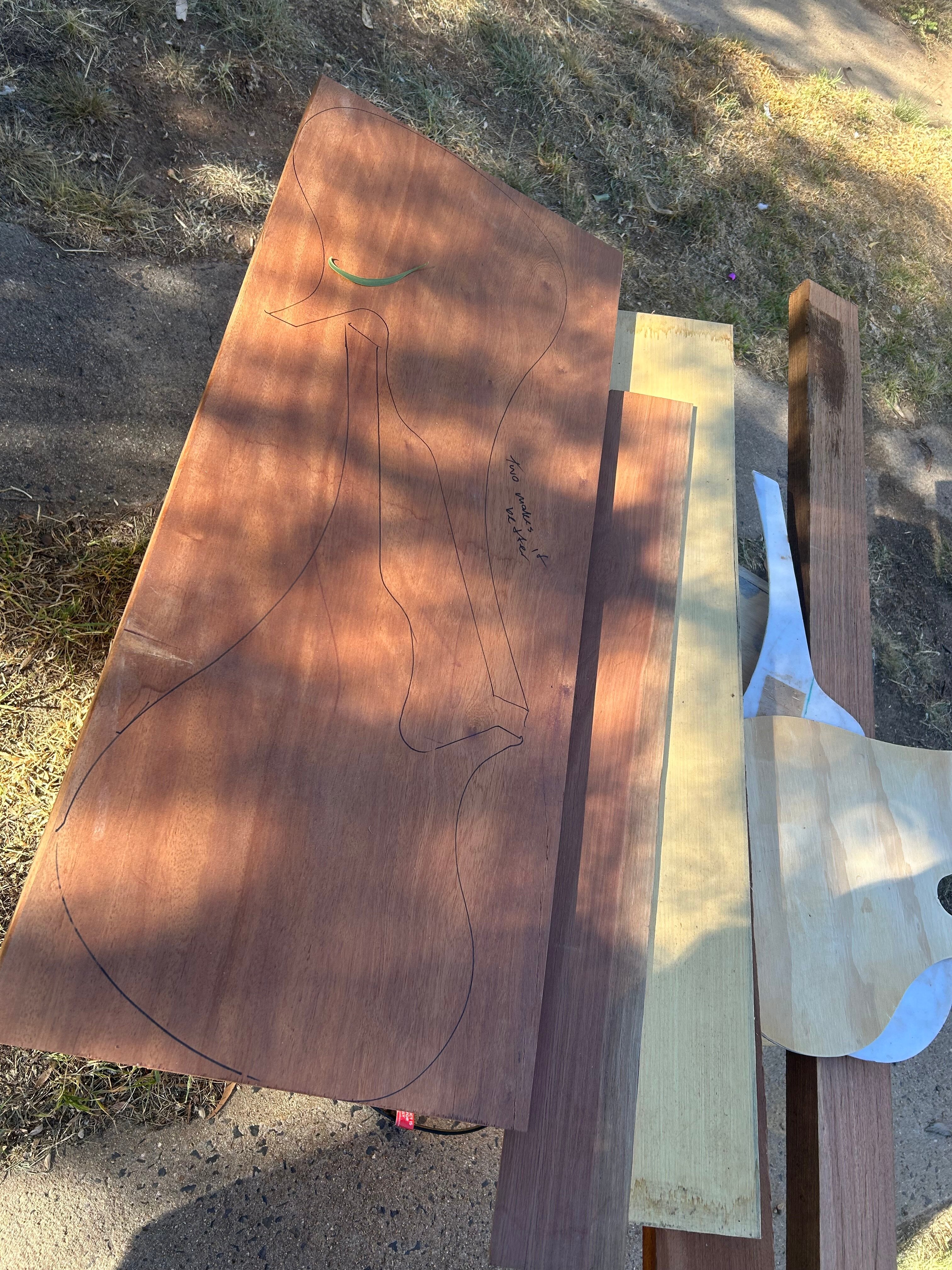
IMG_9923.jpeg


As for fitting with the twin theme, you will see I have two bodies traced on the mahogany slab. One for Richard, and one for me. Mine will come at a lot later date, but it will still be a twin of sorts.

Stay tuned!
 
This morning I band sawed the body, trimmed it with a template and router, then put a 45 degree chamfer on.

1000001770.jpg


1000001771.jpg


This bass has some length to it. As such, I gave @dickwagor two options for grain orientation. One was grain running parallel with the strings, the other was running parallel with the upper horn. We went with grain parallel to the horn. It's a subtle difference, but it means there is no short grain for the upper horn to fail/snap at. Neither of us wanted this to be the Gibson headstock equivalent of a bass body.

This rose mahogany is a very sought after, and reasonably expensive timber is Australia. Wetting it down and putting it in the sun shows why!
 
This morning I band sawed the body, trimmed it with a template and router, then put a 45 degree chamfer on.

View attachment 7106710


View attachment 7106711


This bass has some length to it. As such, I gave @dickwagor two options for grain orientation. One was grain running parallel with the strings, the other was running parallel with the upper horn. We went with grain parallel to the horn. It's a subtle difference, but it means there is no short grain for the upper horn to fail/snap at. Neither of us wanted this to be the Gibson headstock equivalent of a bass body.

This rose mahogany is a very sought after, and reasonably expensive timber is Australia. Wetting it down and putting it in the sun shows why!
That rose mahogany is jaw dropping !
 
Hi Folks,

This build is for a fellow TBer @dickwagor who contacted me after seeing some of my instruments online.

Richard is a fairly big guy and needed a fairly big bass - something I was happy to help with.

Some specs
39” scale five string
BEADG Tuning with Newtone Strings
Rose mahogany body (one piece)
Rose mahogany and silver ash laminate neck
Buloke fretbaord
Twin Delano split P pickups
Black Hipshot Ultralite tuners
19mm spacing, with individual bridges
A thick neck! 25mm (1”) at the first fret!

This will have a much more subdued aesthetic when compared with most of my basses, and for that reason, I am excited about building it.

Obligatory wood pile photo below

View attachment 7106550

As for fitting with the twin theme, you will see I have two bodies traced on the mahogany slab. One for Richard, and one for me. Mine will come at a lot later date, but it will still be a twin of sorts.

Stay tuned!
Woooohoooo! It's begins!
 
I know I’ve used this line before but that rose mahogany is so nice I liked your post then unliked it just so I could like it again. :drool: :thumbsup:
Yeah, it's pretty nice. It smells amazing, too (hence the rose part of the name).

Aside from a mild propensity to split, it is very easy to work, too. Shame it's so damn expensive!
 
For the fretboard for this build, Richard selected Ironbark. A beautiful red eucalypt, that just so happens to have an almost identical hue to rosewood when it's finished. It's easily as hard as ebony, and while it can be a punish to work with, it's worth it.

IMG_9982.jpeg


Given this build is have a super chunky neck, I got my enginerd hat on and used a thick fretboard, plus a silver ash veneer underneath. Total fretboard thickness is almost 10mm (3/8th"). This let me sink the stainless reinforcement 4ish mm deeper into the neck. Richard wanted a stiff neck, and this will be stiff.

IMG_9980.jpeg


After some trimming using a bandsaw and then a router sled it looked like this.

IMG_9985.jpeg


A trick I've found super helpful when tapering necks on the router sled is to place an Allen key of the right thickness under the first fret. The taper on this one measured within 15 thou of where I wanted it.


Lastly, here's a work in progress mock-up.

IMG_9983.jpeg
 
Hehe! Hey all! Yeah I'm on the bigger side and an upright bass player as well. I'm 6'7" for one thing. So... a 39" scale is only like a half size upright so I don't think this will be so weird. The extended scale is aimed at getting it so my right arm isn't cramped up , this will also hopefully relieve right shoulder and neck distress. This is a picture of me playing my fender modern player V . Hopefully this build will let me drop my right arm and eliminate the right shoulder being raised as you can slightly see in the photo.
 

Attachments

  • 53817448757_588e39a9e4_o.jpg
    53817448757_588e39a9e4_o.jpg
    3.1 MB · Views: 27
A lovely new keyless chuck turned up for my drill press today (why didn’t I put a keyless chuck on it years ago?!), so I drilled some holes.

This is somewhere that engineering meets lutherie. In portal frame and I -beam construction joining plates do not get their strength from the bolts in them, but the friction that the bolts create in the between the plates they are sandwiching. This neck/body joint will be the same.


A tight fitting neck pocket is all well and good, but with enough clamping force, it is entirely unnecessary to get pedantic about. Something else people hung up on tight neck joints often don’t consider is that their tight joint may simply be from two point of pressure, rather than a uniformly undersized pocket. I may be committing lutherie heresy here, but I’ll stand by my words. With those words said, this is not a loose pocket.

Nine screws did the job here. I suspect that while he does it for artistic reasons as much as anything else, Jens Ritter is across this.

I do like the Bruce Bar approach, and it’s arguably better than a lot of screws. A lot of screws and a deep pocket should achieve the same objective, however (plus it looks cooler IMHO).

IMG_0041.jpeg
 
Last edited: