• TalkBass has been independent since 1998. Add your voice.
    Create a free account to reply to discussions, view embedded media, and browse with fewer display ads.
    Join freeLog in
    Want zero display ads or expanded classifieds tools? Compare plans.

Wired IEM with Dual (Instrument/Headphone) Cable

drpepper

Supporting Member
Jul 20, 2009
4,805
3,120
Columbia, Maryland
www.facebook.com
This would really only be of interest if you run your bass wired and are using or looking into IEM setups (and aren't 100% sure of the details of available options). While there is a sort of intuitive attraction to wireless IEMs, I've found that running wired bass, on balance, leaves almost no practical advantage to wireless IEMs. There are individual advantages to either one, and how those come out on balance is a matter of personal preference, but that shouldn't be based on mistaken ideas about what is involved.

A number of comments I've seen make me believe that there are general notions floating around that wired IEM setups are more involved and cumbersome than they actually have to be. There also seem some naturally picked up misconceptions about what's required. I saw one comment that a wired IEM setup involving "a small mixer" was recommended; that one left me scratching my head. I'm aware of and briefly looked at the Jump Audio IMX system but it doesn't really make sense to me given the alternatives...I can see (while still considerably less that higher tier wireless systems) how some people might be turned off by the prices alone.

Wired IEM involves exactly what the name says; simply getting a wired signal to your ears. At bottom, this requires a headphone amp. Beyond that, there are multiple forms that the setup can take in terms of details of the configuration and cabling and in terms of cost.

My progression through this has been that I was using wireless for both my bass and IEMs. Over time, I found that wireless for my bass really wasn't doing anything for me, and overall, I actually preferred wired. I ditched my wireless bass unit but kept using wireless IEMs. Over time and with a couple of unfortunate incidents, I began to question that and not knowing too much about available wired solutions, I looked into it. I decided that using a simple (DIY) dual instrument/IEM cable made the most sense for me. The recent addition for me of audio over cat cable snakes makes it an absolute home run.

Since it seems like written descriptions and photos sometimes don't fully convey what's meant, some of the comments I had seen recently prompted me to try to share in a short video describing what's working for me. If you're considering wired IEMs but aren't sure what the various options involve or have come to believe that it's necessarily a cumbersome setup, this perspective might be of benefit.


(Edit: Based on comment prior to the post, I have considered having a volume control at my hip which could be done with an inline volume control (<$10 item) but I haven't felt the need. I generally use the volume control on the headphone amp during setup/soundcheck and on the control app after that. That's been sufficient for me.)
 
Last edited:
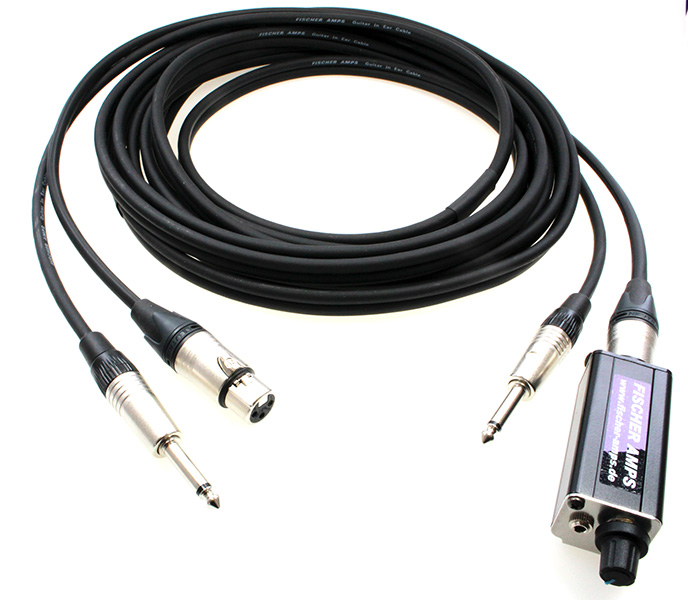
Thanks for the video. I would like to have the fragile IEM cable more out of the way, though. Could buy stereo microphone cable, like Mogami W3106, terminate it, and add a volume control. More or less how Fischer Amps does it with their ready-made cables.

haa001121.jpg
 
  • Like
Reactions: drpepper
I use a wireless for my bass and it's been a godsend, mostly because I smash cables with my right foot when dancing. I'm slowly moving to a headset and I'm trying to figure if it's more worth it to go back to cables or if I'll need to drop the cash on a wireless unit. If my headset is going to be cabled my bass will be too. It's not that hard to make a snake out of two cables; I just gotta figure how to route it so I don't render them useless every few months.
 
  • Like
Reactions: drpepper
I'm just starting in on IEM's and have decided to start wired. I do move around on stage a bit, but nothing too crazy. After watching @drpepper 's video (very well done!), I've ordered the parts to make this dual cable and hopefully will have a working version later this week.
 
@drpepper I do the same thing. I have a Behringer P2 attached to my pedalboard and run a smaller cable along side my instrument cable like you do. It works like a charm and is super simple. The following cable is the one I'm using and so far has held up great. I also keep a spare setup in my bag in case one of the cables fail.

3.5mm Male to Female AUX Extension Cable 20 ft,Ruaeoda Long Headphone Stereo Audio Extension Cable Double Shielded Braided 1/8 3.5mm Extension Cord : Electronics (amazon.com)
 
As an Amazon Associate, TalkBass may receive commissions from qualifying purchases made via links on this site.
Thanks for the video. I would like to have the fragile IEM cable more out of the way, though. Could buy stereo microphone cable, like Mogami W3106, terminate it, and add a volume control. More or less how Fischer Amps does it with their ready-made cables.

Yep, as I said there are multiple forms that the setup can take in terms of details of the configuration and cabling and in terms of cost. Whatever works and feels best.

The practical reality could be different than what I imagine and we can have different sensibilities, but I don't see the IEM cable as being particularly fragile and I don't really want to wear the headphone amp as a beltpack. Also, going in that direction wouldn't work for stereo IEMs, which may or may not be an issue.
 
65ADDFDA-DCC1-4E3B-BE4E-616B1FA28598.jpeg


I happily use wired IEM with a Presonus belt pack. I tethered the Presonus audio and power cables to my bass instrument cable. I put the pack on my back right pocket, and plug in my bass and IEM to the pack and am off and running. Feels no different than just my normal instrument cable. Thinking about getting a simple headphone extension cable to leave the presonus belt pack down on my pedal board and only have one thin cable tethered to my bass cable…

(yeah I also use an Aguilar 2x10 1x15 stack that I may or may not even turn on. I honestly use it more for looks on IEM gigs.)

edit to add: I need stereo IEMs and chose the presonus because it offers a proprietary thin/light stereo audio cable that branches off to accept two XLRs.
 
Last edited:
I'm just starting in on IEM's and have decided to start wired. I do move around on stage a bit, but nothing too crazy. After watching @drpepper 's video (very well done!), I've ordered the parts to make this dual cable and hopefully will have a working version later this week.

As I said, you'll kind of figure out as you go on working with the sleeving, but a few lessons learned...

- Melt the end when you cut the sleeving, if you don't the fraying can get out of control

- Don't try to cut the length of sleeving, you lose length from fraying and diameter expansion over the nominal size. Instead, cut the second end after you've got it put together the way you want

- Use shrink tube instead of tape

- Lay the cables out side by side as you feed to avoid having the cable wrap around each other
 
Yep, as I said there are multiple forms that the setup can take in terms of details of the configuration and cabling and in terms of cost. Whatever works and feels best.

The practical reality could be different than what I imagine and we can have different sensibilities, but I don't see the IEM cable as being particularly fragile and I don't really want to wear the headphone amp as a beltpack. Also, going in that direction wouldn't work for stereo IEMs, which may or may not be an issue.

The Fischer Amps belt packs have a stereo switch, allowing you to receive a stereo signal over a single mic cable, just need an adapter.

Any loose cable on you is eventually going to get caught on something. These days, I run the IEM cable under my shirt and make sure there's no extra. Was wired last weekend, and the length of cable going to the belt pack was caught on a mic stand. The locking XLR connector survived without damage, but the situation could've been different with a 3.5mm stereo plug.

Adaptor%20cable-001142_web.jpg
 
The Fischer Amps belt packs have a stereo switch, allowing you to receive a stereo signal over a single mic cable, just need an adapter.

Any loose cable on you is eventually going to get caught on something. These days, I run the IEM cable under my shirt and make sure there's no extra. Was wired last weekend, and the length of cable going to the belt pack was caught on a mic stand. The locking XLR connector survived without damage, but the situation could've been different with a 3.5mm stereo plug.

Again, we can have different sensibilities. Whatever you're comfortable with is what you're comfortable with.
 
  • Like
Reactions: Windreaper
Very nice...and timely as I was thinking about doing something like this. I do use a wireless for my bass most of the time, and have a wired IEM unit. I run a long XLR cable from the mixer to the IEM that is clipped to my belt or pocket. But sometimes I cant use the bass wireless and instead of clipping it to my waist, I could velcro it to my pedal board and just run a long 1/8".
 
  • Like
Reactions: drpepper
Here's another thread on this topic from a few years ago.

IEMs and extension cables

Yep, there's at least a few threads on the topic generally and specifically to these same dual cables. I posted on that one and other...I started a thread in 2016 when I was first looking into it.

I started a new thread because it just seems to me that sometimes subjects bear updating and a fresh start so that the post don't require wading through a whole thread.
 
You can also use 5 pin XLR and make a custom cable.
Headphone jack (3 pin) + 1/4" bass (2 pin) > XLR-5 on both ends

XLR4 and share the same ground would also work

The TC Helicon cable uses a regular, round 4 or 5 conductor cable, and this would be the preferable way of doing it for me. That specific cable became my go-to, but started getting hinky after 6 years. Maybe I'll open the ends and reflow the solder to see if that's where the issue is.

Had they still been available, I would have have kept buying them.

For someone who can competently terminate the ends using a 5 conductor cable and do a nice, tight job, you're right, that'd be the way to go. I could be underestimating my abilities, but it just seems a bit too ambitious for me on a gut level.
 
I've already got the materials to fabricate drpeppers combined cable, but I can see where the 5pin XLR would also be a good approach. Pardon my uninformed question, but really, you just need 5 conductor cable for this right? 2 for the 1/4" instrument part and 3 for the 3.5mm stereo part .... not necessarily XLR ?
 
I've already got the materials to fabricate drpeppers combined cable, but I can see where the 5pin XLR would also be a good approach. Pardon my uninformed question, but really, you just need 5 conductor cable for this right? 2 for the 1/4" instrument part and 3 for the 3.5mm stereo part .... not necessarily XLR ?

Right...he was referring to the bare cable that is used for 4 or 5 pin XLRs, not with XLR connectors on the ends.

And using braided sleeving is hardly *my* design or even idea or modification; it's just the option that I latched onto. Others here did it before me, and you can buy them already assembled and built to order (~$60-120). It's just that it's a pretty easy thing to do yourself for a few dollars in materials over the cost of the cables, so doable for less than half of the cost of the lowest priced built cable.

You can leave the cables separate; bundle them with tape, zip ties, velcro, rubber bands, twist ties, etc. You can get a similar result with do the same thing with the Jump IMX, which is effectively a dual cable with belt pack volume control and still requires a headphone amp ($199). You can get the cables that Fisher resells/redistributes (~$120 for mono and ~$170 for stereo - requiring a headphone amp that supports unbalanced stereo). There are a number of options.

The DIY dual cable is the one that's most attractive to me.
 
Last edited: