• TalkBass has been independent since 1998. Add your voice.
    Create a free account to reply to discussions, view embedded media, and browse with fewer display ads.
    Join freeLog in
    Want zero display ads or expanded classifieds tools? Compare plans.

Wood choices and considerations

How important do you consider hardness? I see a lot of bass bodies made of soft woods such as basswood and okoume these days. Should I be concerned about durability?


Consideration of hardness and durability depends on the component you're choosing wood for. Fretboards obviously need to be very hard to hold frets and hold up to play wear. Necks see a lot of handling so they need to be hard too. Wood choices that are good enough to be used for necks and fretboards in terms of stiffness are usually hard enough, so it's not really a primary concern.

Bodies are pretty much the only place where woods like you're mentioning come in to play. Bodies have a bigger tolerance for durability, and the impact of low durability is mostly cosmetic until you get to wood choices that are so soft they can't even hold a screw. But woods that soft are often so light weight that the bass would be unbalanced. So as long as you are ok with cosmetic damage and choosing woods that will hold screws OK and won't cause balancing issues, it's hard to go wrong.
 
  • Like
Reactions: mrperkolator
Roasting doesn't increase hardness, at least not in a way that would be transformational. Wood that is heavily roasted tends to have some negative side effects too - it gets brittle and the grain starts breaking down. Heavily roasted red cedar would probably be about like working with textured chalk. I don't think it would really get you to a better place in terms of durability for a body, for instance.

Roasting can have an advantage in terms of stabilizing heavily figured wood. Otherwise - in my book at least - it's as much a cosmetic treatment as anything else.

If you wanted to use a very light and commonly available softwood for bodies, one method might be to cap it top and bottom with a thin veneer of more durable wood. That would help with general play wear and handling damage. If you wanted to stick with the "generally available" criteria, you could use hard maple here in the US. Or you could just go with two layers of hard maple and hollow the body to get to your weight target. Then you'd keep the durability advantages of maple throughout the body (i.e. screw holding).
 
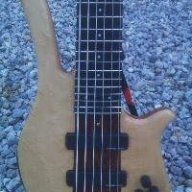
IMHO, any woods that compliment each other visually can work. Using a top over another wood can help with weight. Also, chambering the body can make huge difference in weight. When I built my bass, I used Mahogany for the main part of the body because it sounds warmer than ash or alder. My top woods were a layer of purple heart with wings of birdseye maple and a center stripe of Cocobolo. I wanted the warmer sound of the mahogany to offset the brightness of my graphite neck. It weighs a tick over 10 pounds and sounds great. I sometimes wish I would have chambered it to knock off a little weight, but it is my #1 until I croak.
IMG_3408 (2)-682x1482.JPG
 
I only mentioned Pecan and Mesquite because it's what grows here. If I go up into Oklahoma, I could add Osage orange to that list. Which could be an interesting discussion by itself.

Those are all good woods. I can get hickory (pecan) at my local wood supplier, and I eye it every time I go down there. I end up just buying maple simply because the hickory they get there just doesn’t look much different than maple. I just go with what I know in that case.

I have some mesquite and Osage orange fretboards in my wood pile. They’re both beautiful woods. The only problem I see with them is they’re not as easy for me to source in California. Also, mesquite tends to be a real knotty, twisted wood. If you take extra care, you can find some clean pieces. I have some nice straight-grained quatersawn pieces.

Osage orange darkens drastically as it ages. It starts as a bright yellow, which I love. The wood turns a medium brown with yellow highlights. It’s actually really cool looking. Apparently, it’s really plentiful in some parts of the USA. I don’t know why they don’t harvest it commercially - I imagine the tree itself is pretty small or is not very useful commercially.

Now people often forget that Puerto Rico is technically a part of the US, and they have pretty cool woods down there. I know it’s kinda stretching my “buy local” rules, but I found a supplier who sells domestically harvested mahogany. I imagine shipping costs are a fortune. I’m hoping to find some bulletwood which apparently also grows there. I dunno. Next time I go to PR, I might cruise a few lumber joints and see what’s up.

I get that the OP is in the USA, so circumstances, wood availability etc. will be quite different to mine here in Australia, but I'll throw in some thoughts for what they're worth.

While I have used and still sometime do use, the "tonewood" standards like mahogany, maple, ash, alder, rosewood and so on, they are almost all imported, traveling thousands of miles to get here (so I tend to avoid using them these days)and I certainly can't comment on their availability, sustainability in America.

But when it comes to "tonewood", where you were on this planet, pre the age of air transport and motor powered ships, meant that people depended on what was growing locally. There are plenty of woods that make fine acoustic stringed instruments that are outside the half dozen or so old favorites.

Starting in the mid 1970's I began using native Australian woods, specifically Tasmanian woods, as that's where I was living at the time. The Maton and Noyce companies had been using Australian woods well before I began and a number of custom builders make classical guitars out of Australian timbers and they're played by world class musicians.

Anyway, I work with timbers that most closely match the weights, densities, hardness, etc. of classic stringed instrument timbers, Tasmanian Blackwood, (an acacia close to Koa) Tasmanian Myrtle, Sassafras, Silver Wattle, Mountain Ash, (a eucalypt) Celery Top and King Billy Pines. Plus Queensland Maple (not a true maple more like a blonde mahogany) an a few others. While some of the names might sound familiar, that's just because early settlers often named plants, animals, birds, etc. after species that looked the same from back home. Tasmanian Myrtle, Sassafras, Ash, Celery Top and King Billy pines are unique ancient species. (Tasmanian 'Pines' match the finest spruces as acoustic soundboards)

The point is that there are many woods from all over the planet that will provide the same, or very similar properties to the 'old favorites' even for constructing world class classical guitars and violins, so they'll certainly work for solid body guitars and basses. Some of them can look pretty good too.

Yeah you guys have some cool woods down there. Occasionally, I browse through some thread about Australian tone woods, and I get a little jealous! Haha grass is always greener, I guess. But yeah, you’re right - unless you live in a place that doesn’t have trees, chance are, there’s some kind of wood that grows nearby that’s great for building guitars.
 
Now people often forget that Puerto Rico is technically a part of the US, and they have pretty cool woods down there. I know it’s kinda stretching my “buy local” rules, but I found a supplier who sells domestically harvested mahogany.

I'm struggling to find it now, but there was a thread maybe a year or two ago about a wood vendor in Florida who was selling "cuban" mahogany and a few species of rosewood, from trees that were harvested locally in Florida. Apparently there were a lot of rosewood and mahogany trees planted on golf courses and other commercial landscaping that are now naturally dying off and available for lumber.
 
I'm struggling to find it now, but there was a thread maybe a year or two ago about a wood vendor in Florida who was selling "cuban" mahogany and a few species of rosewood, from trees that were harvested locally in Florida. Apparently there were a lot of rosewood and mahogany trees planted on golf courses and other commercial landscaping that are now naturally dying off and available for lumber.

I seem to remember reading that as well. That would be a trip to buy mahogany grown in… Florida…?
 
  • Like
Reactions: Durham52
"p'kon"

Well I saw that rosewood is usually around 2200 to 2400 on hardness. Honey Mesquite (what grows here) is around 2340 lbs on janka skale (wood-database.com). maple.... has too many options for me to compare. Regardless, Mesquite should prove to be a good fretboard material. Not quite to Ebony, but slightly harder than average rosewood.

For necks and fretboards, you want straight grain, or your neck will twist. If you've ever seen Mesquite growing wild, there typically ain't a straight branch in the whole bush (most mesquite isn't really "trees", but rather bushes growing in the desert) - i sincerely doubt you're going to have good luck with mesquite in terms of stability for a neck. For a top on a body, sure, for a neck or fretboard, I wouldn't touch mesquite.
 
Last edited:
  • Like
Reactions: Mickey666
If we consider the propagation of sound waves through different densities it would make sense. Low frequencies travel quite well in dense materials but high frequencies get attenuated.

OK, I actually studied Acoustical Physics, and this makes no sense to me. High frequencies are attenuated by damping in the material, not it's density. They make xylophones with metal bars, which (despite being much more dense) ring far longer (and with much more high frequency content) than the wood bars in marimbas. If you've ever worked with torrefied wood, it rings far longer (and with more high frequency content) than untorrefied wood, even though it's a bit lighter - the resins, which damp vibrations, have been crystallized by the process, reducing the damping. It's not about material density, it's about damping.
 
Roasting can have an advantage in terms of stabilizing heavily figured wood. Otherwise - in my book at least - it's as much a cosmetic treatment as anything else.

Roasting (torrefaction) does more than aesthetics. The Vikings (not the football team, the actual Vikings) used the process in the 8th century (1300 ish years ago), because it made their ships tougher and last longer in the environment. I don't think Vikings gave a rip about cosmetics. I also doubt they used heavily figured wood for their ships.
 
I thought roasting and torrefaction were 2 different things.
Torrified being high temps with O2 removed, roasting basically just roasting in an oven at lower temps to darken (mildly burn) the wood.
One process yielding specific structural properties and the other just cosmetic.
 
I thought roasting and torrefaction were 2 different things.
Torrified being high temps with O2 removed, roasting basically just roasting in an oven at lower temps to darken (mildly burn) the wood.
One process yielding specific structural properties and the other just cosmetic.

"Roasted" and "Baked" are used in ads, probably because "Torrefied" doesn't sound as friendly or something - they're all referring to the same process - heating with a low oxygen environment.

I have actually oven (the one in my kitchen) baked (with plenty of oxygen) a wood thumb rest that I wanted to look the same as a body made of torrefied wood - that worked just fine for that purpose.
 
I have some mesquite and Osage orange fretboards in my wood pile. They’re both beautiful woods. The only problem I see with them is they’re not as easy for me to source in California. Also, mesquite tends to be a real knotty, twisted wood. If you take extra care, you can find some clean pieces. I have some nice straight-grained quatersawn pieces.

Osage orange darkens drastically as it ages. It starts as a bright yellow, which I love. The wood turns a medium brown with yellow highlights. It’s actually really cool looking. Apparently, it’s really plentiful in some parts of the USA. I don’t know why they don’t harvest it commercially - I imagine the tree itself is pretty small or is not very useful commercially.

I find Osage interesting. Wikipedia says the're 8-15 meters tall. So for some areas that's tall... if you live near a place that looks like Endor, then no it's short. I believe in some areas they consider the tree invasive. The fruit it produces is pretty ugly, and we threw them like baseballs as kids. For some reason no one likes these trees. Seems a sustainable option to me.

Mesquite... yeah I know they're knotty. Most of the actual living trees I know of wouldn't make a fretboard. Maybe a pen on a lathe. I didn't think about twisting, so that gives me knowledge I didn't have before. I'm liking this thread more....

For necks and fretboards, you want straight grain, or your neck will twist. If you've ever seen Mesquite growing wild, there typically ain't a straight branch in the whole bush (most mesquite isn't really "trees", but rather bushes growing in the desert) - i sincerely doubt you're going to have good luck with mesquite in terms of stability for a neck. For a top on a body, sure, for a neck or fretboard, I wouldn't touch mesquite.

We harvested mesquite branches for grilling and bbq. They are everywhere here. So I've seen a few. I'm not sure if you could get boards enough for a top... I'll have to investigate.