
Enjoy the benefits of a premium membership!
Upgrade Account
-
TalkBass has been independent since 1998. Add your voice.
Create a free account to reply to discussions, view embedded media, and browse with fewer display ads.
Join free Log in
Want zero display ads or expanded classifieds tools? Compare plans.
You are using an out of date browser. It may not display this or other websites correctly.
You should upgrade or use an alternative browser.
You should upgrade or use an alternative browser.
Wood choices and considerations
- Thread starter mrperkolator
- Start date
More options
Who Replied?

To turn this back to wood..... has anyone tried bamboo? arguably those boards are half glue since it's bamboo fibers in the shape of wood...

I lived in Louisiana for a short stint in the early 90s.
I was looking at a rental property Reno job with my then FIL and there was a tree growing on the property. I asked what it was and he picked a pecan up off the ground, ate it and said, it's a pecan tree. They grow everywhere down here.
I was also informed that the wood is used for just about everything, since the trees are everywhere.
I remember seeing a piece of the wood and wanting to make something from it, but after moving back north, I never saw another piece of pecan wood and forgot what it looked like.
If large boards without knots and crazy crooked sapwood/heartwood transitions are available and inexpensive, I'd be all over it. Especially if it's stable and comparable to hard maple in strength/hardness.
Kinda looks like a cross between oak and walnut.
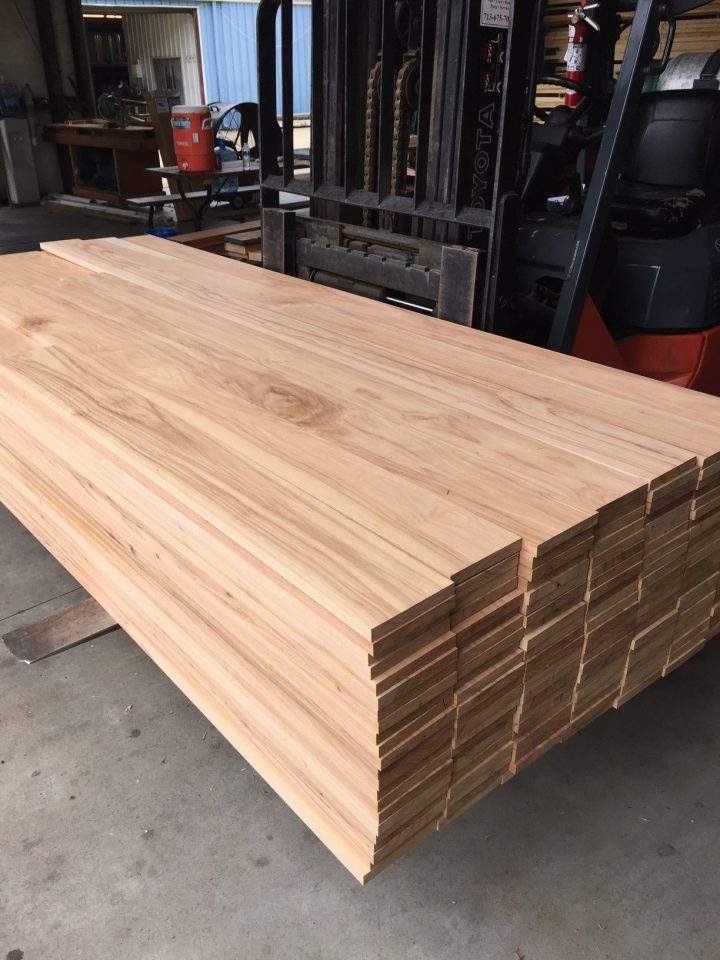
I was looking at a rental property Reno job with my then FIL and there was a tree growing on the property. I asked what it was and he picked a pecan up off the ground, ate it and said, it's a pecan tree. They grow everywhere down here.
I was also informed that the wood is used for just about everything, since the trees are everywhere.
I remember seeing a piece of the wood and wanting to make something from it, but after moving back north, I never saw another piece of pecan wood and forgot what it looked like.
If large boards without knots and crazy crooked sapwood/heartwood transitions are available and inexpensive, I'd be all over it. Especially if it's stable and comparable to hard maple in strength/hardness.
Kinda looks like a cross between oak and walnut.

Freekmagnet
Commercial User
i sincerely doubt you're going to have good luck with mesquite in terms of stability for a neck. For a top on a body, sure, for a neck or fretboard, I wouldn't touch mesquite.
Mesquite... yeah I know they're knotty. Most of the actual living trees I know of wouldn't make a fretboard
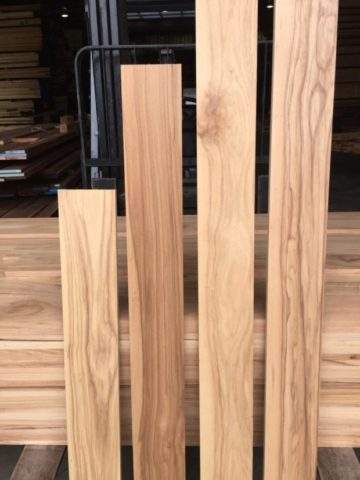
You can get some good pieces of mesquite, but you have to be diligent. Pictured on the left here, I have some nice straight grained mesquite. The guy who made them was a luthier, so he knew what to look for.
L-R: mesquite, osage orange, 2 black locust and maple
He said it was really hard to get straight, clear pieces of mesquite. I paid for 6, but he gave me one extra because it had a tiny knot in it.
Last edited:
He said it was really hard to get straight, clear pieces of mesquite. I paid for 6, but he gave me one extra because it had a tiny knot in it.
the second from the right looks the prettiest to me. I wonder how one like that would hold up over time.
Freekmagnet
Commercial User
the second from the right looks the prettiest to me. I wonder how one like that would hold up over time.
That’s black locust. I imagine it would hold up really well. It’s really hard wood and known for its durability. In this state, it’s a gold/green color. Supposedly it darkens considerably.
That’s black locust. I imagine it would hold up really well. It’s really hard wood and known for its durability. In this state, it’s a gold/green color. Supposedly it darkens considerably.
mesquite is far left? sorry I thought those may have been dyed for different colors. I should have guessed that. didn't think about it.
Freekmagnet
Commercial User
I lived in Louisiana for a short stint in the early 90s.
I was looking at a rental property Reno job with my then FIL and there was a tree growing on the property. I asked what it was and he picked a pecan up off the ground, ate it and said, it's a pecan tree. They grow everywhere down here.
I was also informed that the wood is used for just about everything, since the trees are everywhere.
I remember seeing a piece of the wood and wanting to make something from it, but after moving back north, I never saw another piece of pecan wood and forgot what it looked like.
If large boards without knots and crazy crooked sapwood/heartwood transitions are available and inexpensive, I'd be all over it. Especially if it's stable and comparable to hard maple in strength/hardness.
Kinda looks like a cross between oak and walnut.
View attachment 4552065 View attachment 4552066
That’s some nice wood! I could see making a neck outta that.
Freekmagnet
Commercial User
mesquite is far left? sorry I thought those may have been dyed for different colors. I should have guessed that. didn't think about it.
I added a label beneath the photo for clarity.
excerpt From Wood Database :
Osage Orange has a relatively low modulus of elasticity compared to its weight and modulus of rupture which helps explain why it is sometimes used for archery bows. It’s sometimes called Bois d’arc, which literally means “bow wood” in American French. The wood is also very stable, with little seasonal/environmental movement.
"little seasonal movement" sounds like good neck material. Except it's a little heavy. Perhaps in a laminated neck.
Edit: @Freekmagnet your lighter colored osage board would look great next to a darker oil stained pecan.....
Osage Orange has a relatively low modulus of elasticity compared to its weight and modulus of rupture which helps explain why it is sometimes used for archery bows. It’s sometimes called Bois d’arc, which literally means “bow wood” in American French. The wood is also very stable, with little seasonal/environmental movement.
"little seasonal movement" sounds like good neck material. Except it's a little heavy. Perhaps in a laminated neck.
Edit: @Freekmagnet your lighter colored osage board would look great next to a darker oil stained pecan.....
Last edited:
Because they also know they are talking to the same consumer base that thought the A&W 1/3rd pound burger was smaller than the McDonald's 1/4 pounder AND the same consumer base that stopped buying Corona beer because of the virus."Roasted" and "Baked" are used in ads, probably because "Torrefied" doesn't sound as friendly or something - they're all referring to the same process - heating with a low oxygen environment...



excerpt From Wood Database :
Osage Orange has a relatively low modulus of elasticity compared to its weight and modulus of rupture which helps explain why it is sometimes used for archery bows. It’s sometimes called Bois d’arc, which literally means “bow wood” in American French. The wood is also very stable, with little seasonal/environmental movement.
"little seasonal movement" sounds like good neck material.
Little seasonal movement is good in a neck. A low modulus of elasticity means it's not stiff, which is....not good for a neck or fretboard. You want a high modulus for that application - you're wanting a plank that doesn't move much , not something you can bend.
If Osage Orange looks good visually, I'd use it as a top, but definitely not for a neck or fretboard..
Little seasonal movement is good in a neck. A low modulus of elasticity means it's not stiff, which is....not good for a neck or fretboard. You want a high modulus for that application - you're wanting a plank that doesn't move much , not something you can bend.
If Osage Orange looks good visually, I'd use it as a top, but definitely not for a neck or fretboard..
this info is why I started this thread. Thanks!
this info is why I started this thread. Thanks!
Think of the neck and fretboard of your instrument as the structure holding up a skyscraper - they're the concrete and steel of the building - the stuff that keeps you from plunging to your death, or being crushed by thousands of tons of floors and stuff falling on you. You're gonna be very picky about what those materials are. What they look like? who cares?
The top on your bass is the facade - if you've done the structure part right, things are safe, you just gotta pick something that looks nice to dress the thing up, and stick it on the front.
I seem to remember reading that as well. That would be a trip to buy mahogany grown in… Florida…?
We have a similar situation down here, well in more northern parts of Australia. Honduran mahogany trees that were grown as plantation crops. (also grown in parts of Asia and in Fiji) A reclaimed timber operation close to me had some huge slabs of it for table tops etc. all Queensland grown mahogany. Reclaimed wood yards are reasonably common down here, they mostly get exotic species that were planted as street trees, or reclaimed stuff from demolished buildings. So they're one way of getting exotic woods without the shipping miles. Supplies aren't consistent though...
MOE seems to be a measurement that's more of a ball park thing with wood, than a rigid rule. Mostly because of the variance from tree to tree, grain orientation, etc.
That being said, The MOE of Osage Orange is equivalent to Black Walnut and higher than Honduran Mahogany.
Which I find confusing, because Mahogany and Walnut don't seem super flexy and Osage Orange is/was used for bows.
That being said, The MOE of Osage Orange is equivalent to Black Walnut and higher than Honduran Mahogany.
Which I find confusing, because Mahogany and Walnut don't seem super flexy and Osage Orange is/was used for bows.
I think it's important to keep the relative nature of the physical properties in mind. What's "low" in one case may be "fine" in another case, and there will always be a range of acceptable values. Even in a case where you wanted to use a wood that was a little out of range, that's not a terminal problem. For instance, when it comes to neck design, if you want to use a wood that's slightly less stiff than you'd like, you can compensate with carbon fiber reinforcement.
Osage Orange has an elastic modulus of 11.64 gpa according to wood-database, which isn't really all that low. If anything it's right in range with many other typical fretboard materials (i.e. hard maple at 12.62) and higher than some woods seen in necks (i.e. mahogany). It may be low relative to osage orange's weight, but it's certainly more than stiff enough to function as a fretboard. I've never used it as a fretboard myself, but I see a lot of builders in regions where it's common using it regularly, and if I had it available I wouldn't hesitate to use it. It's definitely nice looking and visually distinct.
I have a lot of black locust growing on my property and have used it in a bunch of projects. Not in a bass - yet - but I have some drying for future bass use. It would be a great fretboard wood, it's extremely durable. It does darken over time but putting it under finish slows that down. It's also very hard on tools, it ruins my chainsaw chains faster than anything else I've ever cut.
Osage Orange has an elastic modulus of 11.64 gpa according to wood-database, which isn't really all that low. If anything it's right in range with many other typical fretboard materials (i.e. hard maple at 12.62) and higher than some woods seen in necks (i.e. mahogany). It may be low relative to osage orange's weight, but it's certainly more than stiff enough to function as a fretboard. I've never used it as a fretboard myself, but I see a lot of builders in regions where it's common using it regularly, and if I had it available I wouldn't hesitate to use it. It's definitely nice looking and visually distinct.
That’s black locust. I imagine it would hold up really well. It’s really hard wood and known for its durability. In this state, it’s a gold/green color. Supposedly it darkens considerably.
I have a lot of black locust growing on my property and have used it in a bunch of projects. Not in a bass - yet - but I have some drying for future bass use. It would be a great fretboard wood, it's extremely durable. It does darken over time but putting it under finish slows that down. It's also very hard on tools, it ruins my chainsaw chains faster than anything else I've ever cut.
Think of the neck and fretboard of your instrument as the structure holding up a skyscraper - they're the concrete and steel of the building - the stuff that keeps you from plunging to your death, or being crushed by thousands of tons of floors and stuff falling on you. You're gonna be very picky about what those materials are. What they look like? who cares?
The top on your bass is the facade - if you've done the structure part right, things are safe, you just gotta pick something that looks nice to dress the thing up, and stick it on the front.
This exactly.^
I started out only building laminated through necks, (hey, it was the 1970's) I still often do, but even for set, or bolt on necks, I often put a central core in the body of something that will work structurally and sonically. After that I can add lighter wings, hollowed out ones, cap the front and back with the showy stuff, whatever. A block of say maple or mahogany 1-1/2" thick and 4" wide gives a solid core of "tonewood" and a reliable base for holding bridge and neck screws. (In my case Blackwood or Myrtle sort of fill that role as well as being local)
Freekmagnet
Commercial User
Edit: @Freekmagnet your lighter colored osage board would look great next to a darker oil stained pecan.....
Yeah, see I haven’t seen any of that nicely colored pecan here in California. Most of the stuff we get here is light in color and not distinguishable enough from maple to not buy maple. My local hardwood dealer only carries pecan in 4/4, and I usually go with 5/4 for necks. I can get maple in any size here.
Just in terms of strength and cost, you can’t really beat a laminated maple neck. I’ve been building a lot of necks lately, and I’m really digging walnut these days, mainly because it’s lighter weight than maple. Walnut more than twice the price per B/F for me, but that’s OK. Also, it’s easier for me to carve details in maple - things move just a little more quickly working with walnut, but I can get the results I’m looking for if I work with caution. But, the looks and the weight savings are doing it for me. I might start messing around with stiffener bars to see if I can toughen my walnut necks up a bit.
I haven’t messed around with cherry much. I can get that here. I used to not like the color, but it’s been growing on me. Anyone else made cherry necks?
Last edited:


