• TalkBass has been independent since 1998. Add your voice.
    Create a free account to reply to discussions, view embedded media, and browse with fewer display ads.
    Join freeLog in
    Want zero display ads or expanded classifieds tools? Compare plans.

Wood choices and considerations

I'm sorry to say it, but I'm simply tired of writing about the subject of how wooden bass frames affect the sound of an electric bass. I've written countless pages about it over the years here on TalkBass. But there's an endless stream of threads asking if and how the wood makes any difference in the sound. And every thread brings out waves of people who want to argue endlessly about it. They deeply believe that the sound of an electric bass is all strings and pickups. No amount of rational discussion of engineering and testing will change their minds. I've tried my best, and I'm outnumbered and tired of arguing.

The sad reality is that, to the majority of bass players/owners, the sound of their instruments is all in turning knobs on their electronic gear. They don't listen to or care about the sound of the bass itself. Builders like myself, who concentrate on making our basses have a beautiful inherent sound through a clean amp, are a small niche part of the bass market. We have our little crowd of customers who appreciate our basses. I'm happy with that, and I'm tired of trying to change the minds of the masses.


Loved reading this last bit. With basses, I've always subscribed to the Michael Tobias way of thinking where an electric bass is an acoustic instrument first. I want it to sound and feel good when unplugged. 90% of my practicing is unplugged anyway.
 
how did the canary wood turn out?


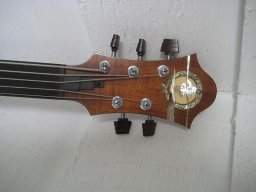
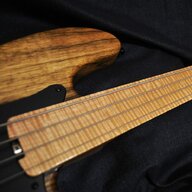
It’s fine. No glue issues for sure. I’ve mostly been playing one of my fives or my six string so it’s been sitting a bit but I have been thinking about setting up one of my 32” scale four strings as BEAD and if I do it will probably be that one. I also turned a tea light holder out of some of the scraps. The canarywood is the wings. The center section is the Lahti.

IMG_9377.jpeg IMG_9378.jpeg IMG_9379.jpeg
 
@Matt Liebenau and others that have worked with canary wood, how stable is it? I noticed warmoth offers it as a neck wood and doesn’t require a hard finish like others. I’m curious now how easy/difficult it is to work with. It has a pretty grain at least to my eyes.

edit: well… not currently offering canary wood. They have it in videos though
 
Last edited:
  • Like
Reactions: Matt Liebenau
@Matt Liebenau and others that have worked with canary wood, how stable is it? I noticed warmoth offers it as a neck wood and doesn’t require a hard finish like others. I’m curious now how easy/difficult it is to work with. It has a pretty grain at least to my eyes.

edit: well… not currently offering canary wood. They have it in videos though


The body has been fine since I made it but it’s obviously a thicker piece and I tried to alternate the grain when I glued them up. The boards were from Woodcraft on sale and started at a nominal 3/4”. I did have to pick and choose which parts of the boards I used as several ended up a bit twisted but after they moved they seem to have stayed where they moved to. The portion I still have of one board hasn’t moved out in the garage through however many seasons it’s been since.
 
  • Like
Reactions: mrperkolator
@Matt Liebenau and others that have worked with canary wood, how stable is it? I noticed warmoth offers it as a neck wood and doesn’t require a hard finish like others. I’m curious now how easy/difficult it is to work with. It has a pretty grain at least to my eyes.

edit: well… not currently offering canary wood. They have it in videos though

I built a red canarywood neck about two and a half years ago. The build thread is here if anyone is interested:

https://www.talkbass.com/threads/fi...y-maple-fretless.1425272/page-4#post-25744598

I haven't adjusted the neck since I built it and just went and looked at it again. It has a bit more relief than when I first set it up (perhaps another 0.25 mm or 10 mil) but is even along both sides of the fingerboard and no twist. Really happy with mine.
 
When did they twist? While initially drying out?


There was a bunch at Woodcraft, I think they were on sale that month. I picked through for the straightest ones. After I brought the boards home, 3 or 4 in all, 2 of them continued to move a little more, my boards stay in the garage but stored mostly properly. I had them a month or so before I started the build. Once the boards got to a certain point they seemed to quit moving. I figured it was just the change in environment. I’ve had other boards move some after bringing them home.
 
Hmm, roasted basswood is interesting, and I can imagine exactly how it would smell (which is not bad, a bit sugary I think.)
It certainly would be light. I wonder if the roasting makes the end grain sand better. That is my main complaint about basswood, the way the end grain is so fuzzy and hard to sand to a good finish without multiple coats of sealer. The roasting might harden up the surface a little bit, which would be welcomed. Let us know if you try some; I'd be curious to hear about the results as I've more or less given up on basswood as a material for solid bodies.
 
  • Like
Reactions: mrperkolator
I have a pretty decent stash of salvaged American Chestnut I’ve been sitting on while I try to decide how best to use it.

Some of the pieces are ideally sized and shaped to be used in a neck glue-up but I’m doubtful that Chestnut is really strong enough for use in a neck - a stable neck, anyway - and since it’s extinct for all practical purposes I don’t want to waste it experimenting. Carbon fiber backstrapping, laminates with harder wood, etc… might yield a stable neck but any prototype that fails is a piece wasted. And the open grain would need a lot of filling - it seems like the juice may not be worth the squeeze. I should probably just use the bigger pieces for body tops and the longer, slimmer pieces for non-guitar related stuff.