• TalkBass has been independent since 1998. Add your voice.
    Create a free account to reply to discussions, view embedded media, and browse with fewer display ads.
    Join freeLog in
    Want zero display ads or expanded classifieds tools? Compare plans.

wooden bridge insanity (help designing)

I like Dennis Havlena's approach to it- he's got a customisable wooden electric bass bridge.
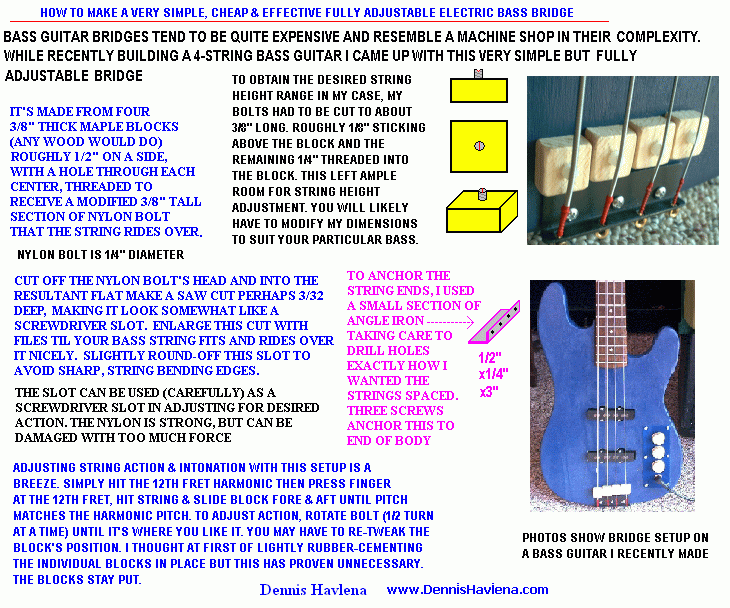
nylon.gif

I do like simple, but that doesn't look like it would look good on any bass as is. Take the concepts and work them into a design that looks good to the eye.

Call me old fashioned, but I like Carl Thompson's approach:
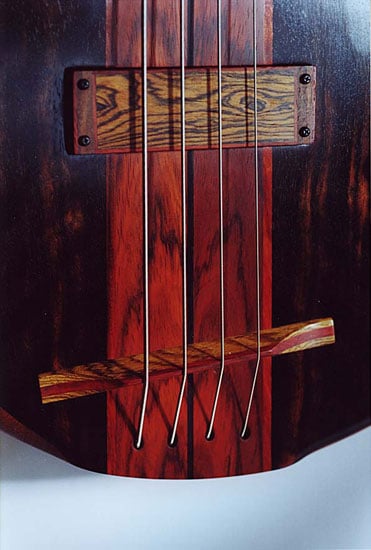
73102pickupbridge.jpg


Not as adjustable, granted, but still, as simple as it gets...

Pasda Beer's approach certainly rocks, though! :)

For a few seconds, I thought that was ppk's second bass, then i remembered the bocote at center was much thinner of a piece. So Is the saddle held just by string pressure? How does he do those pup covers? One thing i don't like is strings just fed from the back out of nowhere. If there is a cover on it, sweet, but otherwise, i am fond of the 2 piece wooden bridge.

 
I made one similar to Pasdabeer's:

DSC00770.jpg

You make me want to kick myself in the nuts, seriously:scowl:. That is awsome, and i am an idiot for not thinking up something like that. Are the saddles held in just by string pressure? what are they made of? how do you cut the channels? The strings are fed through the back right? for a radiused fb, do you just cut the channels at different depths, shim it like pasda beer's plan, or just groove them to where they should be height wise? How did you ground that? could you put more pics up?

I like all it! If i go for something like this for mine, then i will probably make a few changes like, making it a bit thicker, and routing and gluing the bridge in (if it drops in perfectly, would i need to glue it, or would it being pulled to the nut make it stay in place?), finding a way to anchor the strings without stringing them through the back, and maybe making the saddles wooden (what wood and oreintation would be best? bloodwood good?) and the shape (obviously), also make the treble side bigger, and put the volume knob there.
 
This approach would lend itself to make it a piezo bridge quite easily, as well. I can even do the "saddles" with my hole cutting saw, and use a threaded insert for the screw adjustment.
Individual elements could be placed either directly under each of the round "saddles", or one between each string. Ha!:hyper:

pandabeer why don't you combine your idea for the bridge plate with the other idea above.

Make a round saddle that you can rotate and then an adjustable piece comes up from it. You turn the center peice to get the correct height, then you turn the saddle to line up with the string. Here is one saddle.
 
When i designed that bridge sketch, the idea was to have no metal/plastic touching the strings, just natural materials.

hight adjustment is done during intial set up with groving the sadles, and fine tuning is with rosewood shims.

Yes I was thinking that the nylon might be a potential problem. I wonder if threaded wood would handle the pressure over time. Perhaps if it the right kind of wood like ebony or something. And would the diameter be too large?

On the other hand you could DEFINITELY do this with metal screws, but if you are trying to avoid metal then what's the point.

Example:

CFS40267_00.jpg


[Invalid or Expired Link Removed]
 
You make me want to kick myself in the nuts, seriously:scowl:. That is awsome, and i am an idiot for not thinking up something like that. Are the saddles held in just by string pressure? what are they made of? how do you cut the channels? The strings are fed through the back right? for a radiused fb, do you just cut the channels at different depths, shim it like pasda beer's plan, or just groove them to where they should be height wise? How did you ground that? could you put more pics up?

I like all it! If i go for something like this for mine, then i will probably make a few changes like, making it a bit thicker, and routing and gluing the bridge in (if it drops in perfectly, would i need to glue it, or would it being pulled to the nut make it stay in place?), finding a way to anchor the strings without stringing them through the back, and maybe making the saddles wooden (what wood and oreintation would be best? bloodwood good?) and the shape (obviously), also make the treble side bigger, and put the volume knob there.

Thanks! The saddles are made of small pieces of ebony (but any other dense wood would do), and are held in by the string pressure. I didn't actually cut the channels (that would be the optimal way to do it though; with a table saw and a dado blade); I cut out all the strips for in between the saddles individually, sanded them to the right size, and glued them carefully to a flat piece of the same wood, then scraped the glue squeeze out with a razorblade. You could cut the channels at different depths for a radiused fingerboard, or you could just make the middle saddles higher than the outside ones. The grounding is actually really, really annoying on this bridge, since the only metal that the strings touch are the individual ferrules on the back side. I had to figure out a way to have a ground wire going to all seven ferrules. I ended up using a dremel to route little channels underneath the bride leading to each hole, and then drilled a hole from the edge of the channel to the bridge pickup cavity (which had a hole to the neck pickup cavity, which eventually connects up with my electronics cavity :crying: ). I'll take more pictures of it later for you.

 
I think a combination of Havalena's design and Pasdabeer's would be cool and useful.
The slotted bottom plate with the square saddles with brass headless screws for height adjustment.

Matt
 
Yes I was thinking that the nylon might be a potential problem. I wonder if threaded wood would handle the pressure over time. Perhaps if it the right kind of wood like ebony or something. And would the diameter be too large?

On the other hand you could DEFINITELY do this with metal screws, but if you are trying to avoid metal then what's the point.

Example:

CFS40267_00.jpg


[Invalid or Expired Link Removed]

I thought about using threaded rosewood, didnt try it just due to cost of tooling. Maybe next time though.
 
Thanks! The saddles are made of small pieces of ebony (but any other dense wood would do), and are held in by the string pressure. I didn't actually cut the channels (that would be the optimal way to do it though; with a table saw and a dado blade); I cut out all the strips for in between the saddles individually, sanded them to the right size, and glued them carefully to a flat piece of the same wood, then scraped the glue squeeze out with a razorblade. You could cut the channels at different depths for a radiused fingerboard, or you could just make the middle saddles higher than the outside ones. The grounding is actually really, really annoying on this bridge, since the only metal that the strings touch are the individual ferrules on the back side. I had to figure out a way to have a ground wire going to all seven ferrules. I ended up using a dremel to route little channels underneath the bride leading to each hole, and then drilled a hole from the edge of the channel to the bridge pickup cavity (which had a hole to the neck pickup cavity, which eventually connects up with my electronics cavity :crying: ). I'll take more pictures of it later for you.
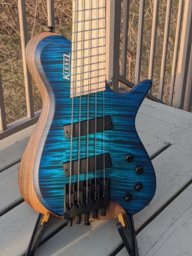
Thanx. I figured out how to ground mine. It will have a zero fret, so it will be a bit easier. Since I am putting the knob in with the bridge, i will put a back cavity over the whole area (another benefit, is i don't have to look at those awful ferrules). I can just do a simple rig in there to ground one of the strings, and let the zero fret be tthe conection to the rest of the strings.
 
I made one similar to Pasdabeer's:

DSC00770.jpg

i have been thinking about doing something similar to this one for my current build. i was thinking about using Link Removed for the saddles. some one told me that they had a similar bridge and had issues with the hhigher strings not having enough tension to hold the saddle down during aggressive playing. (its a 7 string with a high F) has any one else had these issues? i really dont want to buy a 7 string metal bridge (expensive, and i thinnk it will ruin the look of my bass).

as far as electrical grounding goes, the 2 options that i have found that should work ok are these:
#1: add a "fret" on the body of the bass right where all the strings anchor into the body, and ground the fret.
#2: anchor the strings in the back of the body into a copper or brass plate and ground the plate.
 
i have been thinking about doing something similar to this one for my current build. i was thinking about using Link Removed for the saddles. some one told me that they had a similar bridge and had issues with the hhigher strings not having enough tension to hold the saddle down during aggressive playing. (its a 7 string with a high F) has any one else had these issues? i really dont want to buy a 7 string metal bridge (expensive, and i thinnk it will ruin the look of my bass).

as far as electrical grounding goes, the 2 options that i have found that should work ok are these:
#1: add a "fret" on the body of the bass right where all the strings anchor into the body, and ground the fret.
#2: anchor the strings in the back of the body into a copper or brass plate and ground the plate.


Ive played a few with floating wood bridges, and I play pretty hard and never had an issue.

Im actually going to be using brass screws with my design just for ease of adjustment.