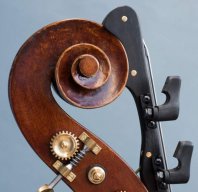
I bought a bass about 2 months ago via ebay (brave I know, but it was very inexpensive!). It turns out it had been lying around in some guy's garage for some years. It's a Hungarian factory-made bass from the 50s/60s with carved top and laminated back & sides.
The sound was very woolly on the E and A strings, but I replaced all the strings as a gamble and that vastly improved the sound.
I noticed that the bridge was warped (toward the fingerboard) and was getting more and more annoyed with the ridiculously high action so, with a view to getting a new bridge fitted, I decided to take it to a local luthier for an assessment.
The guy (mainly a violin/cello-maker I gather) looked it over thoroughly and advised me that the following needed doing:
1. replace bridge (as it is on the verge of collapse!)
2. fingerboard does not have sufficiently concave profile, so that needs planing - but it's only a stained hardwood f'board.
3. a crack between the bass-side foot of the bridge and the f-hole has been badly repaired and needs re-setting to prevent it spreading across the top
4. ideally the angle of the neck needs to be altered, as otherwise the bridge will need to be cut down far too low to get a playable action - although as a compromise we could use a smaller bridge...
I then was talking to another luthier who said that there's no way that a smaller bridge should be used as it would ruin the tone, and would cause problems with soundpost placement etc. He said it would be necessary to alter the neck angle to provide the correct elevation. Therefore, he suggested selling the instrument again and putting the money towards a new budget bass...
As you can imagine, the cost for the repairs would be considerable - it would double the total amount I paid for it (to about 700-800 pounds).
However, the first guy said that there have been no major structural repairs and that it is basically a solid instrument considering its class.
Anyone have any advice or ideas? Are any of the repairs suitable for attempting myself? (obviously I'm not going to touch the neck angle!!)
The sound was very woolly on the E and A strings, but I replaced all the strings as a gamble and that vastly improved the sound.
I noticed that the bridge was warped (toward the fingerboard) and was getting more and more annoyed with the ridiculously high action so, with a view to getting a new bridge fitted, I decided to take it to a local luthier for an assessment.
The guy (mainly a violin/cello-maker I gather) looked it over thoroughly and advised me that the following needed doing:
1. replace bridge (as it is on the verge of collapse!)
2. fingerboard does not have sufficiently concave profile, so that needs planing - but it's only a stained hardwood f'board.
3. a crack between the bass-side foot of the bridge and the f-hole has been badly repaired and needs re-setting to prevent it spreading across the top
4. ideally the angle of the neck needs to be altered, as otherwise the bridge will need to be cut down far too low to get a playable action - although as a compromise we could use a smaller bridge...
I then was talking to another luthier who said that there's no way that a smaller bridge should be used as it would ruin the tone, and would cause problems with soundpost placement etc. He said it would be necessary to alter the neck angle to provide the correct elevation. Therefore, he suggested selling the instrument again and putting the money towards a new budget bass...
As you can imagine, the cost for the repairs would be considerable - it would double the total amount I paid for it (to about 700-800 pounds).
However, the first guy said that there have been no major structural repairs and that it is basically a solid instrument considering its class.
Anyone have any advice or ideas? Are any of the repairs suitable for attempting myself? (obviously I'm not going to touch the neck angle!!)