
Enjoy the benefits of a premium membership!
Upgrade Account
-
TalkBass has been independent since 1998. Add your voice.
Create a free account to reply to discussions, view embedded media, and browse with fewer display ads.
Join free Log in
Want zero display ads or expanded classifieds tools? Compare plans.
You are using an out of date browser. It may not display this or other websites correctly.
You should upgrade or use an alternative browser.
You should upgrade or use an alternative browser.
Would using a larger gauge B help improve definition on my short scale?
- Thread starter Just Wrong
- Start date
More options
Who Replied?

I don't really believe the thick string is better. In Salsa, we use SOLO strings in our uprights or Ampeg baby bass and other EUBs (which should be tuned to F# in Orchestra and we get more thump out of that. It' thinner and floppier yet it just thumps better than a heavier string. I used light flats on the electric bass and just raise the action a tad 3.5 mm on the 12th fret and even higher.
I say you go opposite and go thinner or stay where you're at. Experiment with plucking positions , cut the bass on the amp, use an HPF. Raise the action some
I say you go opposite and go thinner or stay where you're at. Experiment with plucking positions , cut the bass on the amp, use an HPF. Raise the action some
I like this idea. Is there a way to simulate an HPF like Broughton's in Logic before dropping $100 on one?You could use a HPF in your signal chain to improve definition
I had a HPF control on my Bergantino HP Forté, but I never really played with it and have since sold it.

The string may be fatter but it still rests on the same pointsThe diameter is thicker though so even if it vibrates less off the center it still takes more space between string and fret. My experience is action goes up a bit or there’s fret buzz. Once you file the nut slots and get intonation right in first frets .
I retract my statement. My experience with a short scale 5 was going to a higher gauge B was a lot more clank and fret noise. Must have been due to something else being off.The string may be fatter but it still rests on the same points

No, you are right, a thicker gauge strings will have more travel when it vibrates, therefore needing more clearance space between the strings and the frets, and therefore potentially clankier compared to a thinner gauge string with the same setup.I retract my statement. My experience with a short scale 5 was going to a higher gauge B was a lot more clank and fret noise. Must have been due to something else being off.
In any case, as stated earlier, a thicker string will not result in better definition, quite on the contrary, you will get less harmonic content and more fundamentals, which is not helping definition and articulation, and only will make your tone more muddy.
That said you will need to experiment to find the right balance between gauge, tension and flexibility that works for the scale length of your bass and your playing style, setup and personal taste.
Last edited:
I'm using an ancient version of Garageband only, Logic should have a lot more options, see below.I like this idea. Is there a way to simulate an HPF like Broughton's in Logic before dropping $100 on one?
I had a HPF control on my Bergantino HP Forté, but I never really played with it and have since sold it.


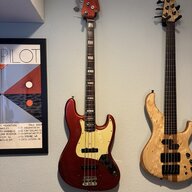
This is my bass with the specs, though I'm pretty sure the neck is maple and not ash.
Wait a minute. That's the bass you play and you want to buy a Mustang? I love Mustangs. But dude. Seriously. There's no way you're gonna be happy with a Mustang coming from that.
As for your original questions, I have a LaBella RX .130 on my Mustang. Whenever I change the strings, I have a DR set with a .125 B ready and waiting. I'm still very much in the experimentation phase.
I’m still not sure that bigger strings need more room to vibrate etc but that aside I’m wondering if the extra buzz and clank are due to the feel of the strings and potentially more energy being applied to play them. Anyway I think in general, higher tension will provide a more taught low B. On my Mustang I always play in drop D. I have a very light touch and find that Elixir 45-105 are perfect and tighter than the 40-100 I usually use on long scale.

Given two strings of different mass (say, a 120 and a 145 from the same product line) but same vibrating length, tension and plucking force applied, I would indeed expect the more massive one to have more momentum and excursion at midpoint. Please note that equal tension and length but different mass necessarily entails a different pitch.I thought a lighter string needed more room to vibrate, whereas a thicker string under more tension is by definition, tighter and requires less space to vibrate?The problem with larger gauges is they need more room to vibrate
However, having the same two strings at the same length but also tuned to the same pitch, I would expect the lower tension of the less massive one - compounded with a higher flexibility - to decidedly trump the higher acceleration of the other, with a resulting wider excursion, and a need for more fretboard clearance, from the former.
[Of course, real-world conditions are more complicated than that: for example, the plucking hand of the player will tend to automatically adjust to the lower tension and wider movement of the less massive string (again, pitch and length being equal), and exert a lighter, not equal, force to it.]
That’s my understanding, too. I remember playing a P with some seriously big flats on it - they felt like they didn’t move at all! Mind you I was playing 40-95 rounds at the time.Given two strings of different mass (say, a 120 and a 145 from the same product line) but same vibrating length, tension and plucking force applied, I would indeed expect the more massive one to have more momentum and excursion at midpoint. Please note that equal tension and length but different mass necessarily entails a different pitch.
However, having the same two strings at the same length but also tuned to the same pitch, I would expect the lower tension of the less massive one - compounded with a higher flexibility - to decidedly trump the higher acceleration of the other, with a resulting wider excursion, and a need for more fretboard clearance, from the former.
[Of course, real-world conditions are more complicated than that: for example, the plucking hand of the player will tend to automatically adjust to the lower tension and wider movement of the less massive string (again, pitch and length being equal), and exert a lighter, not equal, force to it.]
Wait a minute. That's the bass you play and you want to buy a Mustang? I love Mustangs. But dude. Seriously. There's no way you're gonna be happy with a Mustang coming from that.
As for your original questions, I have a LaBella RX .130 on my Mustang. Whenever I change the strings, I have a DR set with a .125 B ready and waiting. I'm still very much in the experimentation phase.
 don’t get me wrong, I absolutely love that bass. But it’s my only bass, and I’m looking to pair it with something more vintage sounding
Theoretically if the gauge is doubled at same pitch, scale, brand,type, the amplitude is halved and conversely, given the same parameters, if the gauge is halved the amplitude is doubled. From that you can discern that if you went from a 100 E for example to a 110 E, you can do the equation (.100/.110=.909) multiplied by A (where A is the action set for the smaller gauge in this case). Say the action is bog standard 2.4mm, than .909x2.4mm = 2.18mm for the lower amplitude 110. If going down a gauge from 110 to 100 it would be .110/.100 = 1.1 multiplied by the action for the larger gauge 2.18x1.1 = 2.40mm etc etcGiven two strings of different mass (say, a 120 and a 145 from the same product line) but same vibrating length, tension and plucking force applied, I would indeed expect the more massive one to have more momentum and excursion at midpoint. Please note that equal tension and length but different mass necessarily entails a different pitch.
However, having the same two strings at the same length but also tuned to the same pitch, I would expect the lower tension of the less massive one - compounded with a higher flexibility - to decidedly trump the higher acceleration of the other, with a resulting wider excursion, and a need for more fretboard clearance, from the former.
[Of course, real-world conditions are more complicated than that: for example, the plucking hand of the player will tend to automatically adjust to the lower tension and wider movement of the less massive string (again, pitch and length being equal), and exert a lighter, not equal, force to it.]
Thought I'd give an update. I finally got around to trying a new set of strings, and the new B (.130) has much more definition than the previous one (.118). Both are nickel plated, but they're also different brands, so gauge might not have anything to do with it. The .118 was a La Bella RX, while the .130 B is a D'Addario NYXL. I've heard NYXLs tend to be brighter than other nickel-plated strings, so maybe that's what it is more so than the gauge?

Would using a larger gauge B help improve definition on my short scale?
No. It would make it worse because it would start damping the string keeping it from properly vibrating in its overtones to be tonally consistent with the other strings, losing both tone and sustain. Moreover, due to inharmonicity, as reserached by Dr. Kemp in Scotland (see his threads on this forum), what overtones are left would be thrown out of tune for the reasons described in his research.
The Italians knew this about their harpsichords 500 years ago. Ever since there have been stringed instruments, there has been a compromise in the bass among scale, feel, tension, tone, and sustain. Every maker of every stringed instruments and strings ever since have had their own "solution" as to how they balance these criteria.
No. It would make it worse because it would start damping the string keeping it from properly vibrating in its overtones to be tonally consistent with the other strings, losing both tone and sustain. Moreover, due to inharmonicity, as reserached by Dr. Kemp in Scotland (see his threads on this forum), what overtones are left would be thrown out of tune for the reasons described in his research.
The Italians knew this about their harpsichords 500 years ago. Ever since there have been stringed instruments, there has been a compromise in the bass among scale, feel, tension, tone, and sustain. Every maker of every stringed instruments and strings ever since have had their own "solution" as to how they balance these criteria.


