I think the B string I'm currently using (.118) on my short-scale bass is fine, but it's not as defined as the other strings. I know it will never sound like the one on a 34- or 35-inch scale, but would using a larger gauge help improve definition? And if so, how much bigger should I go to hear a worthy difference? I prefer light gauge strings - .0.40 to .100 - so I'd still like to keep tonal and tension balance.

Enjoy the benefits of a premium membership!
Upgrade Account
-
TalkBass has been independent since 1998. Add your voice.
Create a free account to reply to discussions, view embedded media, and browse with fewer display ads.
Join free Log in
Want zero display ads or expanded classifieds tools? Compare plans.
You are using an out of date browser. It may not display this or other websites correctly.
You should upgrade or use an alternative browser.
You should upgrade or use an alternative browser.
Would using a larger gauge B help improve definition on my short scale?
- Thread starter Just Wrong
- Start date
More options
Who Replied?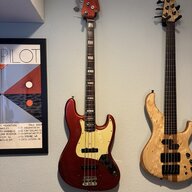
Which short scale? The problem with larger gauges is they need more room to vibrate and with the lower tension of the short scale you can end up with a lot of buzz/clank or really high action.I think the B string I'm currently using (.118) on my short-scale bass is fine, but it's not as defined as the other strings. I know it will never sound like the one on a 34- or 35-inch scale, but would using a larger gauge help improve definition? And if so, how much bigger should I go to hear a worthy difference? I prefer light gauge strings - .0.40 to .100 - so I'd still like to keep tonal and tension balance.


Likely so, though may not be in keeping with your light gauge preference. Not short scale, but on my 34" scale Sire V7, I ended up going to a .145 B (DR DDT) to get the tone I was after.
Chasing tone can make one do strange things, though.
Chasing tone can make one do strange things, though.
This is my bass with the specs, though I'm pretty sure the neck is maple and not ash.Which short scale? The problem with larger gauges is they need more room to vibrate and with the lower tension of the short scale you can end up with a lot of buzz/clank or really high action.
Last edited:


When I got my first 5-string bass (34" scale) back in 2018, I experimented quite a bit with low B's and found out the bigger gauges didn't necessarily sound better. Strings that are naturally stiff tend to do better in smaller gauges for clarity and definition. For example, GHS Boomer .120 vs. Round Core Boomer .126.I think the B string I'm currently using (.118) on my short-scale bass is fine, but it's not as defined as the other strings. I know it will never sound like the one on a 34- or 35-inch scale, but would using a larger gauge help improve definition? And if so, how much bigger should I go to hear a worthy difference? I prefer light gauge strings - .0.40 to .100 - so I'd still like to keep tonal and tension balance.
I've also learned it's perfectly ok to mix-and-match the low B's in order to achieve better tonal balance with the other four. For example, a stainless steel roundwound low B with nickel rounds for E-G. I even used GHS Pressurewound .128 (hex core) successfully with Round Core Boomers 45-100.
I have no experience with short-scale basses, but I would imagine some of these ideas can apply there as well.

I put a .120 on the B of a 30” scale bass I had and it opened up the tone nicely. Across the board I was using 45/65/80/100/120.
Four short scale 5ers. Two with Dunlop, (31") one with LaBella DTF (30") and on with DR Legends (32") All are 45 - 125, and I think the LaBell might be a 128 B. No issues with any of the B strings. Love em.
Yeah, good point. I've been thinking about trying low tension flats E-G and keeping heavier B that I currently use. I'm a lazy creature of habit so no telling how long it will take me before I actually change strings.I've also learned it's perfectly ok to mix-and-match the low B's in order to achieve better tonal balance with the other four.
I have a 130 on my 32" scale bass. This set specifically: BSN35130 6 strings MEDIUM CUSTOM - TAPERED
I think it sounds as good as the B on any of my longer scale basses.
I think it sounds as good as the B on any of my longer scale basses.

I would say it's the contrary... Fatter string improves feel (tension) at the sacrifice of clarity.
For me, the fatter the B, the less it seems to sound like the other 4 strings on the bass.
For me, the fatter the B, the less it seems to sound like the other 4 strings on the bass.

Which short scale? The problem with larger gauges is they need more room to vibrate and with the lower tension of the short scale you can end up with a lot of buzz/clank or really high action.
I thought a lighter string needed more room to vibrate, whereas a thicker string under more tension is by definition, tighter and requires less space to vibrate?
Basvarken
Commercial User
- Dec 3, 2010
- 1,743
- 10,606
- Disclosures
- Hobby Luthier / Gibson Bass Book

i like the Pitbull short scale set with a 130 low B, though im keen to try the curt mangum short scale set which has a tapered 135 low b. ive tried 140/145 low Bs before and I agree with others who say you start losing clarity.
where are you getting a set with a 115 low E?
Yes, the heavier the gauge the better the tone. I use 115 for my E-string on my shorties.
where are you getting a set with a 115 low E?

It will depend a lot on your playing style. I find the 118 and 120 B’s work better on my 30.5” scale basses than heavier gauge - as noted above, they blend better. I also am currently mixing a stainless 118 B with a nickel 4-string set (Labella). It was a little clanky at first but I like the articulation. It’s blending better as it breaks in.

Make sure they fit: Curt Mangan specifies their short-scale sets have a 34.75" winding from ball to taper, which makes them medium-scale plus rather than true shorties.im keen to try the curt mangum short scale set which has a tapered 135 low b.

The diameter is thicker though so even if it vibrates less off the center it still takes more space between string and fret. My experience is action goes up a bit or there’s fret buzz. Once you file the nut slots and get intonation right in first frets .I thought a lighter string needed more room to vibrate, whereas a thicker string under more tension is by definition, tighter and requires less space to vibrate?
Fatter strings can allow for lower action because they vibrate less. Its the exact opposite of what you said.Which short scale? The problem with larger gauges is they need more room to vibrate and with the lower tension of the short scale you can end up with a lot of buzz/clank or really high action.

for me, i'd rather have a stiffer string than a thicker string.
Basvarken
Commercial User
- Dec 3, 2010
- 1,743
- 10,606
- Disclosures
- Hobby Luthier / Gibson Bass Book
GHS Bass Boomers Heavy 50-115. These are readily available.where are you getting a set with a 115 low E?


