
Enjoy the benefits of a premium membership!
Upgrade Account
-
TalkBass has been independent since 1998. Add your voice.
Create a free account to reply to discussions, view embedded media, and browse with fewer display ads.
Join free Log in
Want zero display ads or expanded classifieds tools? Compare plans.
You are using an out of date browser. It may not display this or other websites correctly.
You should upgrade or use an alternative browser.
You should upgrade or use an alternative browser.
Wow-just picked up a Peavey Databass
- Thread starter Lync
- Start date
More options
Who Replied?

Good find on the schematics.
Another bit of info I ran across since my last post - the ports of this cab are on the bottom. I haven't seen them, but it sounds like they're round tube ports. This is unlike any other Peavey combo I've ever seen, and might indicate a better (lower) tuning.
I couldn't find a picture of the ports. Any Databass owners wanna post one?
Another bit of info I ran across since my last post - the ports of this cab are on the bottom. I haven't seen them, but it sounds like they're round tube ports. This is unlike any other Peavey combo I've ever seen, and might indicate a better (lower) tuning.
I couldn't find a picture of the ports. Any Databass owners wanna post one?
A heads-up for any tech-folk contemplating taking a soldering iron to this unit: For some bizarre reason, Peavey engineers appear to have a habit of expressing capacitor values incorrectly. An example.... I'm ordering some replacement capacitors for the power supply section, and instead of the value being spec'd as 680 uF/ 200v (where 'uF' is the nomenclature for 'microfarads'), they write it as '680R200. It took me a while of headscratching to realize that what they meant by "R" is "radial", which is the form factor of the cap. I haven't seen it, yet, but it stands to reason that if you see something listed (for example) as '680A200', the "A" would designate 'axial'.
"R" is usually used to designate resistance, which is not a spec of capacitors.
"R" is usually used to designate resistance, which is not a spec of capacitors.

Behold, the 450W "Databass" combo.
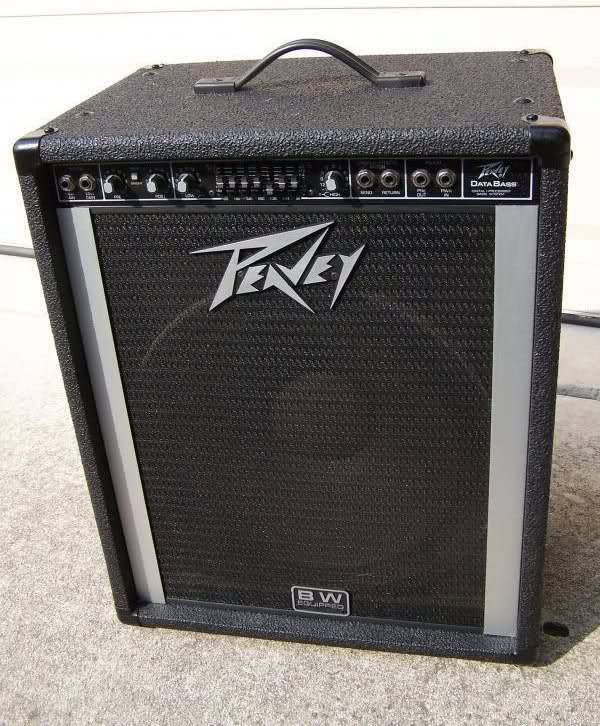
If this is your cab, could you post a picture of the bottom (ports)?
Here's what the insides of one look like. Sorta. I mean, there's more in the third section between the front panel and the power amp board sitting in front; it kind has to stack that way because I didn't disconnect all the cables some 13, 14 years ago.
That, and this unit is really dirty. I don't expect anyone else's to look this bad.
[Invalid or Expired Link Removed]
That, and this unit is really dirty. I don't expect anyone else's to look this bad.
[Invalid or Expired Link Removed]
If this is your cab, could you post a picture of the bottom (ports)?
no that's not my combo but here's a look at the ports and external cab jack of someone's amp. personally I would run a combo like this with a cab to lessen the chance of detonation. I assume the oem BW is 4 ohms so that would mean swapping it out for an 8 ohmer and running an 8 ohm cab, but it would be killer. not sure about running the 8 ohm BW with no ext. cab, but it would probably run a little less powerfully with less chance of blowout as well.
I haven't played through one of these but I have seen one and lifted it and it wasn't anything unusual. it seems like people want bass amps made out of balsa wood or something, I sure don't...
Invalid Link Removed
no that's not my combo but here's a look at the ports and external cab jack of someone's amp. personally I would run a combo like this with a cab to lessen the chance of detonation. I assume the oem BW is 4 ohms so that would mean swapping it out for an 8 ohmer and running an 8 ohm cab, but it would be killer. not sure about running the 8 ohm BW with no ext. cab, but it would probably run a little less powerfully with less chance of blowout as well.
I haven't played through one of these but I have seen one and lifted it and it wasn't anything unusual. it seems like people want bass amps made out of balsa wood or something, I sure don't...
Thanks for this picture. I spent quite a while on Google image search, and came up empty. This is enlightening. No port tubes, as far as I can see, but there'd be a duct the height of the feet (unless it's on carpet). Kicking the cab back would have a noticeable effect, I imagine.
I got to play one of these a couple times (shared backline), and liked it, despite the graphic EQ. Kept my eye out for one for a while, but they aren't that common. I'm not inclined to own one now (want one of those balsa wood things
 ), but still find it an interesting amp.
I think you're right about the speakers. I've read some criticism of Peavey's decision to put a 300w speaker in a 450w combo. It's headroom until you blow your speaker, then it's stupid.
 I rarely need to drive even one 15" BW to full output, but louder players would be better off with one or two 8 ohm speakers, as you say. I'd think that amp could take even an 8 ohm BW to it's limit, so the choice of a 4 ohm speaker is mysterious.
I think Peavey knew there was a problem early on. The schematic shows a block ahead of the power amp labeled "excursion filter"; appears to be a high pass. And the lowest band on the graphic is 120hz; the only Peavey bass amp I've ever seen configured that way. I'd love to chat with the designer(s) of this thing... bet there are some good stories.

Not be to be a thread crapper (but yes, I will be), my Carvin BR515N blows away the databass. Half the weight, just as loud, and sounds way way better.
For it's time the Databass was awesome technology, but 386 processors used to be happening too.
For it's time the Databass was awesome technology, but 386 processors used to be happening too.
Thanks for this picture. I spent quite a while on Google image search, and came up empty. This is enlightening. No port tubes, as far as I can see, but there'd be a duct the height of the feet (unless it's on carpet). Kicking the cab back would have a noticeable effect, I imagine.
I got to play one of these a couple times (shared backline), and liked it, despite the graphic EQ. Kept my eye out for one for a while, but they aren't that common. I'm not inclined to own one now (want one of those balsa wood things
I think you're right about the speakers. I've read some criticism of Peavey's decision to put a 300w speaker in a 450w combo. It's headroom until you blow your speaker, then it's stupid.
I think Peavey knew there was a problem early on. The schematic shows a block ahead of the power amp labeled "excursion filter"; appears to be a high pass. And the lowest band on the graphic is 120hz; the only Peavey bass amp I've ever seen configured that way. I'd love to chat with the designer(s) of this thing... bet there are some good stories.
I pulled up the manual for this the other day out curiosity and also noticed that in the block diagram. In addition to the excursion filter is some called a "low contour" filter that isn't tied in to the eq section or any kind of " deep switch". I'm wondering if they didn't filter this too high in an effort to protect speakers causing players to crank up bass blowing them anyway. FWIW the bass knob (not graphic) is 80hz shelving. Yes it is unusual for peavey.
I'd grab one of these if it came up used and probably do some modifications to it. The ports and ext. jack on the bottom makes me go

Not be to be a thread crapper (but yes, I will be), my Carvin BR515N blows away the databass. Half the weight, just as loud, and sounds way way better.
For it's time the Databass was awesome technology, but 386 processors used to be happening too.
I haven't heard a BR515N, but I think I'd like it. Have you played a Databass? I can believe the BR515N sounds better, but "way way better"?...
The Databass is the earliest class D bass amp that I know of. Was probably the loudest, smallest 115 combo you could buy 20 years ago. Still a pretty giggable amp today. That they are known more for speaker failure than amp failure is remarkable for a leading-edge amp design.
I pulled up the manual for this the other day out curiosity and also noticed that in the block diagram. In addition to the excursion filter is some called a "low contour" filter that isn't tied in to the eq section or any kind of " deep switch". I'm wondering if they didn't filter this too high in an effort to protect speakers causing players to crank up bass blowing them anyway. FWIW the bass knob (not graphic) is 80hz shelving. Yes it is unusual for peavey.
Yeah, the low contour and excursion filters together are interesting. The schematic only hints at their purpose, but I think it was as you say.
I'd grab one of these if it came up used and probably do some modifications to it. The ports and ext. jack on the bottom makes me go
Ditto.
Those bottom ports are just wierd. When you set the thing on the floor, you end up with what is essentially a leaky sealed cab, causing people to turn the bass up even more.
Estimating the bottom at 20" x 14", that'd be 68" of circumference. Feet 1/4" high would give a "port area" of 17 square inches. Port length might average out to around 6". So that could result in a reasonable tuning for that speaker.
Of course, lay it on carpet, or tilt it back (as I have seen recommended), and that's out the window. This might be a creative way to get a smaller cab within certain restraints, but I don't wonder why the configuration is not more common. It does seem to show more thought than the simple baffle holes in other Peavey combos of the period.

Reading some earlier posts, I noticed someone saying there's switch for the DDT compression on a Data Bass. There is NOT, just a bright switch. The Mark IV head and I think some of the later Mark series heads have it, but not the Data Bass. Additionally, the Dat Bass doesn't have the standard Peavey triangular ports...it has 2 huge holes on the "floor" of the cabinet. If you get the thing loud enough, it might levitate!
The D.B. sounds very different from a TNT, Combo 115, etc, MUCH cleaner. Even if you turn the Post volume way down and crank up the Pre vol. they won't distort...just get a bit stuffy sounding.
I've had mine apart and can tell you that most on the amp's weight is the cabinet, it's particle board (the baffle's plywood, IIRC) and quite heavy. The amp chassis weighs almost nothing, not surprisingly since its a class D amp.
I've been using mine since I bought it new in the early '90s, never let me down volume-wise. Used it on some big stages, too.
Of course, I blew the Black Widow several times...installed an 4 ohm 600 watt Eminence Kapa 15C...that's been great.
It's funny that some have said they think the amp needs the bass turned up...I've always felt it had a ton of bottom and could use more treble. (I'm NOT a funk player and don't use a particularly bright tone.) The rather skimpy owner's manual advises leaving the controls pretty close to flat, saying that the amp was designed to sound right that way. Not that I ever do that, but I do try to avoid using a lot of bass...around one o'clock usually does it for me with the next to the lowest EQ band boosted just a tad. Peavey should've put an extension speaker jack on the Data Bass. A glaring omission on a 450 watt combo supplied with a 300 watt speaker...
BTW, the "Data Bass" moniker comes from an onboard computer that's supposed to monitor the bass response, more at lower volume, less at higher volumes, kind of like the "loudness" button on a stereo receiver only smarter.
They're still great amps. There are lighter and as powerful or more powerful combos out there now, but tone-wise they seem voiced for funk and/or jazz. No one seems to make a rock-voiced bass amp these days anyway. It's weird.
The D.B. sounds very different from a TNT, Combo 115, etc, MUCH cleaner. Even if you turn the Post volume way down and crank up the Pre vol. they won't distort...just get a bit stuffy sounding.
I've had mine apart and can tell you that most on the amp's weight is the cabinet, it's particle board (the baffle's plywood, IIRC) and quite heavy. The amp chassis weighs almost nothing, not surprisingly since its a class D amp.
I've been using mine since I bought it new in the early '90s, never let me down volume-wise. Used it on some big stages, too.
Of course, I blew the Black Widow several times...installed an 4 ohm 600 watt Eminence Kapa 15C...that's been great.
It's funny that some have said they think the amp needs the bass turned up...I've always felt it had a ton of bottom and could use more treble. (I'm NOT a funk player and don't use a particularly bright tone.) The rather skimpy owner's manual advises leaving the controls pretty close to flat, saying that the amp was designed to sound right that way. Not that I ever do that, but I do try to avoid using a lot of bass...around one o'clock usually does it for me with the next to the lowest EQ band boosted just a tad. Peavey should've put an extension speaker jack on the Data Bass. A glaring omission on a 450 watt combo supplied with a 300 watt speaker...
BTW, the "Data Bass" moniker comes from an onboard computer that's supposed to monitor the bass response, more at lower volume, less at higher volumes, kind of like the "loudness" button on a stereo receiver only smarter.
They're still great amps. There are lighter and as powerful or more powerful combos out there now, but tone-wise they seem voiced for funk and/or jazz. No one seems to make a rock-voiced bass amp these days anyway. It's weird.
BTW, not sure if someone pointed it out already, but the ports on the bottom are just holes. No tubes or ducts.
I put pull-out casters on mine soon as I got it and usually leave them on to give the ports some clearence. Without wheels on a carpeted stage the amp's weight is enough to just about seal off the ports.
Re the "balsa wood bass amp" thing, sadly, lightweight bass amps usually sound lousy. There was a company called Flyte Sound 15 or 20 years ago (not sure if they still exist) that specialized in super lightweight speaker cabinets. The material varied, but was basically 3/4" plywood with every other layer foam instead of plywood. I had a 1-15" with an 8" tweeter and 1-18" with a horn tweeter. Neither sounded very good, unfortunately.
I put pull-out casters on mine soon as I got it and usually leave them on to give the ports some clearence. Without wheels on a carpeted stage the amp's weight is enough to just about seal off the ports.
Re the "balsa wood bass amp" thing, sadly, lightweight bass amps usually sound lousy. There was a company called Flyte Sound 15 or 20 years ago (not sure if they still exist) that specialized in super lightweight speaker cabinets. The material varied, but was basically 3/4" plywood with every other layer foam instead of plywood. I had a 1-15" with an 8" tweeter and 1-18" with a horn tweeter. Neither sounded very good, unfortunately.

I know this is an old thread, but I had to share my good news. I just bought a Peavey Databass from eBay for $325 including shipping. The owner was a bass player since the 70's and he bought this a while back, and it's in mint condition. He sent the head into Peavey and had it refurbished. It came back with a clean bill of health.
Then he bought a brand new Peavey Black Widow 1502 4. Evidently the new BW is much more capable of handling the power than the older BW's, it's Kevlar impregnated and has a 4" voice coil. So anyway, brand new speaker, amp was refurbed by Peavey, and the amp is in mint condition. He then installed Ernie Ball casters because he realized he had to have the cab off the floor for the bottom ports. He played a couple gigs with it and decided that at his age he doesn't want to hurt his back pushing the small beast around.
He did have to ship it in two boxes because of the weight. One box is for the cabinet and the speaker and Ernie Ball casters are in the other shipping box.
I feel very fortunate to own this piece of history. I'm going to report after I use it and hopefully the updated BW speaker will be more capable of handling the power. If not guess I'll be buying an Eminence. I no longer play in loud rock bands, but I still perform. I probably will never need to turn it past 3 on master, but it will be nice to have that power backing my bass up.
I'm attaching a picture of it without the casters...
Anyway, woo hoo, finally got an amp I've wanted for 20 years!
Then he bought a brand new Peavey Black Widow 1502 4. Evidently the new BW is much more capable of handling the power than the older BW's, it's Kevlar impregnated and has a 4" voice coil. So anyway, brand new speaker, amp was refurbed by Peavey, and the amp is in mint condition. He then installed Ernie Ball casters because he realized he had to have the cab off the floor for the bottom ports. He played a couple gigs with it and decided that at his age he doesn't want to hurt his back pushing the small beast around.
He did have to ship it in two boxes because of the weight. One box is for the cabinet and the speaker and Ernie Ball casters are in the other shipping box.
I feel very fortunate to own this piece of history. I'm going to report after I use it and hopefully the updated BW speaker will be more capable of handling the power. If not guess I'll be buying an Eminence. I no longer play in loud rock bands, but I still perform. I probably will never need to turn it past 3 on master, but it will be nice to have that power backing my bass up.
I'm attaching a picture of it without the casters...
Anyway, woo hoo, finally got an amp I've wanted for 20 years!
Attachments


Nice score, now you can add "Peavey DataBass Administrator" to your resume
Laughingggg... it's ironic... I work in the IT field during the day... more of a weekend warrior now... soo yes... Databass administrator lol...
Decided to post some pics, I finally got the amp put together. The Black Widow was wrapped in factory plastic shipped from Meridian. It was easy to drop the speaker in, only 8 screws, odd shaped. Small about the first half inch then larger towards the head.
It IS loud for its size. As you can tell, it has some good sized casters on it. When using it on the floor, the volume is impressive.
I think I'm feeling sad though. I realize now why the 80's and 90's are gone.... I had such fond memories of this amp, but I'm beginning to think it really is a one trick pony.... it's a bit hard to get a great variety of tones from it, and it definitely can't do gritty mild distortion....
I think I have more of an emotional attachment to these old amps than a practical one. Schepping this one to a practice was MURDER!.... still got a couple smiles from the guys when I cranked it up...
It IS loud for its size. As you can tell, it has some good sized casters on it. When using it on the floor, the volume is impressive.
I think I'm feeling sad though. I realize now why the 80's and 90's are gone.... I had such fond memories of this amp, but I'm beginning to think it really is a one trick pony.... it's a bit hard to get a great variety of tones from it, and it definitely can't do gritty mild distortion....
I think I have more of an emotional attachment to these old amps than a practical one. Schepping this one to a practice was MURDER!.... still got a couple smiles from the guys when I cranked it up...


