• TalkBass has been independent since 1998. Add your voice.
    Create a free account to reply to discussions, view embedded media, and browse with fewer display ads.
    Join freeLog in
    Want zero display ads or expanded classifieds tools? Compare plans.

Wow-just picked up a Peavey Databass

I went through the same thing. Cool amps...but technology has come a long way for the small/loud/light factor.

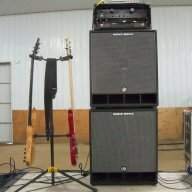
Decided to post some pics, I finally got the amp put together. The Black Widow was wrapped in factory plastic shipped from Meridian. It was easy to drop the speaker in, only 8 screws, odd shaped. Small about the first half inch then larger towards the head.

It IS loud for its size. As you can tell, it has some good sized casters on it. When using it on the floor, the volume is impressive.

I think I'm feeling sad though. I realize now why the 80's and 90's are gone.... I had such fond memories of this amp, but I'm beginning to think it really is a one trick pony.... it's a bit hard to get a great variety of tones from it, and it definitely can't do gritty mild distortion....

I think I have more of an emotional attachment to these old amps than a practical one. Schepping this one to a practice was MURDER!.... still got a couple smiles from the guys when I cranked it up...

 
....only 8 screws, odd shaped. Small about the first half inch then larger towards the head....

Those are called "Dog Points" and are designed to guide the threads of the bolt into the captive nut to minimize the possibility of cross threading when using power screwdrivers in high volume production.

I won't say what part of the dog they are named after. ;)

Great amp for 80s technology. If there had been a 600W speaker around there would be more of them sold.

mech
 
Those are called "Dog Points" and are designed to guide the threads of the bolt into the captive nut to minimize the possibility of cross threading when using power screwdrivers in high volume production.

I won't say what part of the dog they are named after. ;)

Great amp for 80s technology. If there had been a 600W speaker around there would be more of them sold.

mech

Laughingggg... dog points eh... I get the picture! :D

Thanks for the info. I'm going to try some pedals with the amp as MJW suggested, the little guy is just stupid with volume for its size...
 
Those are called "Dog Points" and are designed to guide the threads of the bolt into the captive nut to minimize the possibility of cross threading when using power screwdrivers in high volume production.

I won't say what part of the dog they are named after. ;)

Great amp for 80s technology. If there had been a 600W speaker around there would be more of them sold.

mech

Haha....in the Army we had a similar name for the flexible spout you put on your fuel can. It was named after the same piece of anatomy....on a donkey. :D


blitz-cans-compression-nozzel.jpg
 
The picture of the bottom by hrgiger has an external jack; I assume this was added? I have an op for one of these badboys, but would definitely use it as a head since the one I'm looking at has the original BW (which seems incapable at least in that cab of doing the volume justice). Figure I could power a 4X10 with this and maybe connect the 15 in the cab, too?
fnord!
 
I have one that has been modded a bit. The 4-ohm BW 15" is a weak link. Mine currently has an Eminence Gamma 15A in it - it's an 8-ohm speaker that handles 300w - not the ideal solution either. The Databass isn't really thrilled with the impedance mismatch. It sounds fine, but hiccups and pops a couple times at turn-on with the 8-ohm-er. Probably something to do with the microprocessor in the circuit. Through a 4 ohm cab there are no funky noises at all. The head is originally tied to the internal speaker with a pair of flimsy leads from the PCB. The wires got boogered up when the head was being taken out of the enclosure, so I had a conventional 1/4" speaker jack installed, and added an jack in the cabinet as well.
 
Is the lesson: Keep the impedance at 4 ohm? I have a couple of 12" 8 ohms in a cab that are currently run in sequence giving 16 ohm, but I assume I could rewire them to make 4 ohms? i also have some old CTS 10" speakers that are either 8 or 32 ohms (two in one cab that I haven't pulled apart yet that=16 ohms according to Earth Sound Research, they also mark them as 12's, so take that what it's worth). Is there a way to measure the ohms of a single speaker?:confused:
thanks,
fnord!
 
Probably best to wire the 12's as a 4 ohm cabinet. It was never designed to run 8 ohms. Lowend is right, it's easy to pull the head and add a 1/4" jack. Let us know how it works out for you.

I think a 410 cab will really take advantage of the power. I would love to hear that combination.

Eminence does have a 600 watt speaker that runs at 4 ohms.
 
Will do; if I can get the Data at the right price.
Have been looking into using my BDDI into power amp route, but always flexible. Like getting 450 watts with a BW15 for a good price! It's more volume than I need, the only caveat is that I would like the flexibility of a 2 channel for testing lots of evil, wrong speaker combinations than everyone warns will be out of synch!:hyper:
newbiedumblikethat,
f n o r d !
 
I'm running mine into an 8 ohm BW speaker with NO pops or hiccups, and I too wired a jack to use an external speaker if I needed to. I saw nothing in the schematic that would've been affected by a 4 to 8 ohm impedance change IMHO.

I saw a possible trouble point that may be the cause of your pops: the speaker wires terminate in 90 degree connectors that slip onto lugs on the underside of the amp's chassis. These connections are quite close to the wooden enclosure and it's almost impossible to slide the head in or out without pushing on/scraping/stressing the lugs. Those lugs are merely soldered to the printed circuit board and don't have any real rigidity to them! On mine, both the solder joints were already cracked (where the lugs met the PCB). I resoldered the solder joint and soldered the wire directly to the lug. I would encourage you to check those connection points!

 
I owned a databass back when they were first available. At the time I needed something small and powerful and it fit the bill. It sounded great but with all the lighter options available now it is definitely a dinosaur.
 
I'm running mine into an 8 ohm BW speaker with NO pops or hiccups, and I too wired a jack to use an external speaker if I needed to. I saw nothing in the schematic that would've been affected by a 4 to 8 ohm impedance change IMHO.

I saw a possible trouble point that may be the cause of your pops: the speaker wires terminate in 90 degree connectors that slip onto lugs on the underside of the amp's chassis. These connections are quite close to the wooden enclosure and it's almost impossible to slide the head in or out without pushing on/scraping/stressing the lugs. Those lugs are merely soldered to the printed circuit board and don't have any real rigidity to them! On mine, both the solder joints were already cracked (where the lugs met the PCB). I resoldered the solder joint and soldered the wire directly to the lug. I would encourage you to check those connection points!

I had the jack professionally installed, so I doubt that the issue is there. As a matter of fact, it was the tech who originally mentioned the hiccup at power on time. Sometimes it is worse than others, but it ONLY happens with the 8-ohm speaker connected. If I go to my SVT or 4-ohm Ampeg B40 (loaded with Peavey Scorpions) the amp behaves itself. Currently, I have the head mounted in a rack case to use independently of the combo box. I want to install another 4-ohm 15" to further prove/disprove my theory, but haven't decided on which one yet.
 
Your point about the PCB connection is on the money. That's what sent me to the tech in the first place, so I'm fairly certain it was taken care of. But even if it is the reason for the noise, why only with an 8-ohm load?
I know there were some factory service bulletins, not sure if previous owners had them addressed.