
Enjoy the benefits of a premium membership!
Upgrade Account
-
TalkBass has been independent since 1998. Add your voice.
Create a free account to reply to discussions, view embedded media, and browse with fewer display ads.
Join free Log in
Want zero display ads or expanded classifieds tools? Compare plans.
You are using an out of date browser. It may not display this or other websites correctly.
You should upgrade or use an alternative browser.
You should upgrade or use an alternative browser.
Wrist pain from thin neck?
- Thread starter 707GK
- Start date
More options
Who Replied?
My experience is that it's not directly a narrow nut, but depth front-to-back. Most narrow necks are deeper so ther7enogh wood to ensure stability. I am most comfortable on my '83 VS '62 Precision which is 1.75" wide but very shallow, and my fretted Lakland 4-94 that's a little more narrow and just a bit deeper. Most uncomfortable and my only experience with pain in the wrist and thumb are was the Geddy Lee I owned for about a year. Extremely narrow but deeper and that combination forced my hand into an angle that caused pain.


Might repeat some of what's been said here, and I'm not trying to discount anybody's dislike of thin bass necks, but just to rule out some things.
- If it starts to hurt when you play, and you're not performing on stage - put the bass down. Pain is an indicator it's time to stop. If it's not a hydration issue, it's okay to give it a day or two of rest.
- Stay hydrated, muscles need water. I've had cramps vanish with about 5-10 minutes of rest and drinking a bottle of water when I haven't been drinking enough of it and overdo it at rehearsal. Sometimes caused by getting a little lost in the music with a band and overdoing it.. a relaxed state while playing is a developed skill.
- Make sure you're not applying too much pressure when fretting, your thumb shouldn't be doing anything but supporting the position of your hand for added stability, if you're squeezing the life out of your instrument's neck, you're doing it wrong. One thing that helped me to stop doing this was practicing playing without the support of my thumb at all, folded into my palm not touching the back of the neck. Fretting a note shouldn't take a lot of power.
- Straight wrists are happy wrists.. if you're having to bend your wrist to play, set your strap height higher, or angle the neck upwards. Thumb and fingers should be the main contact points, the palm may slightly graze the underside of the neck, not the back of it. Rotation of the shoulder and a very slight bend of the wrist should be all it takes to reach the lower strings.
- Go to a doctor and rule out carpel tunnel or other issues.
If all this has been ruled out, sell the bass and stick to chunky necks.
- If it starts to hurt when you play, and you're not performing on stage - put the bass down. Pain is an indicator it's time to stop. If it's not a hydration issue, it's okay to give it a day or two of rest.
- Stay hydrated, muscles need water. I've had cramps vanish with about 5-10 minutes of rest and drinking a bottle of water when I haven't been drinking enough of it and overdo it at rehearsal. Sometimes caused by getting a little lost in the music with a band and overdoing it.. a relaxed state while playing is a developed skill.
- Make sure you're not applying too much pressure when fretting, your thumb shouldn't be doing anything but supporting the position of your hand for added stability, if you're squeezing the life out of your instrument's neck, you're doing it wrong. One thing that helped me to stop doing this was practicing playing without the support of my thumb at all, folded into my palm not touching the back of the neck. Fretting a note shouldn't take a lot of power.
- Straight wrists are happy wrists.. if you're having to bend your wrist to play, set your strap height higher, or angle the neck upwards. Thumb and fingers should be the main contact points, the palm may slightly graze the underside of the neck, not the back of it. Rotation of the shoulder and a very slight bend of the wrist should be all it takes to reach the lower strings.
- Go to a doctor and rule out carpel tunnel or other issues.
If all this has been ruled out, sell the bass and stick to chunky necks.
Lessons + exercise and stretching routine are what keeps me going, no matter if it`s about my fretted J, fretless P or big a** upright neck. That said, I much prefer chunkier necks, still learning the ergonomics of a fretted J after 4-ish months of owning and playing one daily.

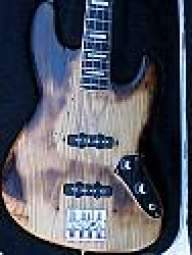
then necks with smaller radius bothered my hand/wrist ... a medium 'C' jazz neck with 9.5-10 radias was OK ... a Geddy neck = nope ...
i looked for some Carpal Tunnel type stretching exercises ...
and did some very boring wrist curls ... in all directions
only to find out later i hand a ruptured tendon in my wrist ...
frequently , i wear a soft brace loosely on my wrist overnight ... which helps prevent those weird sleeping angles ... and keeps it warm ... ( pic of wrap - recent re-injury of wrist / bent finger )

i looked for some Carpal Tunnel type stretching exercises ...
and did some very boring wrist curls ... in all directions
only to find out later i hand a ruptured tendon in my wrist ...
frequently , i wear a soft brace loosely on my wrist overnight ... which helps prevent those weird sleeping angles ... and keeps it warm ... ( pic of wrap - recent re-injury of wrist / bent finger )

There is a chance I’m putting too much pressure on my thumb. I typically use my thumb to support while my fingers wrap around unless that creates an awkward angle, then I just use the tough bits on my palm to hold the neck in place, but with little pressure. I’ve been watching SBL and using more of the 1-finger-per-fret technique, which I’ve found does allow for more efficient movements but with the Jazz bass...I dunno it’s like my fingers are cramped even though I have small hands, and need to twist my wrist a bit.
Just sent an email to the doctor just in case. No need for me to physically go into the Dr’s office in this time...I can deal with less than 1 minute of sharp pain every day so it’s not an emergency. We shall see what he says.


Yes. Some decades ago I dislocated my thumb. It finally "healed." That means I can still play, but the neck has to be the right scale length, the right nut width, the right contour, and the right thickness so the tendons from the wrist to the thumb will remain relatively relaxed. Right now, what fits me is a 1 3/4 inch nut, 33 inch scale length, moderate C profile.
Any significant deviation from these specs, including too thin a neck, will cause the top of my wrist to my thumb to cramp. Even my guitars have a 1.73 to 1.75 nut, as the "standard" 1.69 causes my thumb to close in and irritate the tendons. Yes, I can feel the difference in 1/16 inch at the nut, and it hurts. My thumb is popping even as I type this.
The current gig bass that keeps my fretting hand relaxed is an Ibanez BTB845B "solo," which I have had my luthier convert from the E-C "solo" tuning to "conventional" B-G tuning for gigging, and upgrading the Asian pickups and electronics to USA Barts and EMG preamp.
So yes, the wrong neck thickness can cause everything from missed frets to irritation to outright pain in the hand and wrist.
Any significant deviation from these specs, including too thin a neck, will cause the top of my wrist to my thumb to cramp. Even my guitars have a 1.73 to 1.75 nut, as the "standard" 1.69 causes my thumb to close in and irritate the tendons. Yes, I can feel the difference in 1/16 inch at the nut, and it hurts. My thumb is popping even as I type this.
The current gig bass that keeps my fretting hand relaxed is an Ibanez BTB845B "solo," which I have had my luthier convert from the E-C "solo" tuning to "conventional" B-G tuning for gigging, and upgrading the Asian pickups and electronics to USA Barts and EMG preamp.
So yes, the wrong neck thickness can cause everything from missed frets to irritation to outright pain in the hand and wrist.

Just putting it out there- working music retail for many long years, most people that came to about needing wider/narrower necks because of wrist and hand pain were running their strap way too long, and their bass too low. Trying to reach around the neck. I think that about 50% of the time I got them to shorten up, and their pain went away.
Haha my strap is as tight as it gets!! I’m a small guy, I play with the upper horn at about my sternum, maybe a little lower (too high is almost as uncomfortable as too low).

I had the same issue. Went to a physical therapist and got some exercises to help. But I put a thicker neck on my Jazz, and it made a huge difference.

Narrow string spacing at the nut tends to make my hand cramp a bit, an issue I don't have with wider string spacing. I play with my thumb on the back of the neck, not over the top. With a thinner neck I have to move my thumb inward slightly. Closing my thumb in by just a few millimetres tends to put more pressure on the muscles creating a bit of pain in the area where the thumb meets the wrist. I've been playing basses with wide string spacing for over 40 years, so the muscles in my hand simply aren't used to the tighter position; I'll guess this would work itself out if I started playing narrow spacing regularly, but I have no reason to start playing basses with narrow spacing.

Nice!! How you liking that Classic Vibe Pbass I sold you?
Still with me and along with my MM Cutlass these two are my favs.
Left everything as you did and man, l love it.
This is one helluva bass I won't sell, ever.
Thank you for that great bass

Last edited:

Other factors besides thickness affect neck comfort. After years and years of Fender J type 9.25" radius necks on various basses, I got a Gretsch G2220. It has a slightly thinner neck with a slightly wider nut width and 12" radius. Night and day for me, but YMMV.
Both my P and J are 9.5, my Sterling is 12ish. The Sterling is a Jazz width but thicker front to back and a flatter radius than the Jazz, you may be onto something here.

This used to come up a lot on a guitar forum I frequented. Skinny necks can be problematic that way. Grab a broomstick in one hand and a baseball bat in the other and squeeze, and see which hand cramps first. For a lot of people, the thicker necks are easier over a prolonged period.


