

Enjoy the benefits of a premium membership!
Upgrade Account
-
TalkBass has been independent since 1998. Add your voice.
Create a free account to reply to discussions, view embedded media, and browse with fewer display ads.
Join free Log in
Want zero display ads or expanded classifieds tools? Compare plans.
You are using an out of date browser. It may not display this or other websites correctly.
You should upgrade or use an alternative browser.
You should upgrade or use an alternative browser.
Double Bass You haven't listened to me.
- Thread starter Jeff Bollbach
- Start date
More options
Who Replied?
Raising the bar, re your linguistic skills.Ed Fuqua said:Though those with hair may play, only the bald, win?

- Dec 13, 1999
- 11,737
- 8,953
- 70
- Disclosures
- Chuck Sher publishes my book, WALKING BASSICS:The Fundamentals of Jazz Bass Playing.
Jeff Bollbach said:Raising the bar, re your linguistic skills.
 well, I will admit to raising a few AT the bar...
- Jan 25, 2006
- 1,292
- 6
- Disclosures
- Endorsing Artist; Arnold Schnitzer/ Wil DeSola New Standard RN DB
arnoldschnitzer said:I removed a patch like Jeff describes from a beautiful Gand bass a few years ago. The epoxy could only be removed by a super-sharp scraper, and when I got down to the bare wood it was impregnated with the stuff. This required me to scrape original wood off, a process that caused me much trepidation. I probably lost close to a mm of original material, beyond where the epoxificating "criminal" had excavated.
Hi Arnold, sorry to be off topic, but since you're reading this thread, please return my email.
Thanks, Brian Glassman
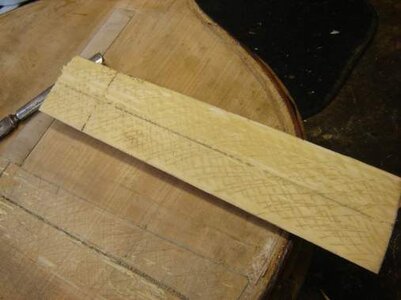
Sorry Matthew, I forgot to answer this one. Actually and thankfully I am not going to restore the belly at least not now. The bass came in with a lot of set up issues and upon inspection we discovered that the upper crossbar was 60% off so that was something that HAD to be dealt with. Hence the removal of the back. Here's a pic of what was off and reinforcement of the fact that scoring a gluing surface is a hack procedure-fingers of glue my @#$%!Matthew Tucker said:So, what are you going to do? Plane it off and start again? Is the bass bar glued with epoxy, too? And how come the back is off, not the belly?
Attachments
Matthew Tucker
Commercial User
- Aug 21, 2002
- 2,686
- 387
- Disclosures
- Owner: Bresque Basses, Sydney Basses and Cellos
from here, doesn't look so much like the scoring was a problem as much as lack of glue! I guess the scoring is a misguided attempt at making up for a bad fit. Do you reckon that was done by the same bovine as did the belly patch?
I know it was. That's just SOP in that shop. There was a good amount of aliphatic resin glue present but your right the fit was bad. A crossbar shouldn't fail [certainly not in a few years]. The other issue is that the scoring is cutting into original wood and in this case the back was 4mm thick. Custodial care of old instruments is pretty clear as to what's right and what's wrong.Matthew Tucker said:from here, doesn't look so much like the scoring was a problem as much as lack of glue! I guess the scoring is a misguided attempt at making up for a bad fit. Do you reckon that was done by the same bovine as did the belly patch?
Off topic I have been following you project and find it a great read. You are doing a great job[both in making and documenting]. I love your sense of invention.
Jeff Bollbach said:Sorry Matthew, I forgot to answer this one. Actually and thankfully I am not going to restore the belly at least not now. The bass came in with a lot of set up issues and upon inspection we discovered that the upper crossbar was 60% off so that was something that HAD to be dealt with. Hence the removal of the back. Here's a pic of what was off and reinforcement of the fact that scoring a gluing surface is a hack procedure-fingers of glue my @#$%!
I came across this tool. I take it the idea behind it isn't what is accepted here amongst the TB luthiers.
Invalid Link Removed
- May 6, 2003
- 5,272
- 160
- 64
- Disclosures
- Proprietor Fifth Avenue Fret Shop. Technical Editor Bass Gear Magazine
1/2 of what stewmac sells is usefull stuff. The rest is just sh-t they make money on.basswraith said:I came across this tool. I take it the idea behind it isn't what is accepted here amongst the TB luthiers.
Invalid Link Removed
fwiw, I don't have that particular tool, and none of my peers do either. Lets see, take wood off to glue wood together. Yea, that makes sense.
I'm still not seeing "toothed" bridges on Martins I've taken apart.

Jake deVilliers
Commercial User
- May 24, 2006
- 6,349
- 607
- Disclosures
- Owner of The Bass Spa, String Repairman at Long & McQuade Vancouver
You'll find those scoring marks on Martin bridges and fingerboards from the twenties and thirties; probably earlier too, but I haven't been there yet.
Elgar suggests doing that very thing in his " To Build a Bass ".
Don't get me wrong, I agree with Phil entirely that its a retrograde move, I just wanted to point out that it was the schizzle in the early part of the twentieth century.
The technique is also mentioned in an early ship carpentry book I have.
And I'd say that 10% of Stew-Mac's stuff is useful.
Jake
Elgar suggests doing that very thing in his " To Build a Bass ".
Don't get me wrong, I agree with Phil entirely that its a retrograde move, I just wanted to point out that it was the schizzle in the early part of the twentieth century.
The technique is also mentioned in an early ship carpentry book I have.
And I'd say that 10% of Stew-Mac's stuff is useful.
Jake

I was involved in medical research back in the 1970s. a technician constructing prototype equipment used for performing research on single muscle cells and small bundles of muscle cells. Because of the minute forces involved all of the fixtures that secured the muscle to the force and length measurment transducers had to be ultra low mass and the pieces were initially secured together with the garden variety epoxy adhesives that were available at the time - late 1970s.
The problem we soon discovered was that those epoxy formulations, while resistant to pure water or tap water, began to disintegrate when exposed to the isotonic (slight saline concentration) solutions required to keep the muscle cells alive. We actually had to have a special epoxy formulated that could withstand immersion in normal saline. The special formulation produced toxic fumes until fully cured, so I had to build the fixtures under an exhaust hood.
I do not know the current state of the art in epoxy technology but it is quite possible that many garden variety epoxies are still vulnerable to a low concentration saline solution and that such a solution may be used to remove some epoxies. What effect this would have on the woods involved is something I will leave to the wood experts.
Peace,
S
The problem we soon discovered was that those epoxy formulations, while resistant to pure water or tap water, began to disintegrate when exposed to the isotonic (slight saline concentration) solutions required to keep the muscle cells alive. We actually had to have a special epoxy formulated that could withstand immersion in normal saline. The special formulation produced toxic fumes until fully cured, so I had to build the fixtures under an exhaust hood.
I do not know the current state of the art in epoxy technology but it is quite possible that many garden variety epoxies are still vulnerable to a low concentration saline solution and that such a solution may be used to remove some epoxies. What effect this would have on the woods involved is something I will leave to the wood experts.
Peace,
S
Matthew Tucker
Commercial User
- Aug 21, 2002
- 2,686
- 387
- Disclosures
- Owner: Bresque Basses, Sydney Basses and Cellos
The only way in which scoring might help is to increase the potential surface area in contact with the glue. However this also has the side effect - if the scoring raises surface ridges - of significantly decreasing the contact between the surfaces to be glued! With a gap-filling glue like epoxy this might not be an issue and the increased surface area might help. However it certainly doesn't help a thin glue like hide glue which requires a close fit to be effective. And in my experience, it doesn't help with PVA glues much either. It might help if using PVA glues on ebony or rosewood which have a hard, non-absorbent surface.
But it just seems to me to be rough work, I can't really see the need.
But it just seems to me to be rough work, I can't really see the need.


