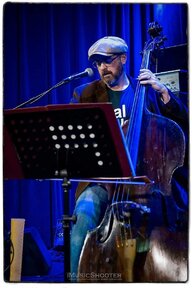
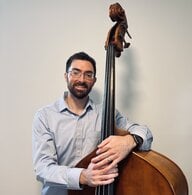
I didn't suggest "requiring a young bassist to play standing indefinitely" but rather that they play standing until they're able to play standing well. I do consider it a right of passage in that it's a thing I want all my students to be able to do.
Do you also require all of your bass students to learn how to play on a stool? It seems both should be addressed to see what is best for the child.
The reality of orchestra rehearsals is the bass players often wait around while the instructor works with the other sections. I can only speak from my own experience, but the time my instructors spent working with the basses was grossly less; so there is a real practical concern here. If your bassists are standing around bored thinking about how much their feet hurt, it's not going to make them love the instrument.
There's a whole other discussion we could have on this subject. We in Western societies, now more than ever, spend way too much time sitting on our arses and it's just not good for us. For me, that's one of the reasons I choose to continue to play standing and not sitting - I sit enough already. The devil is in the doseage in most things - too much standing, if you haven't gotten acclimated to it in a gradual way - I agree that it could and would have a negative impact on your playing.
I am sorry but this is BS and sort of arrogant on your part. Basically since you can easily do something, you erroneously think everyone should be able to do it. Engaging in physical activity is important, but not everybody can or should do the same types of activities. There are scholarly articles that claim too much standing can make your whole body hurt and degrade your mental state.
Now too much standing is bad for us, says study
This may not apply to you, but it definitely applies to me.
I would advise you to avoid judging me unless you have lived in my skin. I regularly go to the gym to work out with weights and do aerobic training, but standing for an extended time is painful and saps me of mental energy and focus. I have had long-term jobs where I stood all day, so it's not a matter of training. When I was in top physical condition it was actually more painful to stand for an hour than to run for an hour. As a military musician I had plenty of opportunities to stand a parade rest for an extended time; one for almost three hours.
FYI, I resisted transitioning to the stool when turned professional. I had played standing for so long that it just felt natural and it took me an extended time to get used to playing sitting down. Honestly at the time I was a better player standing than sitting. I also had to work with my instructor quite a bit to find the right approach. But once it clicked, there was no going back for me.
I frequently had three hours of rehearsals in a given day. On really long days it might extend to five or more hours. Sometimes our concerts extended over three hours as well. Because standing is painful and mental draining for me, it really was a necessity, and the added benefit is it actually expanded my technique.
The longer I teach, the less dogmatic I become in how I go about it, but I still teach all my bass students to play standing. I don't think "what fits" is as simple as trying things and deciding whether or not they fit. And in this, I don't think "flexible" is necessarily a good guideline in all things for a teacher - one should be flexible in some things, not flexible in others. I had a conversation with one of my teachers in college once where I looked at him and said, "Is your way here really better than mine?" And he said, "Maybe, and maybe not, but it's important for your development that you learn to do it my way for now so that you fully understand my approach." And I agree with that.
I don't disagree with this. In order to try out a technique and really understand if it will work for you, you have to live with it for an extended time. As an instructor you are obviously most qualified to teach the techniques you use and excel at. As I mentioned, my last instructor was way more flexible than most, and I really appreciated it. When I struggled with one technique that I had been working on for an extended time, he made the effort to take me down a different path and try a different approach.
As a student you strive to learn from many masters over your life. Some of them will probably be very strict and dogmatic, and you will learn a lot from them, some of which you will treasure and some of which you will discard. But hopefully the first person who teaches you to play bass will be kind and patient, and let's keep in mind we are talking about little kids.



 .
.