I dig Lesh and that whole scene...
Deadheads know how excellent Lesh is and how sophisticated his playing is...non-Deadheads can only judge from the outside looking in...which sometimes isn't pretty

To truly understand that music, one must get inside of it.
I agree about the sound industry being better off because of the Grateful Dead Family of gearheads.
Here's an excerpt from a interview with Dan Healy in 1992-
Dan relates, "The Grateful Dead has always been unbelievably supportive. They would get royalty checks for records and instead of buying houses and cars and yachts and all of that junk, they would give me the money back to put into the sound system and stuff. And so we reinvested emotionally and materially for years. By the early '70s we were the leaders in the field. By 1969 I was asking questions that had no answers. I had bottomed out all the research which [had basically been done] by the Bell Labs in the '20s. During that period a number of now-famous audio people sort of collaborated on the Wall of Sound." By working together, Dan claims their collective knowledge moved ahead by leaps and bounds.
"It caused major, major changes," he says. "Changes that are still going on in the sound industry today. We debunked so much stuff that you'd be amazed. And we verified so much stuff. In the period from 1969 to 1974, the entire audio industry completely turned upside down and the Grateful Dead was at the hub of it. Just that alone is something to have lived through and seen.
**********************************
some more interesting info-
Phil Lesh's Basses
[Invalid or Expired Link Removed]
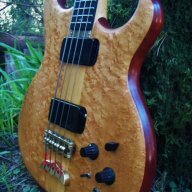
* Speaking on the new Osage Orange Alembic bass just built for him*
Phil is using a new quadraphonic bass, the electronics of which were designed and built by George Mundy and the body and pickups by Rick Turner. The new bass has the same versatile qualities as the old bass: three pickups (bass and treble pickups covering all the strings, and a quad pickup which has a separate signal for each string); on each of the bass and treble pickups there are controls which enable him to select 1) the band-width of the filter, 2) the center frequency of the filter, 3) the kind of filter being used and 4) mix unequalized unfiltered direct sound with the filtered sound. The variety of sounds which can be achieved on the bass is the result of the many different combinations of these variables which can be used. The new bass has a frequency response with a crisper tone, and two quad pickups instead of one, the new one being a frequency-detector pickup. The main addition to the new bass is a Digital Decoding Circuit such that ten push buttons on the bass allow Phil to select any one of sixteen quad spatial arrangements of his speakers, and eight in stereo mode
The bass guitar system has two columns of fifteen inch tranducers stacked 18 high. Four power amplifiers are used as the bass requires more power for equal loudness. Since the instrument has the capability to operate with individual outputs on each of the four strings, the array can be fed in this manner which makes it possible to play chords on the bass without intermodulation.
[Invalid or Expired Link Removed]