• TalkBass has been independent since 1998. Add your voice.
    Create a free account to reply to discussions, view embedded media, and browse with fewer display ads.
    Join freeLog in
    Want zero display ads or expanded classifieds tools? Compare plans.

ShuttleMax semi-parametric freqs, nominal

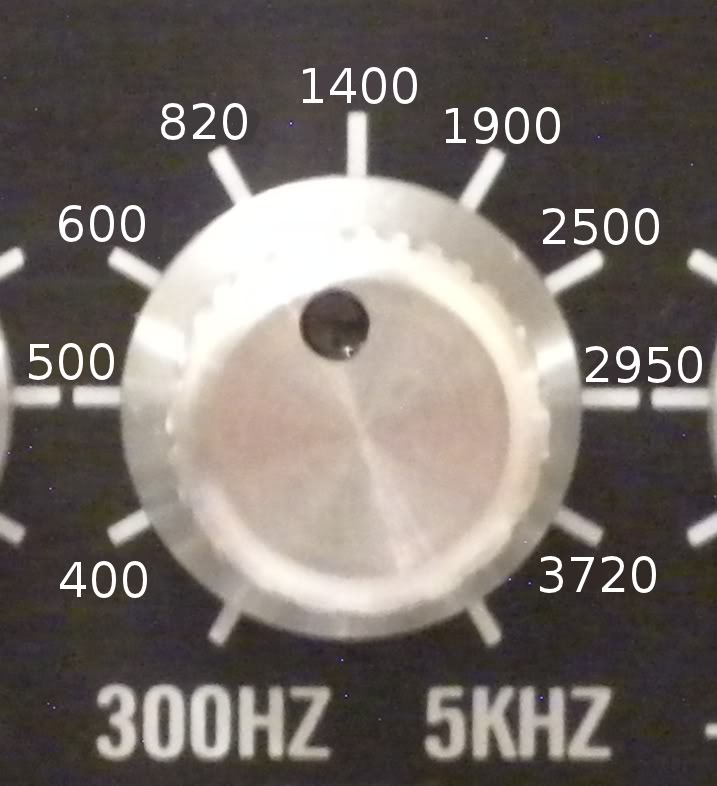
So this is all updated, I basically deleted the original post that started this thread. But this seems clearer. Here are the para-metric mid EQ knobs' nominal frequency values, as graciously provided in the thread below by agedhorse.

Lo-Mid
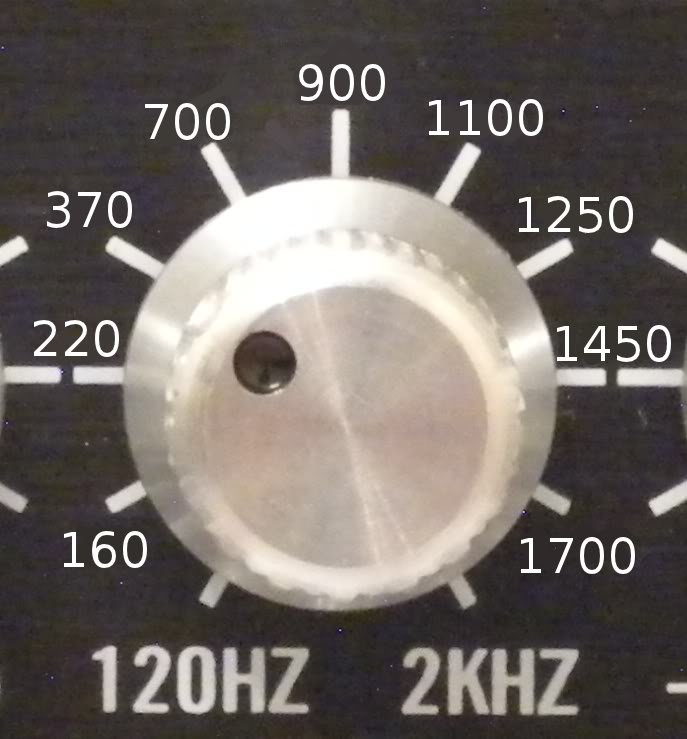
lo-mid_SM9_2_new.jpg


Hi-Mid
hi-mid_SM9_2_new.jpg


agedhorse was kind enough to look this up/test it out for us, as he posted in the thread below. A million thanks to you sir, and all the good folks at Genz Benz.

The curves are in line with what projectMalamute suggested was the right way, with half of each knob covering ~2 octaves.

I'm finding the EQ very powerful, in fact I'm still learning to get it controlled well, taking into account the addition/subtraction of the voicing filters. Now all I need is the fEarful. :ninja:
 
  • Like
Reactions: gscroggin
Agreed- if the taper is not linear, I'd like to update this correctly! Interesting to note, if the above is correct, the range of overlap between the two EQ knobs. The lo-mid overlaps the range of the hi-mid from the second hash (8 o'clock) on up. The hi-mid potentially overlaps the low from the first hash (7 o'clock) up to just shy of the 5th hash (11 o'clock). Useful for me to not get into cross-purpose EQ'ing on the two EQs! I'd also be interested in some info on the Q of the two paras.
 
Cool, this thread might be a little interesting to you. :D
http://www.talkbass.com/forum/f15/e...al-frequencies-parametric-mid-control-552978/

Although that was a diff amp and it was still somewhat inconclusive. Hopefully agedhorse drops in here.

Cool thread indeed, and completely on-topic. Most of note is Agedhorse saying the semi-parametric mid on the Shuttle's is linear, with the standard disclaimer on pot variability making the values only "nominal" and not exact.

Given that it makes sense that these are also linear, as they are on Eden's semi-parametric EQs. The log-freq method is usually used on graphic EQs (note each slider roughly double the freq of the previous on bass heads).

One thing I noticed: an error in your equation:

(highest freq - lowest freq / number of notches)

It should be:

(highest freq - lowest freq / (number of notches -1))

You do not count the lowest, or "zero" notch in the computation, you're really counting the gaps between notches. But thanks for posting that thread, as I think that makes it even more certain that the pots are roughly linear in frequency space. Of course Q is probably not, and I would love to hear from Agedhorse if they scale Q around the knob or have a constant (eg 1/3 octave, 1/2 octave, etc) around the knob. That would mean that Q encompasses less of the "knob-space" as you go higher in frequencies, since (assuming) the knobs are linear.
 
I would be very surprised if the range is linear.

Does it sound like almost half the range of operation occurs in the first 1/8th of a turn? Does it sound like the first half of the dial changes the frequency about 3 times as much as the second half of the dial? That's what the numbers you have written would imply.
 
I am out on a gig today, but I am pretty sure the control is reasonably linear. I will chack one tomorrow and post if different and my memory is just foggy.
 
I am out on a gig today, but I am pretty sure the control is reasonably linear. I will chack one tomorrow and post if different and my memory is just foggy.

Really? Why would you want it set up like this?

Seems like the EQ on every console I use sweeps so that you get a smooth taper in octaves, not Hz. So with a range of 300Hz to 5K like the one above (about 4 octaves) you would have around 1.2K at noon on the dial (~2 octaves above the lowest frequency and ~2octaves below the highest).
 
Really? Why would you want it set up like this?

Seems like the EQ on every console I use sweeps so that you get a smooth taper in octaves, not Hz. So with a range of 300Hz to 5K like the one above (about 4 octaves) you would have around 1.2K at noon on the dial (~2 octaves above the lowest frequency and ~2octaves below the highest).

Like I mentioned in my post above, graphic EQs are definitely set up this way. But in my experience, from Agedhorse's info on the other thread referenced above and on how Eden's semi-parametric EQs work, they are usually linear.

That said, I can see your point. Having TDC (top dead center) be 1.2 kHz instead of 2.6kHz would seem to expand the amount of the dial given to those key mid-freqs from 300 to 1k. The other argument is that the lo-mid knob provides enough focus on that range. I will say that linear interpolation might be easier for people to grasp intuitively than log interpolation.
 
I am out on a gig today, but I am pretty sure the control is reasonably linear. I will chack one tomorrow and post if different and my memory is just foggy.
Thank you very much, have a good gig!

Also, any info on Q for the two mid filters would be greatly appreciated- constant Q (say 1/3 octave, 1/2 octave, or octave) or variable Q (variable such that it was always 300Hz wide at the 50% cut-off, so that Q always covered the same amount of EQ knob's dial).

Or you can tell me to go to heck, because you already did a great job putting this amp together, I'm really loving it!

I put this together because while I like to use my ears, sometimes they can get fooled, and I want make sure I'm not EQ'ing at cross purposes on the two semi-parametric EQs. Also, every once in a while a sound engineer will ask for me to cut (usually) or boost (rarely) a specific frequency; knowing these nominal values precludes a fair amount of hunt-and-peck in cases like that.
 
Like I mentioned in my post above, graphic EQs are definitely set up this way. But in my experience, from Agedhorse's info on the other thread referenced above and on how Eden's semi-parametric EQs work, they are usually linear.

That said, I can see your point. Having TDC (top dead center) be 1.2 kHz instead of 2.6kHz would seem to expand the amount of the dial given to those key mid-freqs from 300 to 1k. The other argument is that the lo-mid knob provides enough focus on that range. I will say that linear interpolation might be easier for people to grasp intuitively than log interpolation.

I don't think I have ever seen a parametric EQ that sweeps the way you are describing. The channel EQ on my Soundcraft and Studiomaster boards doesn't, the EQ on every A&H/Crest/Yamaha/whatever board I've come across doing live sound doesn't, my Orban 622's don't. Just seems like a really weird design choice.

It should be really obvious if it sweeps 3 octaves in the first half a turn and only one in the last half a turn.
 
I don't think I have ever seen a parametric EQ that sweeps the way you are describing. The channel EQ on my Soundcraft and Studiomaster boards doesn't, the EQ on every A&H/Crest/Yamaha/whatever board I've come across doing live sound doesn't, my Orban 622's don't. Just seems like a really weird design choice.

It should be really obvious if it sweeps 3 octaves in the first half a turn and only one in the last half a turn.

So are those true parametric EQs or semi-parametric EQs? Also note everything you mentioned is either a soundboard or an actual outboard full parametric EQ; everything I mentioned are bass amps with semi-parametric EQs. Maybe you're comparing apples and oranges?

I mean I realize completely what you are saying- with a linear taper, the hi-mid EQ knob covers just over 3 octaves on the bottom half of the knob, and slightly less than 1 octave on the top half of the knob.

Now when I play a given note, say an open A with a fundamental frequency of 55 Hz, and sweep through the lo para I cannot tell which frequencies are being altered. I can tell how it changes the tone of that note, I can strike the note again and get a feel for how it affects the attack and the note envelope, but I can't tell what frequency is being affected. If you have this amp, and you can tell that, let us know. I'll wait for Agedhorse's input. Furthermore, realize that I'm not interested in what the best design is - a subjective opinion anyway, in spite of the logic behind your observation. I just want to know how *this amp* actually works. I'm plenty happy with the amp, I just want the knowledge to use it better.
 
I need to test, I really don't remember. It may be inbetween or a fractional reverse log function. Rather than give you bad information, please wait until I actually go back to my paperwork and look atthe circuit and run a sweep test.

Note that on filter circuits, frequency scaling involves log functions and the directions change based on where in the circuit and what type of circuit it is. That's why there are log and reverse log controls to scale in the direction needed based on the type of circuit.
 
After a much needed cup of coffee (late gigs aren't getting any easier these days), I made some measurements and here's what I documented on my benchmark unit:

SHUTTLE 6.0 (specified sweep range 150H-2kHz)

(lines)
-5 = 150Hz
-4 = 170Hz
-3 = 205Hz
-2 = 320Hz
-1 = 550Hz
NOON = 756Hz
+1 = 1kHz
+2 = 1.30kHz
+3 = 1.62kHz
+4 = 1.85kHz
+5 = 2.05kHz

Q is roughly 1.4