Somebody please help me understand what I need. I'm looking to mod one of my basses to add series/parallel/single coil tapping for each pickup, so I think I need two DP3T toggle switches. Problem is, I've seen both the DPDT (on-on-on) and DP3T (on-on-on) switches each with six terminals. For the life of me, I don't "see" the difference. The DPDT (on-on-on) is more readily available. Are these the same switches? Thanks

Enjoy the benefits of a premium membership!
Upgrade Account
-
TalkBass has been independent since 1998. Add your voice.
Create a free account to reply to discussions, view embedded media, and browse with fewer display ads.
Join free Log in
Want zero display ads or expanded classifieds tools? Compare plans.
You are using an out of date browser. It may not display this or other websites correctly.
You should upgrade or use an alternative browser.
You should upgrade or use an alternative browser.
DPDT (on-on-on) vs. DP3T (on-on-on)
- Thread starter Modulus1906
- Start date
More options
Who Replied?
Not sure of the difference (other than double throw vs. triple throw) but I always use DPDT on/on/on switches for that.

If you are seeing DP3T switches with only 6 terminals, the info is either incorrect, or a stock image of a DPDT was used for the part, if you are looking online.
A DP3T switch is actually a 4PDT On-On-On switch with external jumper wires soldered in to allow it to function as a double pole switch with three throws.
First off, the order will be series/single coil/parallel, not series/parallel/single coil. This is a limitation of the switching, so you can't change the order around.
Second, this is a coil split, not a tap. Coil tapping is done with pickups wound with a tap somewhere in the winding.
Third, what you want for this application is a DPDT On-On-On switch, which is also known as an SP3T.
A DP3T switch is actually a 4PDT On-On-On switch with external jumper wires soldered in to allow it to function as a double pole switch with three throws.
I'm looking to mod one of my basses to add series/parallel/single coil tapping for each pickup
First off, the order will be series/single coil/parallel, not series/parallel/single coil. This is a limitation of the switching, so you can't change the order around.
Second, this is a coil split, not a tap. Coil tapping is done with pickups wound with a tap somewhere in the winding.
Third, what you want for this application is a DPDT On-On-On switch, which is also known as an SP3T.
huh?...what you want for this application is a DPDT On-On-On switch, which is also known as an SP3T.
you can apparently make a DPDT act like a SP3T, but they're not inherently the same thing.
here's a DPDT turned into an SP3T to switch between three pickups (found just now on the google);
it does look like the typical jumper config used for series/parallel, doesn't it?
could you use an actual SP3T switch for this application (series/single/parallel)? like half a tele blade switch? hmmm...
huh?
you can apparently make a DPDT act like a SP3T, but they're not inherently the same thing.
here's a DPDT turned into an SP3T to switch between three pickups (found just now on the google);
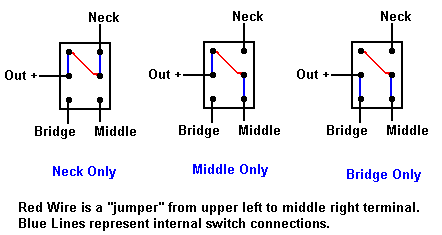
it does look like the typical jumper config used for series/parallel, doesn't it?
could you use an actual SP3T switch for this application (series/single/parallel)? like half a tele blade switch? hmmm...
An SP3T switch is a DPDT On-On-On switch with the addition of an external jumper wire.
Also, it appears that the switching is backwards for the middle position.
For reference, here is a 4PDT On-On-On configured as a DP3T.
The jumpers are shown in red.
Ignore one half, and it is an SP3T or DPDT On-On-On switch.
If you are seeing DP3T switches with only 6 terminals, the info is either incorrect, or a stock image of a DPDT was used for the part, if you are looking online.
A DP3T switch is actually a 4PDT On-On-On switch with external jumper wires soldered in to allow it to function as a double pole switch with three throws.
First off, the order will be series/single coil/parallel, not series/parallel/single coil. This is a limitation of the switching, so you can't change the order around.
Second, this is a coil split, not a tap. Coil tapping is done with pickups wound with a tap somewhere in the winding.
Third, what you want for this application is a DPDT On-On-On switch, which is also known as an SP3T.
In the attached diagram from Bartolini, why do they even show the DP3T switch with 6 terminals in the 4th and 5th diagrams on the first page. Is this a mistake or does it somehow relate to your explanation and I'm just not seeing it? Thanks
Attachments
In the attached diagram from Bartolini, why do they even show the DP3T switch with 6 terminals in the 4th and 5th diagrams on the first page. Is this a mistake or does it somehow relate to your explanation and I'm just not seeing it? Thanks
They termed it wrong. Those are DPDT switches.
By definition, a DP3T switch would have to have a common terminal, plus 3 separate throws. A DPDT On-On-On/SP3T switch has two throws, and one position is "split" so that one common goes to the terminal on one side, and the other common goes to the opposite throw's terminal for it's pole.
A proper DP3T switch has to have at least 8 terminals. Either 8, or more (12) with external jumpers.
They termed it wrong. Those are DPDT switches.
By definition, a DP3T switch would have to have a common terminal, plus 3 separate throws. A DPDT On-On-On/SP3T switch has two throws, and one position is "split" so that one common goes to the terminal on one side, and the other common goes to the opposite throw's terminal for it's pole.
A proper DP3T switch has to have at least 8 terminals. Either 8, or more (12) with external jumpers.
OK, just to be certain, so two DPDT switches (one for each pickup) should work, right? Thanks. You sound like an engineer.
OK, just to be certain, so two DPDT switches (one for each pickup) should work, right? Thanks. You sound like an engineer.
Yes, you want DPDT On-On-On switches for series/single coil/parallel switching.

i'm not sure that was a complimentYou sound like an engineer.


OK, just to be certain, so two DPDT switches (one for each pickup) should work, right? Thanks.
As line6man pointed out, you'll need DPDT On-On-On switches.
These diagrams will help you select which single coil will be active.
Coil A active:
Coil B active:
More info on switching:
http://www.1728.com/guitar7.htm
i'm not sure that was a compliment
Yeah, I'm not sure either.
Based on the data the OP has given, I was able to calculate a 62.378% probability that it was not a complement, however, my margin of error is too significant for it to be a proper analysis.
line6man said:Yeah, I'm not sure either.
Based on the data the OP has given, I was able to calculate a 62.378% probability that it was not a complement, however, my margin of error is too significant for it to be a proper analysis.
Perfect.
Yes, I meant to be complementary. I appreciate all the help. I hope this mod gives me real flexibility instead of a substance over form difference.

Bartolini uses that 3t terminology on other diagrams also and it’s really confusing. I just decided they meant “on-on-on” which is DPDT I believe.

In my experience buying on-on-on mini toggle switches, the electronics industry calls a 6 terminal, DPDT, on-on-on by what I would call the proper term of "DPDT on-on-on". Digi-Key, Newark, Future, etc all sell them by that term. However double things to 12 terminals for what I would call a 4PDT on-on-on and the electronics industry term switches terms to "DP3T" switch. And if you read the data sheets for the indicated parts, they take external jumpers as described above in order to realize the DP3T functionality.
Generally speaking you will not see a 6 terminal device called a SP3T even though you could. And you will not find a 12 terminal device called a 4PDT on-on-on even though you should.
Generally speaking you will not see a 6 terminal device called a SP3T even though you could. And you will not find a 12 terminal device called a 4PDT on-on-on even though you should.

DPDT (on-on-on) vs. DP3T (on-on-on)
Well it's the same switch, and yeah for series/parallel/single, that's the one you need. TBH, neither description perfectly represents this switch. Your confusion is understandable, and not uncommon.
In my experience buying on-on-on mini toggle switches, the electronics industry calls a 6 terminal, DPDT, on-on-on by what I would call the proper term of "DPDT on-on-on". Digi-Key, Newark, Future, etc all sell them by that term. However double things to 12 terminals for what I would call a 4PDT on-on-on and the electronics industry term switches terms to "DP3T" switch. And if you read the data sheets for the indicated parts, they take external jumpers as described above in order to realize the DP3T functionality.
Generally speaking you will not see a 6 terminal device called a SP3T even though you could. And you will not find a 12 terminal device called a 4PDT on-on-on even though you should.
That's been my experience as well.

Sorry to Necro this thread, but I'm trying to do something with a 3 pos on-on-on *slider* switch as I want a lower profile on the base than a conventional switch... I can't hardly seem to find DPDT 3 position sliders that are on-on-on, mostly DP3Ts...
If I'm not mistaken from the above diagrams, these *could work for something like Coil1/Series/Coil2, right?
If I'm not mistaken from the above diagrams, these *could work for something like Coil1/Series/Coil2, right?


