I have posted before on this forum about our ongoing problem with drummers. People have all kinds of ideas about drummers, but I believe that if you are going to be a drummer in a cover band, you need to have the following:
Drummer #1
Drummer #1 came to us when we were a start up. It would be hard to attract top players. We had little gear, and no name in this town. My wife had been in this local scene quite a number of years ago, but then went out on the road, and then "retired" due to her father slowly dying of cancer. She started up this band at least a little bit rusty. I was never known in this town, as I came from somewhere else. We managed to find a great guitar player, who was only 20 years old at the time, and had no experience. He just happened to have natural talent.
So we got Drummer #1, and he was a little weak. We noticed his weaknesses more and more, as we rehearsed, and played our first few shows. He didn't have a natural sense of tempo. He was inconsistent. Mostly, he lacked confidence, and sounded a bit tentative at times.
We discovered that by working with him, and practicing hard, and getting him to practice with the metronome at home, he could overcome some of these issues. We threw some fairly challenging material at him, and to his credit, he did pretty well with it at times.
Here is a video of us on a pretty good stage, doing "Long Tall Sally" into the long version of "Whole Lotta Love."
Long Tall Sally/Whole Lotta Love - YouTube
At this time, we thought he was going to work out, as his weaknesses got better as time went by.
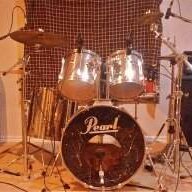
We worked with this guy for about a year and a half. On a personal level, we really liked him a lot. He is a great guy, and shows up on time, ready to rehearse. He has a great kit, and nice Shure drum mics and stands.
His worst problem was that when he felt intimidated, like when musicians from other bands came to see us, he lost his place; he made strange mistakes; just stuff that could have been worked out through more practice.
Unfortunately, he decided it was too much work, and he stopped practicing at home. He grew frustrated, and made more and more big mistakes at shows.
I was the one who fired him. I didn't mince words; I called him up and said, "I've got some bad news," and then added, "we've decided to go with someone else."
Our guitar player was mad at me for doing it, because he liked him very much. The thing is, I liked him very much as well, and I didn't enjoy firing the guy. I wished it could have worked out, but musically, he was holding us back, and I didn't see more effort coming in the future. He was tired of having people tell him how to play his instrument. I can't say I blame him for that, but I also couldn't just ignore parts in songs where the rhythm fell apart.
I'll always remember him for that performance at Martin's that I linked above. We had a good night, and the people liked us.
If you've read all this, then you now know the story of Drummer #1.
- Tempo - You need to know the tempo a song should be played at, and you need to be consistent. You should be at the same tempo from beginning to end of any song, unless that song has a part that is at a different tempo or time signature
- Time signature - You need to be aware of the song's time signature, so you can play the song with the correct feel
- Feel - You need to duplicate the feel of the original, and not do "happy beats" when the mood should be darker, or more rocking
- Dynamics - You have to be able to play any song louder or softer, based on the room, or even the PA you are dealing with. It is probably more challenging to do this in a small time cover band than it is playing for Aerosmith
- Work Ethic - You have to have this. You cannot assume you have all your parts down because you played with the record at home. Many hit songs FADE OUT, and do not have endings. Many others have different versions, whether the original radio version, a live version, etc. There are many reasons you need to spend time going through the material with the other real musicians you are playing with, to find that group dynamic that makes your band stand out, and sound professional
- Decent Gear. If you are playing small venues, or medium venues, and the band is providing sound and PA, it is important that you have some drum mics, or your kick will be lost in the mix, and you will be heard with no effects. It is better to mic drums. You also need a good kit, with well-maintained heads, and you need to be a guy who tunes frequently, so that your kit sounds good with the band.
Drummer #1
Drummer #1 came to us when we were a start up. It would be hard to attract top players. We had little gear, and no name in this town. My wife had been in this local scene quite a number of years ago, but then went out on the road, and then "retired" due to her father slowly dying of cancer. She started up this band at least a little bit rusty. I was never known in this town, as I came from somewhere else. We managed to find a great guitar player, who was only 20 years old at the time, and had no experience. He just happened to have natural talent.
So we got Drummer #1, and he was a little weak. We noticed his weaknesses more and more, as we rehearsed, and played our first few shows. He didn't have a natural sense of tempo. He was inconsistent. Mostly, he lacked confidence, and sounded a bit tentative at times.
We discovered that by working with him, and practicing hard, and getting him to practice with the metronome at home, he could overcome some of these issues. We threw some fairly challenging material at him, and to his credit, he did pretty well with it at times.
Here is a video of us on a pretty good stage, doing "Long Tall Sally" into the long version of "Whole Lotta Love."
Long Tall Sally/Whole Lotta Love - YouTube
At this time, we thought he was going to work out, as his weaknesses got better as time went by.
We worked with this guy for about a year and a half. On a personal level, we really liked him a lot. He is a great guy, and shows up on time, ready to rehearse. He has a great kit, and nice Shure drum mics and stands.
His worst problem was that when he felt intimidated, like when musicians from other bands came to see us, he lost his place; he made strange mistakes; just stuff that could have been worked out through more practice.
Unfortunately, he decided it was too much work, and he stopped practicing at home. He grew frustrated, and made more and more big mistakes at shows.
I was the one who fired him. I didn't mince words; I called him up and said, "I've got some bad news," and then added, "we've decided to go with someone else."
Our guitar player was mad at me for doing it, because he liked him very much. The thing is, I liked him very much as well, and I didn't enjoy firing the guy. I wished it could have worked out, but musically, he was holding us back, and I didn't see more effort coming in the future. He was tired of having people tell him how to play his instrument. I can't say I blame him for that, but I also couldn't just ignore parts in songs where the rhythm fell apart.
I'll always remember him for that performance at Martin's that I linked above. We had a good night, and the people liked us.
If you've read all this, then you now know the story of Drummer #1.