I recently bought a used tube bass preamp off ebay, and it's one you don't see very often, so I thought I'd post my first impressions.
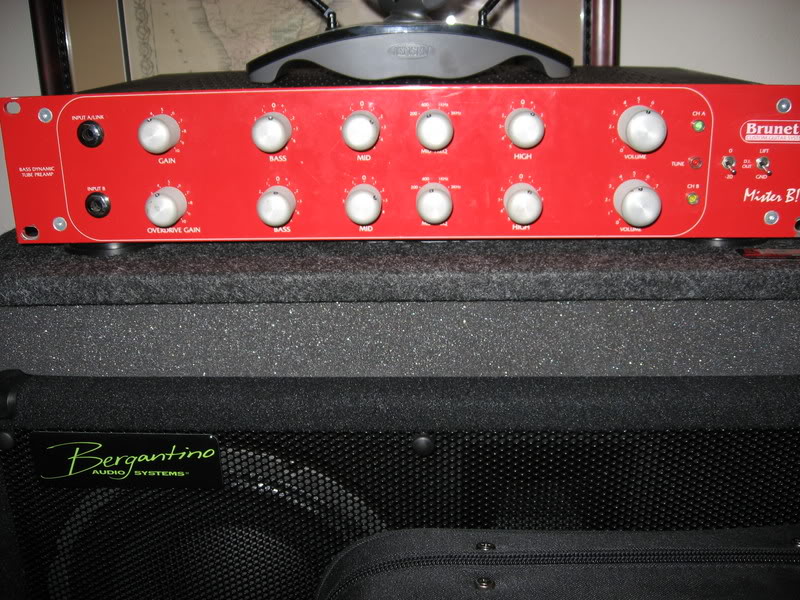
The preamp in question is called a Brunetti "Mister B." It has seven tubes in it: (4) 12AX7 tubes, (1) 12AU7 tube, and (2) PCF82/9U8 tubes, the latter being a very unusual choice, as they were originally used in TV channel switching applications, as far as I can tell.
It has two discrete channels that can be switched using a two-button footswitch (the other button mutes it, turning on the tuner output). Each channel has its own controls, circuitry, and tubes, as well as effects loops, meaning that it really is like having two preamps in one box. Why is this useful? Three things come immediately to mind.
The first, obvious application is to use the second channel as an overdrive channel, as is labeled on the unit. The circuitry is largely the same, though the second channel has a little more in the mids and slightly less bass. As a result, it is tempting to set the gain really high on the second channel (and set the volume low, so that there won't be a massive change in volume when you click on the switch and change channels) to create a fuzzy overdrive effect.
The second possible use is that you can have two different EQ settings, and switch between them using the footswitch. Each channel has its own gain, volume, bass, treble, and mid control, with the center frequency of the mid control being selectable from four choices: 200Hz, 400Hz, 1K, and 3K. Passinwind suggested that sometimes it's better engineered to have an optimized circuit for each choice rather than a continually adjustable parametric, but that's getting way above my paltry level of knowledge. In any event, the Q on the mid control is very wide, and the amount of change is pretty substantial making this a very flexible EQ, from a tonal perspective. I'm only just beginning to explore the tonal range of this amp. In any event, the ability to have two completely different EQ settings as well as gain settings for the preamp is pretty handy.
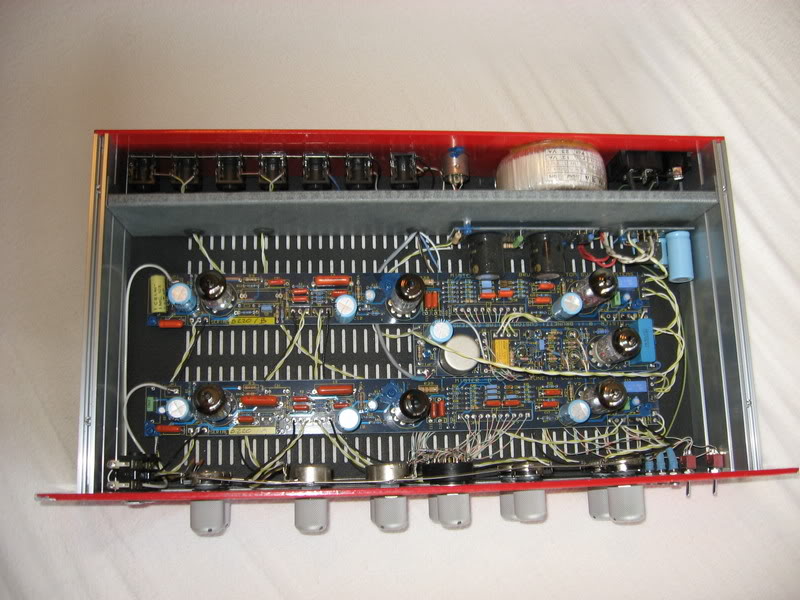
Finally, this is a great preamp for trying out differences between tubes. If you set up both channels with the EQ voiced nearly the same, you can drop in various 12AX7 tubes and listen to them back-to-back with ease, just using the footswitch. I've decided to go ahead and replace the tubes, as some of them were getting microphonic. I decided to get a set of two Tung-Sol 12AX7s for one channel, and two JJs for the other, just for some change of pace. I've also spent the last couple days on a crash course in learning about tubes, and am eager to try all kinds of tubes in it. Passinwind put a Mesa tube in one of the sockets on the second channel, which has a pretty interesting overdriven sound -- a nice contrast to the clean channel. In the picture above, you can see the circuitry and tubes for the two channels which are laid out on separate parallel circuit boards.
The Brunetti is a nice preamp. Though it looks orange in the pics, it is actually red, and takes up two rack spaces. It weighs a little less than 10 lbs. It is well built in the old-school no-frills kind of way, as opposed to the blue-lights chrome-faced kind of way like my PJ Bass Buddy. The knobs and case are very solid, and everything has that built-to-last kind of feel about it.
I have no idea how many of these were made, but they have not been in production for some time. I actually had to contact Marco Brunetti himself to get info on the "Mister B," as it is not on their website, either. A quick TB search turned up next to nothing other than a couple comments by people that they heard good things about Brunetti gear. A google search for the preamp revealed almost nothing, either. Brunetti apparently specializes in making guitar tube heads and amps, and apparently they are pretty decent quality, from what little I can tell.
As for the tone of the unit, all I can say is that playing it through my Bergantino IP 310, I'm getting the best tone I've ever had, though certainly a lot of that is due to the IP310. I would say that the high end is very revealing (I'm discovering lots of flaws in my technique! ), yet is not harsh or overly bright. The midrange is neither forward nor scooped, but is substantial. This preamp drives the IP really well. The bass is well-defined, neither boomy nor flabby, and there's tons of booty. I don't have enough experience to compare it to a wide range of other preamps, but I'll say that I think it stacks up pretty well against some of the other preamps I considered like the Alembic and the Read Purity. I'm very happy with the tone. It's a keeper, for sure.

All in all, I'm pretty danged happy with my crazy obscure Italian tube bass preamp. It was a complete unknown, but I'm glad I took the plunge. A big thanks goes out to TBers 4mal and Passinwind, who graciously hosted me at Mal's house and gave the Brunetti a going-over. I probably would not have taken the plunge if it were not for the knowledge that Charlie could probably figure out how to fix it if something was broken. Another big thanks goes out to Tom Bowlus, who could have easily snapped it up off ebay, but was kind enough to hold off and let me get it for what to me was the bargain price of $382.00.
That's all for now. I'm sure there's something I've forgotten, but I guess I can post more later.
The preamp in question is called a Brunetti "Mister B." It has seven tubes in it: (4) 12AX7 tubes, (1) 12AU7 tube, and (2) PCF82/9U8 tubes, the latter being a very unusual choice, as they were originally used in TV channel switching applications, as far as I can tell.
It has two discrete channels that can be switched using a two-button footswitch (the other button mutes it, turning on the tuner output). Each channel has its own controls, circuitry, and tubes, as well as effects loops, meaning that it really is like having two preamps in one box. Why is this useful? Three things come immediately to mind.
The first, obvious application is to use the second channel as an overdrive channel, as is labeled on the unit. The circuitry is largely the same, though the second channel has a little more in the mids and slightly less bass. As a result, it is tempting to set the gain really high on the second channel (and set the volume low, so that there won't be a massive change in volume when you click on the switch and change channels) to create a fuzzy overdrive effect.
The second possible use is that you can have two different EQ settings, and switch between them using the footswitch. Each channel has its own gain, volume, bass, treble, and mid control, with the center frequency of the mid control being selectable from four choices: 200Hz, 400Hz, 1K, and 3K. Passinwind suggested that sometimes it's better engineered to have an optimized circuit for each choice rather than a continually adjustable parametric, but that's getting way above my paltry level of knowledge. In any event, the Q on the mid control is very wide, and the amount of change is pretty substantial making this a very flexible EQ, from a tonal perspective. I'm only just beginning to explore the tonal range of this amp. In any event, the ability to have two completely different EQ settings as well as gain settings for the preamp is pretty handy.
Finally, this is a great preamp for trying out differences between tubes. If you set up both channels with the EQ voiced nearly the same, you can drop in various 12AX7 tubes and listen to them back-to-back with ease, just using the footswitch. I've decided to go ahead and replace the tubes, as some of them were getting microphonic. I decided to get a set of two Tung-Sol 12AX7s for one channel, and two JJs for the other, just for some change of pace. I've also spent the last couple days on a crash course in learning about tubes, and am eager to try all kinds of tubes in it. Passinwind put a Mesa tube in one of the sockets on the second channel, which has a pretty interesting overdriven sound -- a nice contrast to the clean channel. In the picture above, you can see the circuitry and tubes for the two channels which are laid out on separate parallel circuit boards.
The Brunetti is a nice preamp. Though it looks orange in the pics, it is actually red, and takes up two rack spaces. It weighs a little less than 10 lbs. It is well built in the old-school no-frills kind of way, as opposed to the blue-lights chrome-faced kind of way like my PJ Bass Buddy. The knobs and case are very solid, and everything has that built-to-last kind of feel about it.
I have no idea how many of these were made, but they have not been in production for some time. I actually had to contact Marco Brunetti himself to get info on the "Mister B," as it is not on their website, either. A quick TB search turned up next to nothing other than a couple comments by people that they heard good things about Brunetti gear. A google search for the preamp revealed almost nothing, either. Brunetti apparently specializes in making guitar tube heads and amps, and apparently they are pretty decent quality, from what little I can tell.
As for the tone of the unit, all I can say is that playing it through my Bergantino IP 310, I'm getting the best tone I've ever had, though certainly a lot of that is due to the IP310. I would say that the high end is very revealing (I'm discovering lots of flaws in my technique!
), yet is not harsh or overly bright. The midrange is neither forward nor scooped, but is substantial. This preamp drives the IP really well. The bass is well-defined, neither boomy nor flabby, and there's tons of booty. I don't have enough experience to compare it to a wide range of other preamps, but I'll say that I think it stacks up pretty well against some of the other preamps I considered like the Alembic and the Read Purity. I'm very happy with the tone. It's a keeper, for sure.All in all, I'm pretty danged happy with my crazy obscure Italian tube bass preamp. It was a complete unknown, but I'm glad I took the plunge. A big thanks goes out to TBers 4mal and Passinwind, who graciously hosted me at Mal's house and gave the Brunetti a going-over. I probably would not have taken the plunge if it were not for the knowledge that Charlie could probably figure out how to fix it if something was broken. Another big thanks goes out to Tom Bowlus, who could have easily snapped it up off ebay, but was kind enough to hold off and let me get it for what to me was the bargain price of $382.00.
That's all for now. I'm sure there's something I've forgotten, but I guess I can post more later.