
Enjoy the benefits of a premium membership!
Upgrade Account
-
TalkBass has been independent since 1998. Add your voice.
Create a free account to reply to discussions, view embedded media, and browse with fewer display ads.
Join free Log in
Want zero display ads or expanded classifieds tools? Compare plans.
You are using an out of date browser. It may not display this or other websites correctly.
You should upgrade or use an alternative browser.
You should upgrade or use an alternative browser.
how to "test" a bass
- Thread starter Ryanrocksursock
- Start date
More options
Who Replied?
First I find out if they have the same kind of amp or similar one that I use. Then I either ask for a strap or bring my own, since you can't really get a good feel for the bass sitting down. I play around with the EQ settings on the amp to get what I usually use and then I play songs that I play in my band or at church, songs that really bring out the tone I'm going to produce in a live setting. I'll mess around and play some slap stuff and fingerstyle stuff, isolating the bridge and neck pickups and then blending them. It's usually hard to get the exact sound at the shop that I'll get at home because the first thing I do is change the strings when I get a new bass, and that alone will change the tone dramatically.
Hope that helps.
Hope that helps.


first thing you need to do is smash it into the guitar displays to make sure it's nice and durable.
seriously though, capnsandwich is right on the money IMO
seriously though, capnsandwich is right on the money IMO


Here's my checklist, in no particular order:
1 - Make certain all the electronics work (pups, switches, pots, etc).
2 - Check the neck for smooth surface on the back (no nicks/gouges or lifting/loose truss rod filler).
3 - Sometimes I may ask someone for an allen wrench and make sure the truss rod will adjust (especially on used instruments).
4 - Fiddle with the tuners a bit, check for smooth/tight operation.
5 - Give the fit and finish a very close inspection, especially the neck pocket if it is a Fender.
6 - Try a few different amps (not just the Ampegs) to hear what it will more likely sound like on my junk).
I probably forgot something, but those are my basics...
1 - Make certain all the electronics work (pups, switches, pots, etc).
2 - Check the neck for smooth surface on the back (no nicks/gouges or lifting/loose truss rod filler).
3 - Sometimes I may ask someone for an allen wrench and make sure the truss rod will adjust (especially on used instruments).
4 - Fiddle with the tuners a bit, check for smooth/tight operation.
5 - Give the fit and finish a very close inspection, especially the neck pocket if it is a Fender.
6 - Try a few different amps (not just the Ampegs) to hear what it will more likely sound like on my junk).
I probably forgot something, but those are my basics...
its kinda hard to test out a bass at a music store being that most of the floor models r set up like ****
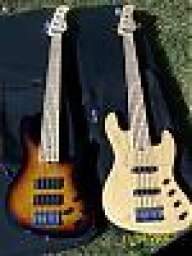
I think you HAVE to play with a live band to really know. I had several basses that sounded great in the living room/store but a live mix changed everything. Ironically, the one that has cured my GAS is one I'm not blown away by at home.
I run down the whole neck and make sure there arent any dead notes. I make sure the fretwork is good. Plug it in and make sure the all the electronics work. I rarely play music if im testing out a bass. I figure as long as the bass is comfy I can make it sound however i want within limits. If you really wanna be sure bring your own amp there. Checking one in the store that isnt the exact same model will throw off your basis for comparison.

first thing you need to do is smash it into the guitar displays to make sure it's nice and durable.Then ask for a discount since it's "shopworn".
seriously though, capnsandwich is right on the money IMO
Fixed it for ya.

I'd go with what's already been said- play what you're gonna play on it throygh aamp similar to what you've got.
Don't forget about the "shopworn" discount. Very important.
Bob

Assuming that first its looks are what caught my eye, I take it down and inspect it, run my hands along its contours, check for obvious defects or problems. Then I sit down with it and play it unplugged for a minute, just to see how it feels. Then I find the amp that's closest to my amp, and plug it in, and see how it sounds. I'lll try out all the different available tone/pickup combinations it may have. I'll play some of the different songs I do with my band, and then noodle around on it in different styles that I enjoy. Simple, really.
I play it flat. It's unlikely they'd have a Genz Benz to play so I just plug into the best they've got. I don't eq the bass, just run it flat to hear it natural. After that I check all the electronics, make sure everything s working properly. I run every fret to see if there are any dead frets. Obviously you do a thorough visual inspection. If it feels, good, sounds good and checks out then you're good to go. Like Maconbass pointed out though, the true test is playing it with your band and see how it fits in the mix.
I play it flat. It's unlikely they'd have a Genz Benz to play so I just plug into the best they've got. I don't eq the bass, just run it flat to hear it natural.
+1. I always make a point to set everything flat, amp and all, to get the basic tone. I also try to use an amp similar to what I play through, which won't happen for me, so I usually try to play through a Fender Rumble, which is my practice amp.
You should also run some scales and technical stuff to make sure there's no dead notes and that it feels good for you. Then of course some band stuff to see if it's the sound you're looking for, and after that, check the body for any nicks.

I've got kind of a hangup about significant dead spots and they're a lot easier to hear in a mix, so a few times, when there was a bass I was particularly interested in, I've brought a headphone amp, headphones and MP3 player with me. It probably seems kind of obsessive, but it's easier to hear the bass clearly in a shop full of wanking guitards and a couple times it's saved me from buying basses I ultimately wouldn't have been satisfied with. At the same time, I've liked other basses that I wouldn't have expected to sound as good as they did. It's not a substitute for playing live or hearing a bass in a studio mix, but it's a decent approximation.

...I've brought a headphone amp, headphones and MP3 player with me.
I do the same thing.

I think you HAVE to play with a live band to really know. I had several basses that sounded great in the living room/store but a live mix changed everything. Ironically, the one that has cured my GAS is one I'm not blown away by at home.
I couldn't agree more with you. The true test of an instrument is how it blends in with the particular music you will be playing. I have a czech Spector bass w/ an Aguilar pre-amp that sounds quite harsh and high in the mids when its played alone, but with my band it blends perfectly and more importantly, doesn't get lost in the mix.
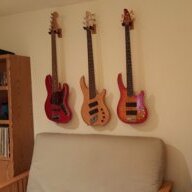
Work with a reputable shop that you know and knows you. Often times I can just take it for a test drive at a gig and bring it back or buy it the following week. If need be and I'm serious about buying and the store has a return policy, I'll just buy the thing and return it if it doesn't suit me. This allows me to take it my guy to see if it will set up the way I like it. This doesn't work well with discount internet purchases and chain stores.

If you are going to the store with the intent to purchase, then you should take a few tools. I have a small kit I carry with me that has the following:
1. Cardinal HSDC-20 digital hanging scale - Let's face it, weight is going to be a comfort factor with any instrument you buy. The GC guys are known to lie about the weight question and you may not have the accurate "calibrated arm" that you think. Take the guesswork out of it with this.
2. Mitutoyo micrometer model 122-126 (or equivalent). Sure, the spec sheet says that nut width is 1.75 inches, but are you willing to take that as gospel? This guy will help you establish the truth.
3. Mabis Signature Electronic Stethoscope - Do you really know where those dead spots, defects, and other tonal pockets are located in that prospective new bass? You simply can not afford to guess. This will allow you to get an accurate map of the tone woods with your ears.
4. Lisle 52500 Mechanics stethoscope - While the standard electronic stethoscope is great for getting the overall picture of what is going on with the body woods, inspecting the neck and fingerboard requires a more precise inspection tool. Before making that purchase decision, know exactly where the dead spots are located.
5. Lisle 68100 Feeler Gauge Set - How well is it put together? A few quick checks on the assembly points with this and you will get a good picture as to the craftsmanship of the instrument.
6. Fluke Ti-10 Infrared imaging camera - If you are buying an active bass, you are concerned with making sure that the electronics are "top-notch". Cold solder joints, substandard electronic components, and faulty assembly can mean problems down the road. By looking at an IR image of the preamp while it is in action, you will be able to pinpoint any areas of the circuit where abnormal operating temperatures may indicate problems that will cause excess battery drain.
7. Fluke 117 Digital Multimeter - Passive electronic components in the preamp need to be checked to ensure that they are within specified tolerance. Any substantial deviation and the preamp may not perform within design limits, often with an impact on your tone. This will allow you to carefully test each component and to take voltage/current readings while the preamp is in operation, ensuring that it is performing as designed. Also, this is useful for routine continuity checks on passive instruments.
8. Kassoy L-820 Jewelers' Loupe - The finish may look fine to the naked eye, but small defects that may eventually become checks and visible surface flaws can only be identified with a more discriminating look. The loupe will allow you to find these with ease.
Each of these tools will allow you to make a detailed examination of the instrument under consideration. Make sure that you take the time to use them thoroughly.
OTOH, I heard from an owner of his brand that Roger actually uses these tools on every bass that comes out of his shop, so if you are buying one of those, you may be able to skip all this.
1. Cardinal HSDC-20 digital hanging scale - Let's face it, weight is going to be a comfort factor with any instrument you buy. The GC guys are known to lie about the weight question and you may not have the accurate "calibrated arm" that you think. Take the guesswork out of it with this.
2. Mitutoyo micrometer model 122-126 (or equivalent). Sure, the spec sheet says that nut width is 1.75 inches, but are you willing to take that as gospel? This guy will help you establish the truth.
3. Mabis Signature Electronic Stethoscope - Do you really know where those dead spots, defects, and other tonal pockets are located in that prospective new bass? You simply can not afford to guess. This will allow you to get an accurate map of the tone woods with your ears.
4. Lisle 52500 Mechanics stethoscope - While the standard electronic stethoscope is great for getting the overall picture of what is going on with the body woods, inspecting the neck and fingerboard requires a more precise inspection tool. Before making that purchase decision, know exactly where the dead spots are located.
5. Lisle 68100 Feeler Gauge Set - How well is it put together? A few quick checks on the assembly points with this and you will get a good picture as to the craftsmanship of the instrument.
6. Fluke Ti-10 Infrared imaging camera - If you are buying an active bass, you are concerned with making sure that the electronics are "top-notch". Cold solder joints, substandard electronic components, and faulty assembly can mean problems down the road. By looking at an IR image of the preamp while it is in action, you will be able to pinpoint any areas of the circuit where abnormal operating temperatures may indicate problems that will cause excess battery drain.
7. Fluke 117 Digital Multimeter - Passive electronic components in the preamp need to be checked to ensure that they are within specified tolerance. Any substantial deviation and the preamp may not perform within design limits, often with an impact on your tone. This will allow you to carefully test each component and to take voltage/current readings while the preamp is in operation, ensuring that it is performing as designed. Also, this is useful for routine continuity checks on passive instruments.
8. Kassoy L-820 Jewelers' Loupe - The finish may look fine to the naked eye, but small defects that may eventually become checks and visible surface flaws can only be identified with a more discriminating look. The loupe will allow you to find these with ease.
Each of these tools will allow you to make a detailed examination of the instrument under consideration. Make sure that you take the time to use them thoroughly.
OTOH, I heard from an owner of his brand that Roger actually uses these tools on every bass that comes out of his shop, so if you are buying one of those, you may be able to skip all this.
 I think Jimtoonz has just put everyone to shame.
If I see a bass that catches my eye, I try playing several different styles to see how it handles (fingerstyle, slap, pick, tapping, etc). If it plays and sounds ok, I check the technical things: dead spots, frets that bottom out, fretwork and fret edges, check that all electronics work, etc) If the bass needs a setup (they always do), I ask if they can adjust height, intonation, pickup height, truss, ect). Make sure I understand the return policy and if everything is still good then it is ok to buy.


