• TalkBass has been independent since 1998. Add your voice.
    Create a free account to reply to discussions, view embedded media, and browse with fewer display ads.
    Join freeLog in
    Want zero display ads or expanded classifieds tools? Compare plans.

Taperwound Question For the Experts

Nov 9, 2001
8,047
148
California
Disclosures
No Bogus Endorsements
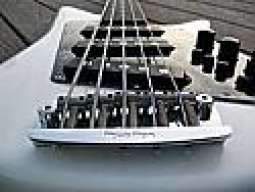
Take a look at this picture.

I say these taperwounds are for a throughbody and the winding steps are out of place on this toploader -- they should be just beyond the saddles.

Someone is trying to tell me they're supposed to be out in breeze like that.

I say the strings just don't fit properly.

Discuss.
 
They fit, that is the correct setup. The main point of taperwound is to have a smaller diameter of string crossing the bridge saddle, for better intonation and less side-to-side movement. Whether those results actually occur is a matter for debate--but that's the idea anyway.
 
They fit, that is the correct setup. The main point of taperwound is to have a smaller diameter of string crossing the bridge saddle, for better intonation and less side-to-side movement.
No, I understand that -- and also (primarily) that they accommodate a sharper break angle, as encountered on through-body stringing, without disrupting the windings -- I'm just saying that the step is supposed to be just past the witness point on the saddle, not way out there like these. Like on 8250Ms on a new Fender.
 
I see what you're saying. I guess the question is, what would the audible effect be?
Of them hanging out so far? I think this Art Major's grasp of physics would suggest intonation problems -- and by "intonation" I mean tonally-true notes played on all the available ascending frets (not just someone adjusting the 12th fret to match its harmonic and calling the instrument "perfectly intonated" :rolleyes:).

Of course intonation that perfect scarcely happens in real life, but physical irregularities in the played length of the string do cause intonation problems, so nearly two inches of skinny string in the end of the scale sure seems to me to be asking for trouble, particularly as it stays at a fixed length as the wound length shortens with ascending notes -- and I have heard complaints (valid or not) that they do have this problem. In any case, there sure would be no benefit to that situation, which brings me to the point, which is that I think it's pretty obvious that this particular set was intended for a through-body strung instrument, which would put the steps where they would most logically be.

Or...am I missing something? :confused:

I remember some discussions years ago by FMIC personnel on the old FDP saying that they tried to adjust the step in the 8250M E string to have just enough for normal saddle adjustment on a stock Fender P or J.
 
Those look like something similar to SIT PowerCore strings to me... a fairly old pair judging from the rust on them. Exposed Cores.

IMHO the exposed core only contacting the bridge saddle results in a noticably clearer and more piano like low end. Especially on the B and E strings.

Here they are on a Schecter CV-5 Prototype.


This is how they're intended to be used and look.

Invalid Link Removed
 
This is how they're intended to be used and look.
I wish that was a straight-on shot so I could better tell the relative length of the steps. :hmm: It looks really odd in that perspective.

I'll keep looking. I still can't see the point of having the steps that far out from the saddle, if it really is intentional.

Any idea? :confused:

[Later] I see nothing on the SIT site that indicates they are supposed to have the steps out that far (or not), and the only explanation I see is consistent with what I said (not much help, really):

"Power Wound electric bass strings with the cover wrap recessed so that the core contacts the bridge saddles on all strings. (There is a thin cosmetic cover wrap to protect the hex from digging into your bridge.)"

So, it's only necessary to clear the saddle for the benefit to be achieved, I guess.
 
Different distances from end of bridge to saddles on different bridges, etc etc etc. Someone really shouldn't be playing that close to the saddle's anyhow.

I played with that set on for several months before I sold the bass, and I 'never' touched the edges or exposed cores.
 
Take a look at this picture.

I say these taperwounds are for a throughbody and the winding steps are out of place on this toploader -- they should be just beyond the saddles.

Someone is trying to tell me they're supposed to be out in breeze like that.

I say the strings just don't fit properly.

Discuss.

Elixir TW's are 1 7/8" from the ball to the end of the taper where SIT Powerwound TW's are 2 7/8". It depends on the manufacturer, and from what I've heard there isn't an industry standard. Some have bare cores, and some don't. Of course a string-thru will have a longer length of string extending past the bridge than a "toploader" so I think you need to find out what string you need based on the taper length given by the specific manufacturer.

^ The picture you showed looks fine to me, and I bet you couldn't hear any difference from regular strings in a blind test. I use one (SIT Powerwound TW .130) for low B, and I swear it has a tad longer sustain than a non-taper. I really like them for the lower strings ... E/B


Invalid Link Removed

SIT Powerwound TW's don't look like those - they are wound all the way to the ball - gradually tapering, but not bare cores like those shown above. The thinnest part of the taper on the .130TW is about the same diameter of a A string.
 
I think the answer is obvious:

They market only one set of string dimensions in order to physically fit the maximum number of instruments -- through- or top-loading -- without any further considerations.

If these were "supposed" to have that much exposed core length for some reason, then they'd market a set for through-bodies that would result in the same amount of exposed core...

And they don't. At least on the sites I've looked at.

Whether there's any additional downside to this much exposed core is another issue, but my original surmise seems correct.