Hello,
I'm new to the group, but I've been lurking around here and taking in info for some time. I wanted to wait with my first post until after I have built a bass.
I always loved instruments, and this was my first serious build of this magnitude. I used the "Low-cost Bass Viol" GAL article and plans, with some modifications. My fascination with the double bass was born fairly recently, based on my messing around with basses lying around when their owners took a break from playing.
This bass is used in Transylvanian folk music (where the rhythm viola is my main instrument), so it's typically strung with plain gut (3-stringer), and 99% of the time it's bowed (heavy, home-made bow with black hair). I built the instrument with these points in mind.
The top is 16-piece, pretty close to what the plans called for.
Back and sides are laminated. I didn't include the upper bout bevel, mainly out of laziness, and also I didn't feel like I needed it.
The neck is a 2 piece, cherry. Fingerboard is maple. I incorporated the E bevel, since it allows me to go a bit lower with the gut A string and still have plenty of room.
I chose a simple endpin socket and wooden dowel for the endpin itself. Home Depot tailpiece wire.
I deviated from the plans a little...for instance, I added purfing (made from scratch from walnut and maple boards). I cut the channel by hand, to avoid screwups with a router.
The bass has some "features" that are sure to delight the pros, like an integrated bass bar I'm aware of the differences, but chose to go with the carved-in bar because of convenience ( = laziness). If something doesn't work out, I can always take the top off and make a real bass bar. I did add a chalk-fitted soundpost patch (kind of pre-emptive), with grain going at about 30 degrees to the top's grain. Thanks Matthew for your detailed photos of this
The only thing I didn't make myself is the bridge - I got a cheap one, and it made no sense whatsoever to cut my own...
The bass is loud, just like I wanted it to be, and it does exactly what I need it to do for this type of music.
I'll try to add some pictures now.
So thanks for letting me lurk around and gather info Great forum!
Now back to playing my new bass...
George
I'm new to the group, but I've been lurking around here and taking in info for some time. I wanted to wait with my first post until after I have built a bass.
I always loved instruments, and this was my first serious build of this magnitude. I used the "Low-cost Bass Viol" GAL article and plans, with some modifications. My fascination with the double bass was born fairly recently, based on my messing around with basses lying around when their owners took a break from playing.
This bass is used in Transylvanian folk music (where the rhythm viola is my main instrument), so it's typically strung with plain gut (3-stringer), and 99% of the time it's bowed (heavy, home-made bow with black hair). I built the instrument with these points in mind.
The top is 16-piece, pretty close to what the plans called for.
Back and sides are laminated. I didn't include the upper bout bevel, mainly out of laziness, and also I didn't feel like I needed it.
The neck is a 2 piece, cherry. Fingerboard is maple. I incorporated the E bevel, since it allows me to go a bit lower with the gut A string and still have plenty of room.
I chose a simple endpin socket and wooden dowel for the endpin itself. Home Depot tailpiece wire.
I deviated from the plans a little...for instance, I added purfing (made from scratch from walnut and maple boards). I cut the channel by hand, to avoid screwups with a router.
The bass has some "features" that are sure to delight the pros, like an integrated bass bar
I'm aware of the differences, but chose to go with the carved-in bar because of convenience ( = laziness). If something doesn't work out, I can always take the top off and make a real bass bar. I did add a chalk-fitted soundpost patch (kind of pre-emptive), with grain going at about 30 degrees to the top's grain. Thanks Matthew for your detailed photos of this The only thing I didn't make myself is the bridge - I got a cheap one, and it made no sense whatsoever to cut my own...
The bass is loud, just like I wanted it to be, and it does exactly what I need it to do for this type of music.
I'll try to add some pictures now.
So thanks for letting me lurk around and gather info
Great forum!Now back to playing my new bass...
George


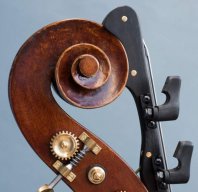
 Even secondhand Rubners would be better than those ...