• TalkBass has been independent since 1998. Add your voice.
    Create a free account to reply to discussions, view embedded media, and browse with fewer display ads.
    Join freeLog in
    Want zero display ads or expanded classifieds tools? Compare plans.

6 String question - alternate tunings?

It strikes me that one could tune a 6'er to B-E-A-D-F#-B and be able just transfer guitar skills over to it.
I’ve considered doing exactly this, but have yet to acquire any kind of six-string or bass vi. Of course a six-string bass tuned this way won’t play just like a guitar only lower, but it would at least feel intuitive to someone familiar with guitar and facilitate some common chords. I wish bass vi type instruments could take heavier strings, or that 30” scale six-string basses were readily available, but I still have half a mind to try it with a 34” Ibanez SR.
 
I am not a 6 string player but I can't help but wonder if any 6 string players use alternative tuning. It strikes me that one could tune a 6'er to B-E-A-D-F#-B and be able just transfer guitar skills over to it.

Anything like this occur in the 6 string world or any other interesting tuning used?
I've thought about doing it a number of times as well as simple EADGBE but I have a Bass VI class instrument, an Ibanez SRC6 and just haven't got around to it.
 
I would love to try a 6er tuned D-F#-A#-D-F#-A# — the range of a 5er, but with the full chromatic scale lying much easier under the hand.

I played around with a 4 string tuned F-A-C#-F, but it became clear very quickly that 4 strings wasn't enough.
 
  • Like
Reactions: thmsjordan
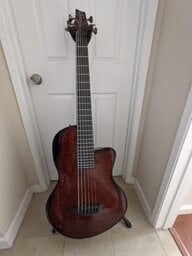
My Ibanez BTB676 is tuned in fifths.
AEBF#C#G#
IMG_1853.jpeg
 
I am not a 6 string player but I can't help but wonder if any 6 string players use alternative tuning. It strikes me that one could tune a 6'er to B-E-A-D-F#-B and be able just transfer guitar skills over to it.

Anything like this occur in the 6 string world or any other interesting tuning used?
I don't know how "interesting" it is, but I tune my 6s BEADGB and always have, for nearly 30 years now. For me, that actually allows a better transfer of what I knew from guitar, because there's no F# string in standard guitar tuning. I know what lives on a G string and a B string; I'd be less comfortable with dealing with an F# string, or a C string for that matter, and have never seen any need to deal with them.
 
I am not a 6 string player but I can't help but wonder if any 6 string players use alternative tuning. It strikes me that one could tune a 6'er to B-E-A-D-F#-B and be able just transfer guitar skills over to it.

Anything like this occur in the 6 string world or any other interesting tuning used?

That tuning is used for guitar because it works really well for playing a variety of chord shapes.

Don’t think I’d bother with it for an instrument that isn’t going to be used for 4-6 string chords.
 
I don't know how "interesting" it is, but I tune my 6s BEADGB and always have, for nearly 30 years now. For me, that actually allows a better transfer of what I knew from guitar, because there's no F# string in standard guitar tuning. I know what lives on a G string and a B string; I'd be less comfortable with dealing with an F# string, or a C string for that matter, and have never seen any need to deal with them.

The F# would make it like a guitar in B Standard tuning i.e. everything down a fourth.

That tuning is used for guitar because it works really well for playing a variety of chord shapes.

Don’t think I’d bother with it for an instrument that isn’t going to be used for 4-6 string chords.

As seen above, I agree with the first half of your statement, and agree also that 4–6 string chords on a bass probably wouldn’t sound good even if they were easy to play, which they aren’t. I still would like to try it, though; easy enough to tune the skinny strings up a semitone if it doesn’t make sense.
 
Last edited:
Not here. 4ths up and down.
Same! That G-to-B interval on the guitar always throws me off.

With that many strings on a bass, keeping the string crossings consistently fourths means you can play anything anywhere on the neck without thinking about it. Two or three note chords are pretty straight forward, too.

If you want to play guitar-style chords, just get a bass VI, that's my advice.
 
I am not a 6 string player but I can't help but wonder if any 6 string players use alternative tuning. It strikes me that one could tune a 6'er to B-E-A-D-F#-B and be able just transfer guitar skills over to it.

Anything like this occur in the 6 string world or any other interesting tuning used?

The usual caveats about chords on bass apply: even that major third interval between the 2nd- and 3rd-highest strings would sound a bit muddy on the first four frets. But, in terms of orienting yourself better with a contra-baritone tuning, if specifically that (or, more in general, having a major third there) is what you're used to: yeah, why not?
 

Latest posts