• TalkBass has been independent since 1998. Add your voice.
    Create a free account to reply to discussions, view embedded media, and browse with fewer display ads.
    Join freeLog in
    Want zero display ads or expanded classifieds tools? Compare plans.

1973 Fender Precision black over sunburst?

Feb 26, 2016
52
28
62
I have an offer to buy a 73 precison, the finish seems to be black over sunburst.

I know that they made oversprays in the 60s, but as late as 1973?

I will try to get some pics tomorrow to include in this thread.

Any of you have something like this?

Thanks!
 
  • Like
Reactions: godofthunder59
Ok, thanks for your quick reply!

My 68 Precision was black over sunburst, but that was made by the first owner... i removed the thin black coat to get back the original finish. :)
 
Last edited:
Found some pics of my old 1974 Jazz (kinda bummed I sold this one now, what a beauty!)...

image.jpeg

image.jpeg
 
Thanks for the picks of the Jazz, wow! Looks nice with the sunburst spots.

The black overcoat seems to be rather thin, right?

Yes, most of the black poly finishes in this era had a real thick coat of clear over them, but since this one already had the sunburst layers under it, I think they went a lot thinner on the black/clear, so it wore away easier than most.
 
Ok, that makes sense.

One more question: There´s a tortoise pickguard on the black P bass. I thought that Fender sold the custom colours with black or white pickguards? At least with the Jazz Bass it seemed to be that way.

I know they changed to white or black entirely at the end of 73, and i prefer to have a nice red tortoise guard so i don´t have a problem with that, i´m just wondering.
 
Ok, that makes sense.

One more question: There´s a tortoise pickguard on the black P bass. I thought that Fender sold the custom colours with black or white pickguards? At least with the Jazz Bass it seemed to be that way.

I know they changed to white or black entirely at the end of 73, and i prefer to have a nice red tortoise guard so i don´t have a problem with that, i´m just wondering.

White guards were the norm for most custom colors in the '60s and early '70s, except for Olympic White (which almost always got tort) . But I've seen some black vintage Fenders with tort. If the tort is in fact from the same era (which we can tell from pics), it's pretty impossible to say this many years later whether someone switched it out at some point with an original tort guard, or if it came that way. Since colors were usually custom ordered anyways, who's to say that they couldn't have ordered a tort guard too, right?

As far as pickguard colors go... In late '73 Fender moved the tugbars to above the strings and turned them into thumbrests, and at the same time they introduced 3-ply black pickguards. However, they still continued to make white and tort guards for a while (just with the holes for the thumbrests above the strings). In '74 they changed the tort to a printed pattern that you can actully see the "dot matrix" pixels in it, and those were only used for about a year, then that was the end of tort (until the '80s). The white guards were still used until '76, then black became the only option at that point, but was made in both 3-ply (BWB) and 4-ply (BWBW) in the late '70s.
 
The pics are not very good, but they show the pickguard and the black over sunburst finish.

Seems that the owner moved the bridge, i think the visible holes mark the original position.

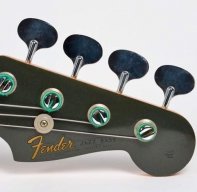
And the headstock has an unusal dark wood grain.


vuHgwUw.png


9NyPt4t.png


U8oJnpC.png


FetWGT9.png


qBVcULR.png


ynEm12L.png


9GQrkcz.png


INT3LCw.png


v6icqeh.jpg
 
  • Like
Reactions: craigie
For some unknown reason Fender moved the bridge back for a short period. That made it difficult to adjust the saddles, especially for the G-string it could happen that you had to move it all the way forward for intonation, so they came up with another idea, a longer screw for the G-string.

Just compare other 73 P-basses with this one, they all seem to have the bridge in the positon suggested by the empty holes on this one.
 
I don't see any reason to think the finish is not original, but removal of the neck is the best way to tell. Pickguard looks original too (or at least of the same vintage). Obviously the original electronics have been messed with. I'd pop the guard off before I would buy it (which is always a good idea anyways), and see what's been done under there.
 
@Lownote38
You are right about the pots, and i asked the seller to send me pics of the back of the pickups.

The pickguard looks fine, i think.

@thebrian
Thanks for your comments. Yes, i should ask the seller to make some pics of the electrics, as there might be more surprises...
 
Last edited:
  • Like
Reactions: Lownote38
For some unknown reason Fender moved the bridge back for a short period. That made it difficult to adjust the saddles, especially for the G-string it could happen that you had to move it all the way forward for intonation, so they came up with another idea, a longer screw for the G-string.

Just compare other 73 P-basses with this one, they all seem to have the bridge in the positon suggested by the empty holes on this one.

Correct. Seems Fender lost their original specs, or something, and put the bridge too far back. Rather than move it to where it was on earlier Precision Basses (like they should have), they put the longer intonation screw on the G string.
 
Correct. Seems Fender lost their original specs, or something, and put the bridge too far back. Rather than move it to where it was on earlier Precision Basses (like they should have), they put the longer intonation screw on the G string.

Was this bridge position unique to 73's or did it start in late 72? When did it end? I have a 'no-rout' body that is either 72 or 73 but I can nail it down specifically. The bridge looks to back further.
 
Was this bridge position unique to 73's or did it start in late 72? When did it end? I have a 'no-rout' body that is either 72 or 73 but I can nail it down specifically. The bridge looks to back further.

As far as I know, it started in 1973 and ended in 1974. They weren't that way for very long. The neck pocket route has a weird curve on the treble side on the 73's I've seen, but not the 72's.
 
Was this bridge position unique to 73's or did it start in late 72? When did it end? I have a 'no-rout' body that is either 72 or 73 but I can nail it down specifically. The bridge looks to back further.

I had a '72 Jazz that had the misplaced bridge. It seems that it happened about the same time they moved the pickup back on the Jazz.. '71/72. Why the P Basses were afflicted with the bridge issue as well, I don't know.
 
Thanks guys for the info on the 72/73 body and bridge stuff and sorry for the derail, OP.

I really dig early 70's Fenders and couldn't asking this question since it was at the top of my mind.