Anyway, that "It takes space for the wave to form" thing.... If that were true, how could headphones work?
Cabin effect

TalkBass has been independent since 1998. Add your voice.
Create a free account to reply to discussions, view embedded media, and browse with fewer display ads.
Join free Log in
Want zero display ads or expanded classifieds tools? Compare plans.
Anyway, that "It takes space for the wave to form" thing.... If that were true, how could headphones work?
Really? Because I'm OK with resonating their chests too.
I'll agree with most of this, having owned at one time or another about all of the 18" designs. I had a Karlson built for an 18- that was the version that was easiest to hear on stage, but it did not live up to its hype. I had both 360s and 301s and I liked the 301'sbetter, even though they are supposed to be the same design. And yes they would throw the sound way out there. I had a pair of them set up side by side and they would rattle glasses of of the tables. I also had a Cerwin Vega that had 2 I think 10's mounted in the front and that could be heard on stage fairly well. I liked the Sunn scoop and half of a W (Cerwin Vega also made this). My vote for the best W cabinet is the C-V with the 2 10's, and the C-V 18 inside - I think the C-V design was also a little deeper than the 360 / 301. The one that I liked the best was a simple EAW 10 cu ft box with a tweeter and 2 6" mids.And you can also simply google folded horn plans and some dawings will come up..I need more detail as I am not a skilled carpenter.
There are several variations on folded horn designs.
Some include the 'W-Horn' or Keele Horn Design. This is what Cerwin-Vega and [Vintage] Acoustic and Acoustic USA employ. Fender, Orange , Peavey..yes..even Ampeg have used w-horn designs at some point. For whatever reason..Horn cabs lost favor and 8x10 or
(2) 4x10' s are far more prevelent today.
JBL 4530 'Sugarscoop' is another .
Karlson Coupler is another as well as more contemporary designs .
And my fave ..Sunn 118-vh is yet another.
Although I will always want a w-horn; preferably Acoustic 301..They have an inherent issue, which is that they 'throw sound ' so well, so as to not be heard well on stage, while KILLING at 40 feet away out in the audience ...or even down the street. I have experienced this first-hand in early 70's with a friends 361 rig. Some claim a loss of highs with W-HORNS..I don't know.
I bought a used Sunn 118-vh.. Google images of that or look in Sunn club, here..it has no loss of highs up to D# on G-String and lows that the Almighty would be proud of.
TONE TO DIE FOR..I can hear mine clearly on stage and I have heard it played with my bass and AC 370 head at 40 feet away..I asked my wife who was by my side, if I was that loud...She said YES. [I had probably caused gastric issues with some patrons..and I wasn't tuned up beyond 2.]
If you want an old school w- horn..simply google w-horn designs ...and drawings will come up..hopefully you can use them.
I have not found a drawing of the Sunn118-vh cab. I even contacted Conrad Sundholm [MR SUNN] who said he no longer had any construction plans for that cab; only that "it was a difficult build".
One day..if I don't buy another, I will take mine to a trusted cabinet shop; have it reverse engineered and provide me with build plans.
Used w-horn cabs are fairly plentiful..but heavy to ship..LOCAL PICK UP ONLY is common when you find one. They are heavy. ..@150 pounds...made of 3/4" plywood.
Find an empty one and install a new speaker..you will be pleased...In my opinion and use..There is the sound of a folded horn..then there's the rest.
Also if you are ever up against a guitar stack or 2..they may even ask you to turn down, if you power it with no less than 300 watts RMS...especially if you employ (2) horn loaded cabs.
There are those who will follow my post with graphs and charts and claims of physics..that a cabinet doesn't throw sound and that only a specific contemporary design is BEST and all..any other designs are archaic..obsolete at best..I am tired of that debate..I will ONLY agree to disagree.
OK..POUR ON THE FLAMES...



[B said:Luckie[/b] Link Removed] I never see folded horn cabs anymore, and I don't know of anyone making them.
What's the reason?
Amps larger than 200 watts. Horns allow you to get loud, low and clean without a lot of power. When big amps became common cheaper direct radiating speakers were able to do what it took horns to do before big amps.
Myth.Folded horn cabinets are designed for a longer throw. If you stand close to them you usually can't hear the bass, but if you back away, say 20 to 30 feet, the bass becomes clearer
http://billfitzmaurice.info/forum/viewtopic.php?f=10&t=999
Myth.Another issue with folded horn speakers is that they have to be placed a certain distance from the wall, in a 90 degree corner, etc. They are not real practical from that perspective.
What separates the layman from the engineer is that the layman knows what he hears, the engineer knows why he hears it.
One issue with the horn is directivity...... I suspect this is the basis of the "throw" myth.
If the cabinet is rather directive (and almost by definition a horn is quite directive down to fairly close to its cutoff), you can stand next to it and have much of the sound power just pass by you so that you do not hear it clearly unless you are "in the beam". You will tend to hear the "least directed" sound, which will be the bottom octave or so, and may experience it as "muffled" or "closed" sounding.
In any case, you probably need a mid driver, as Jimmy says, because mids dont get through the "folds" of the horn particularly well. And then the mids may be imbalanced, because the horn is efficient at lows, but the mids may not be unless they are in turn horn loaded.
And folded horns with good performance DO tend to be bigger.....I don't see this as a "myth", really. You can do some compensation for bad effects with the "box" the driver is in, but for very low frequencies, the horn generally needs to be relatively large in order to get the benefits of the horn loading. ("Voice of the Theatre" cabinets notwithstanding).
It's not unusual for the low end of any sub or low frequency speaker to be hard to hear when standing close to it. Reflections off nearby walls and the ceiling create low frequency null zones. If you're standing in one of those null zones the bass will disappear. If the speaker is a direct radiator what you will hear the midbass and midrange harmonics, and being one to four octaves above the original signal, where the ear is more sensitive, they seem loud. Folded horn subs suppress those harmonics, so in close they may not seem as loud as a direct radiator. When you move away from the null zone the true output of the of the cab will be heard. In the case of the folded horn the level will be on the order of 6 to 12dB louder than with the same amount of power into a direct radiator, so to the layman it would seem that the horn throws further. This effect also gave rise to the myth of wave propogation, that it takes a minimum distance from a source for the bass wave to be heard. But if that was true headphones wouldn't work, nor would car subwoofers.
Front load/ Reflex: Drivers are mounted on the front plane of the cabinet. Reflex: The back wave of the driver can be tuned to augment the front wave of the driver for increased efficiency above the tuning point, at the expense of increased risk of the driver if the source material falls below the tuning point.
Horn load/ folded horn: Drivers are mounted on a horn that magnifies certain frequencies. The low frequency cutoff is determined by the size of the horn's mouth. The efficiency is determined by the ratio of the horn. The lower the frequency, the higher the ratio, the bigger the horn. Folded horn: Due to the long lengths needed to achieve "subwoofer" frequencies, horns are often subject to two forms reducing the overall size. 1. Folding the horn up to fit in a box. 2. Splitting the box into four smaller boxes that will achieve the desired mouth size when coupled next to each other.
Long throw: Usually not relevant to subwoofers. A box that has traded disperation for output. 1. By using a horn with a very tight "q" or desperation, such as 45x45 or 90x5 the output in the smaller field will be much higher. Thus go further (think of the water hose analogy). Such boxes are then arrayed to cover the required field. 2. By coupling large numbers of drivers together the throw of the whole increases. Again more output in near field will equal more output further away. Side note: Often subs will appear to have very little bass by the box, and tons of bass in the back of the room or by the corners. This is due to phasing problems of using two subwoofers in different locations and by the corner effect in any room. By placing subwoofers together you can get a much more even response.
W bins tend to have very small horn mouths and that limits their frequency response to above what most would consider a subwoofer. They gained great popularly in the days of lower powered amplifiers, because they could achieve very high levels of output (in their range) from very low amounts of power. Now that power is cheap, most touring companies have turned to frontloaded systems that operate much lower, but require much more power to achieve the same output. A few horn loaded boxes have been developed that take advantage of both. Note these are still BIG boxes that require systems of 4 per stack and don't easily apply to the mobile DJ's craft.
Bandpass: A driver that is completely housed within the box and both the front and rear waves are tuned via ports. This severely limits the frequency response of the speaker (nick-named the one note wonders) but converts much of the energy of the driver to that frequency range. This lets them get quite loud for their size, but only in a very small window, and any form of accuracy gets thrown out the window.
Outdoor use: Since much of the bass output mobile djs use depends on the corners and walls for support, doing events outside can require 3x the equipment to achieve similar results. Wind, greater distances, and more ambient noise also contribute to the problem.
"Chest thumping lows" Refers to the feeling we have all felt when subjected to HIGH output bass frequencies that match the resonating frequency of our chest cavity. Think of a crystal wine glass. It will resonate at a certain frequency (dependent on the size and thickness of the material) when you induce vibrations with your finger. The lower the frequency, the more vibrations will be needed to start the residence.

"Desperation"?!?
Did he mean "dispersion", or is this an audio usage I haven't met before?
Good summary, thanks!

There is a time and place for bass horns, and the above is not it.
I've been doing the bass horn thing since the 60's, have designed and built a good number of them and know how they work.
A bass horn is not the right cab for the venues you play.
My bass horns are used for:Bass horns are herd animals.
- Outdoor Gigs
- Slamming DJ Gigs
Unless you are constructing a built-in, the horn must be sized small enough to transport.
A transportable horn does not have sufficient mouth area to full produce low frequencies.
This means multiple bass horns summing to a larger mouth area.
I haul mine in a 5x10 trailer.
The horn discussed above will not produce any deep bass because the path is too short.
The horn path must be a quarter-wave length, or longer, at the lowest desired frequency.
Below this frequency, it is just a direct radiator shouting into a tunnel.
The modern equivalent (and much better design) of a short path horn is the BFM Jack Series
'Throw' is a misnomer when applied to bass.
Camp fires do not get hotter 20 feet away, and neither do bass horns get louder at 20 feet away.
Speaker cabs are pressure devices, and the highest pressure is always at the source.
All moving transducers generate motion distortion which introduces higher frequency components into the produced signal.
A folded bass horn attenuates higher frequencies within the folds of the horn where the wave length exceeds 1/12 the radius of the bend.
Long wave bass travels much farther than short wave highs.
Blue whales sing between 10 ~ 40 Hz because their sound travels so far.
What you hear far away is the bass left over after the highs are attenuated inside the horn, and after the highs have faded over distance.
Commercial direct radiator cabs produce little true LF energy, and do sound quite thin when heard at a distance.
My bass horns bring the Noise Police who get complaints from over a mile away.
OP, this is a long explanation of facts and expectations. It has nothing to do with G.A.S. or just wanting to tinker with the old W-horn designs.
In your situation, I would build a tall 'n skinny 2-way direct radiator.
Put the woofer on the bottom for floor coupling, and lower center of gravity.
Put the highs on top closer to your ear.
A 39" or taller box is easier to wheel about than a clunky 4x10 or other squat configuration.
There is a time and place for bass horns, and the above is not it.
I've been doing the bass horn thing since the 60's, have designed and built a good number of them and know how they work.
A bass horn is not the right cab for the venues you play.
My bass horns are used for:Bass horns are herd animals.
- Outdoor Gigs
- Slamming DJ Gigs
Unless you are constructing a built-in, the horn must be sized small enough to transport.
A transportable horn does not have sufficient mouth area to full produce low frequencies.
This means multiple bass horns summing to a larger mouth area.
I haul mine in a 5x10 trailer.
The horn discussed above will not produce any deep bass because the path is too short.
The horn path must be a quarter-wave length, or longer, at the lowest desired frequency.
Below this frequency, it is just a direct radiator shouting into a tunnel.
The modern equivalent (and much better design) of a short path horn is the BFM Jack Series
'Throw' is a misnomer when applied to bass.
Camp fires do not get hotter 20 feet away, and neither do bass horns get louder at 20 feet away.
Speaker cabs are pressure devices, and the highest pressure is always at the source.
All moving transducers generate motion distortion which introduces higher frequency components into the produced signal.
A folded bass horn attenuates higher frequencies within the folds of the horn where the wave length exceeds 1/12 the radius of the bend.
Long wave bass travels much farther than short wave highs.
Blue whales sing between 10 ~ 40 Hz because their sound travels so far.
What you hear far away is the bass left over after the highs are attenuated inside the horn, and after the highs have faded over distance.
Commercial direct radiator cabs produce little true LF energy, and do sound quite thin when heard at a distance.
My bass horns bring the Noise Police who get complaints from over a mile away.
OP, this is a long explanation of facts and expectations. It has nothing to do with G.A.S. or just wanting to tinker with the old W-horn designs.
In your situation, I would build a tall 'n skinny 2-way direct radiator.
Put the woofer on the bottom for floor coupling, and lower center of gravity.
Put the highs on top closer to your ear.
A 39" or taller box is easier to wheel about than a clunky 4x10 or other squat configuration.


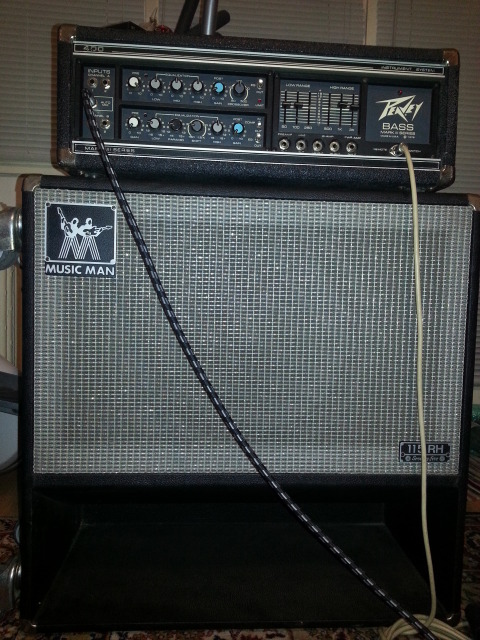
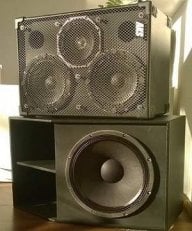
So this is where I am so far in the horn world.
My impressions are:
-This cabinet has a superb sound, much better than any 410 I have ever head. I can hear every note clear and bright
-It is ferociously loud even with low power going in. It's supposed to have a 8Ohm replacement speaker, and the Peavey pushes about 105 Watts at 8 ohms. If I turn the volume up to 7, it blasts you off your feet.
-It is extremely light. I was surprised it only had one top handle, but I can actually lift it, carry it up stairs and load it in my car all by myself.
-The low end is not very powerful, the sound is full but the ground is not shaking.
I honestly now wonder why aren't all bass cabinets built like this.
My question would be how would all of these characteristics translate to a tall horn cabinet, be it 118, 115 or 112