• TalkBass has been independent since 1998. Add your voice.
    Create a free account to reply to discussions, view embedded media, and browse with fewer display ads.
    Join freeLog in
    Want zero display ads or expanded classifieds tools? Compare plans.

1x 18 folded cab build?

I've had a couple of Peavey 18" W horns for 30+ years. I do have to say, the "throw" phenomenon, to me, is quite real. In these later years, having learned a little about wave propagation and sub placement, I have formulated the following theory. STEPPING OFF INTO DEEP WATER HERE...the "W" cab has sound emanating from two sources (top and bottom ports). The bass player, standing directly in front of the cab, is closer to the top port, than the bottom. He is,as well as others near the cab, IMHO, being exposed to wave cancellation, much the same as with two subs being an other than optimum distance apart. Again, IMHO, these two sources travel a frequency dependent distance before they form a single cohesive wave. HATERS, Start Here> Here's where you jump in with your graphs, charts, and your color glossy photographs, with circles, arrows, and paragraphs on the back, explaining what each and every one is...

This is the first explanation I've seen that makes sense. Let's take it for a spin. Speed of sound 343.2 meters per second. The upper port is about a meter away from the lower port. It takes 1/343 seconds for the sound to cover that distance. If that is half the frequency of the note then you get a cancelation. So that means you get a cancellation at about 170 cps and a doubling at 340 cps, another cancellation at 510 and a doubling at 680 and so forth. That would make it hard to hear, I think.

Let's say you stand three meters away. Then the differential distance is sqrt(10) - 3 which is about 0.2 meters. Then the cancellation is at 850 cps and the doubling at 1700, etc. Might be a problem. Five meters you get 1700 cps and 3400 cps, which I think would be OK.

If this bugs you I guess you could put the cabinet on a stand so that the middle is head high, or tilt it back so that the distances from the two ports to your ears are the same.

Anyway, that "It takes space for the wave to form" thing.... If that were true, how could headphones work?
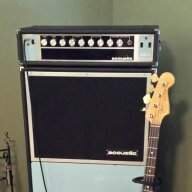
 
I gig an original 360/361 on a regular basis. I wouldn't say the cab has a ton of bass. It has that low end that punches you in the chest, not the subby lows of modern direct radiator cabinets. I love mine because its a big fat warm sound, and isn't that hard to move because the weight is well balanced inside the cab. Gigging a 361 is way way easier to load in and out than a 4x10 or 1x15 cabinet because of the tilt back design and the way you can use the cabinet as a lever to get it into cars and stuff. Plus, once the cab is in, the head is just a preamp so it is extremely easy to move. Lifting a 30 lb preamp is much better than a 90lb tube head. I sent you a PM regarding the clone of one I built a few years ago. It sounded very close to my original just without a power amp.
 
  • Like
Reactions: Iristone
I don't think a 360 preamp weighs 30 lbs. I think it weighs more like 10 lbs. I have both an old one and a new one, and both are very light. Those comments about how easy they are to move are absolutely accurate, at least for me. Sliding it in and out of the van is very easy. Mine lives in the music room in the basement, and I use a refrigerator hand truck to get it up and down the narrow, steep stairs. Any heavy amp that goes down there gets the same treatment going up and down those stairs, whether it is the size of a 360 or much smaller. Sitting on a refrigerator hand truck is the only place a 410 is on equal terms with a 361.
 
About this whole "bass" thing........

In pure technical terms, "bass" is the lower/lowest range of frequencies that we humans can hear. When bass players, or musicians in general, say something "has good bass", or it "makes the bass sound good", we aren't always talking about the same thing.

When saying the old Sunn, or Acoustic, or whatever bass horns had incredible bass, sometimes that means they made the bass sound incredible. That's not the same as saying they did a great job at making the lowest frequencies really loud. Those horns weren't long enough to load down to the "bass", meaning the lowest frequencies. What they did do was give high output to the "bass", meaning the instrument.

Modern technologies and/or just plain bigger horns, will load down to the "bass" meaning the very low frequencies. To some people, that's actually not better, as they don't like how the "bass" sounds down there, meaning the instrument.

Some folks like to have very low frequency in their sound, others don't, and they're both right. Still other people interchange the terms "bass" and "bass". Still others percieve strong "bass" when what they're experienceing is output above the "bass" range that makes nice sounding "bass".

I've read stuff from Hartley Peavey talking about how a lot of the "punch" in a kickdrum is really up around 80hz and not so much the 40 we crank up when we mic them and send them through the PA. Depends on the size and tuning of the particular drum of course, but many bass drums are eq'd/mixed to sound artificially low. As we all know from playing with a regular, un-mic'd drumset, they really don't sound that low and that huge, deep, booming kickdrum you hear at shows doesn't really sound much like the natural drum.

I've read stuff from Bill Fitzmaurice talking about how that "take your breath away" sort of bass that people feel and that moves their bodies is the result of high output in the 50-70hz area.

A TB'er named Sundogue who used to post here really got me thinking one day when he mentioned that the resonance of the average persons chest cavity seemed to be around 90hz. That got me thinking that "punch you in the chest" bass isn't really all that low either.

Still other folks like to have even, relatively uncolored response from the very high range all the way down to the lowest fundamental frequencies of their lowest notes. These folks are also quite capable of making very nice and pleasureable sounds.


What a lot of people consider as being that warm, fat, "vintage" bass tone that all this new stuff just can't match, was actually mixed in those recordings to sound "fat" while being played over a one-speaker, mono, AM radio. Yet still many of us enjoy that sort of "bass" more than any other.


Folded bass horns can play measurably "cleaner" bass that regular ported boxes. They don't have as much harmonic distortion happening, and the bass is more "pure". Sometimes it's hard to tell just how much low frequency you've actually been exposed to until after you leave the show and feel weird physical sensations that are the result of your body being hit with those clean low frequencies at that level of output for that length of time.


Still other folks say the horns lack "punch", or "kick" and they feel them more than hear them. They like the ported boxes better with their harmonic distortion as it seems more "musical" to them.


So.......if we're going to discuss "bass"......what does everybody here mean when they say "bass"?
 
  • Like
Reactions: Iristone
Science? EVERY 6 MONTHS.."This product..[COFFEE.. CHOCOLATE..BIRTH CONTROL PILLS you name it..] ...is PROVEN to cure cancer..6 months later.. same product causes it..6 months after that reversed again...all proved with Science. 'Science' originally proved our world was flat..everything revolved around the earth..you could be killed for disbelieving the FACTS.
You have a very interesting definition of "Science."
 
You have a very interesting definition of "Science."

+1

There's a simple definition for Science
"the intellectual and practical activity encompassing the systematic study of the structure and behavior of the physical and natural world through observation and experiment."

So who doesn't observe and experiment with their sound? Systematically? Stop the music, somebody with golden ears says it's not right.
All these years of acoustic science it's not one set of golden ears, but many many ears. :ninja:

The media and word of mouth is terrible at reporting incomplete information as science. Many things labeled as science is not labeled by scientist as science.
 
I used a big Carvin 2X15" folded horn cabinet with an SVT head in the mid-late 70's and in my biamped rig in the early 80's used a couple Peavey FH1 folded horn 15's for the low end. I had great fun with them, and especially with the Carvin, loved the response and the tone both up close and out in the room. The size just got to be too much.

In the end, you basically have a driver (or two) in a rather small sealed cabinet, projected through a folded megaphone. It can get loud, and the sound projects pretty well, but the bandwidth is limited and these days, I enjoy more full range cabinets over what I used to have.

With the SVT and the 2X15 folded horn I added a large EV re-entrant treble horn to the rig for a while...I liked high end. It was quite an awesome rig. Carvin sold the EV horn as their large PA horn in the mid 70's.
 
Klipsch.

Instead of giant mouth horns like we've seen in some stadium systems as an attempt at low frequency pattern control, today it seems the bread is buttered with line arrays for pattern control to the mid-bass and interesting things are being done with cardioid sub-woofer arrays to get the bass to go where we want it to and not to where we don't want it. So long way to short, there is no "throw" at bass frequencies and bass waves don't need time or space to "develop". As the other guy above said, Bass wave propagation is simple physics that has been well understood since about the 1920's. Please don't misunderstand me, horn loading still has it's place. it's used plenty even in the most modern of line arrays but it's the line array that gives it "throw" and not the horn loading.
The line array use is about more than pattern control. The line array does have an impact on "throw," but different than just pattern control. along with the careful array of angles each unit is mounted at, by establishing a "line source" rather than a "point source," you defeat the law of squares. Instead of the volume quartering with every doubling of distance, the only drops by one half, so you get a more even volume at different distances from the source. As you allude to, even most of the bass is running into that line array (everything above their "sub" frequencies).
 
Here are 1x18 Acoustic cab dimensions...but a fEARful 15/6/1 is better...

301_361dimensions.jpg
 
Hi.

Thanks Jim Carr for the pic, probably the most accurate reply in this thread when the actual question is concerned.

If there only was the average weight of the cab in the pic as well, the OP would probably understand all the derails in this thread...

But to paraphrase the auto, there's no substitute for square inches.

?

I think You mean cubic inches ;).

Your paraphrasing actually implies that a larger diameter piston is better than a smaller one in an IC engine, when the exact opposite is true.

Not that straight forward with cone speakers since a motor drives the piston, and not the other way around, obviously.

I think a lot of this discussion is people confusing "huge bass guitar tone", with actual "low bass frequencies". They're not the same thing and you don't always need one to get the other.

+100000.

That's pretty much what made Ampeg fridge as good as it was, and why it still holds its place even though technology has leaped heaps forward from those early days.

Regards
Sam
 
I don't like the folded horn cabinets. They do not sound great on stage and are designed to throw the sound in a large venue setting. If you play clubs, the rooms are generally too small for a folded horn cabinet. I found you lose bass presence on stage and it sounds muddy.
 
As a long term user of Acoustic bass gear from the mid seventies.
I was frustrated by my 301 cab in certain situations but found a vast improvement in performance when I upgraded my rig with a 408 cab.
If I where building an acoustic clone cab these days of neodymium and light but stiff construction, I would be building a brand new 408 style 4X15":
euCd0-Vab0GIKnC2CO0353wDxT-QpdmkvF-6aQqF82k=.jpg

Like this using the Fital 400's:
I still use my all Original Acoustic 408 cab as an active sub bass unit in my drum room monitoring system.
wchBF8u6XN9a5xnXPysbCO_3Ua9Pyfvbk8qxARTGIxzlABmeJHqVKg==.jpg

In my direct experience my 408 responds a lot lower than my 301 ever did and with all that speaker area has very little distortion down low and much better fart resistance.
The other thing that advantages the 408 is, speaker coupling! which offsets any advantage in efficiency afforded by the horn loading in the 301 design. The 408 is louder cleaner lower.
The 301 was very bassy boomy but didn't have much real output below 60Hz.:bassist:
 
Here are 1x18 Acoustic cab dimensions...but a fEARful 15/6/1 is better...
This short horn path makes it a quarter-wave horn at 80 Hz.

Since this is not hyperbolic design, it has a steep rolloff starting much higher up than the 80 Hz cutoff.
It 80 Hz and below, it is a simple direct radiator facing into a chamber.
This will squelch the highs, and combined with horn action at 160 Hz, make this one very boomy box.